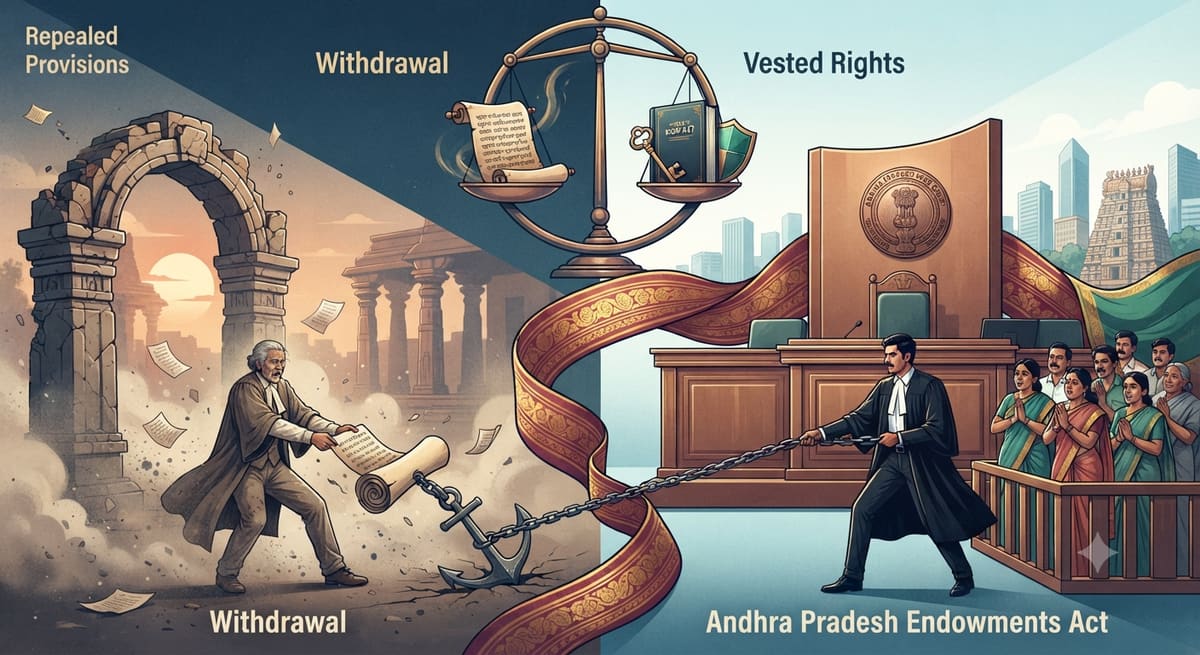
The Andhra Pradesh High Court has set aside the registration of temple land as endowment property under Section 43(6) of the Andhra Pradesh Charitable and Hindu Religious Institutions and Endowments Act, 1987, holding that the statutory mandate of an enquiry under Section 43(5) and issuance of notice to affected parties was not followed. The Court directed compliance with the procedure before any further action.
Background & Facts
The Genesis
The petitioners, Lakkireddy Krupa Var Reddy and Lakkireddy Pulla Reddy, are landowners in Chinnapasupula Village, Peddamudiam Mandal, Y.S.R District. Their land measuring Ac.3.12 cents in Sy.No.44/2, Ac.7.11 cents in Sy.No.54/2 and Ac.1.28 cents in Sy.No.61 was registered as endowed property by the 6th respondent under Section 43(6) of the Andhra Pradesh Charitable and Hindu Religious Institutions and Endowments Act, 1987 (Act 30 of 1987).
Key Facts
- The petitioners claim title through registered sale deeds dated 15.11.1948 (Doc.No.2241/1948) and 08.09.1933 (Doc.No.1683/1933).
- The petitioners have been in continuous possession and enjoyment of the land since the date of purchase.
- The 7th respondent, Sri Chenna Kesava Swamy Temple, claimed the land as its property in revenue records and sought registration under the Endowments Act.
- The 6th respondent issued a certificate of registration under Section 43(6) without conducting an enquiry as mandated under Section 43(5) or issuing notice to the petitioners.
- The petitioners challenged the registration through Writ Petition No.23841 of 2014, which was disposed of with directions for leasehold rights, and their names were mutated in revenue records.
- The 7th respondent issued an auction notice dated 13.08.2014, prompting the petitioners to file the present writ petition.
Procedural History
- 13.08.2014: Auction notice issued by 7th respondent.
- 2014: Writ Petition No.23841 of 2014 filed by petitioners and others for leasehold rights; auction notice stayed.
- 2016: Present Writ Petition No.35270 of 2016 filed before the High Court of Andhra Pradesh at Amaravati.
- 21.07.2026: Judgment reserved on 14.07.2026 and pronounced.
The Parties' Positions
The petitioners contended that the registration was illegal as no enquiry was conducted under Section 43(5) and no notice was issued to them, violating principles of natural justice. They relied on Nallamothu Veeraiah and others v. State of Andhra Pradesh (2022 (1) ALT 229 (AP)), which held that Section 43(5) mandates an enquiry and notice.
The 7th respondent argued that the remedy lay before the Endowments Tribunal under Section 87 of the Act and that the writ petition was not maintainable. It relied on Division Bench judgments holding that once registration is done, the writ court cannot interfere.
The Legal Issue
The central question was whether the registration of the petitioners' land as endowment property under Section 43(6) of the Act 30 of 1987 was valid when no enquiry was conducted under Section 43(5) and no notice was issued to the petitioners, who were admittedly in possession of the land.
Arguments Presented
For the Petitioners
- The petitioners argued that the registration certificate issued under Section 43(6) was illegal as it violated Section 43(5), which mandates an enquiry and notice to affected parties.
- They relied on Nallamothu Veeraiah (supra) and W.P.No.29506 of 2013 (order dated 09.12.2013) to submit that mere entry in revenue records does not constitute title and that the temple was not shown as pattadar or inamdar.
- They contended that the writ petition was maintainable as the violation of natural justice amounted to a violation of fundamental rights under Articles 14, 19, 21 and 300-A of the Constitution.
For the Respondent
- The 7th respondent argued that the petitioners' remedy was before the Endowments Tribunal under Section 87 of the Act and that the writ petition was not maintainable.
- It relied on Division Bench judgments in W.P.(PIL) No.70 of 2022 (order dated 29.03.2023) and W.A.Nos.888 and 899 of 2022 (order dated 23.09.2023) to submit that once registration is done, the writ court cannot direct deletion of the entry.
- The respondent contended that the revenue records reflected the temple's name and that the petitioners' title deeds were non-est in law.
The Court's Analysis
The Court examined the mandatory procedure under Section 43 of the Act 30 of 1987. It noted that Section 43(5) stipulates that before registering an institution and issuing a certificate under Section 43(6), the registering authority must conduct an enquiry and issue notice to all persons having interest in the institution. The Court extracted the procedure in detail:
"(A) (i) where an application is made under Section 43(4) of the Act, 1987, the registering authority shall issue personal notice to such persons having interest as are within the knowledge of the registering authority and also publish a notice in the local newspapers giving all persons having interest in the institution an opportunity to put-forth their views and objections."
The Court observed that admittedly, no enquiry was conducted under Section 43(5) and no notice was issued to the petitioners, who were in possession of the land. It held that the registration certificate issued under Section 43(6) was illegal for violating the mandatory procedure.
The Court also examined the rule of audi alteram partem (right to be heard) as discussed in Union of India v. W.N. Chadha (1993 Supp (4) SCC 260) and Maneka Gandhi v. Union of India (1978) 1 SCC 248. It held that the rule of natural justice applies where a person is deprived of property and that its exclusion must be justified by compelling necessity. The Court found no such justification in the present case.
The Court distinguished the Division Bench judgments relied on by the 7th respondent, holding that they pertained to removal of land from the prohibited list under Section 22A(1)(c) of the Registration Act and were not applicable to the facts of the case.
The Verdict
The Court allowed the writ petition in part. It set aside the registration certificate issued under Section 43(6) of the Act 30 of 1987 for the petitioners' land. The Court directed the respondents to issue notice to the petitioners and all persons having interest in the subject property before granting any registration certificate under Section 43(6). It held that any further action by the respondents must comply with the procedure outlined in Section 43 of the Act, including conducting an enquiry and providing an opportunity of hearing. The Court directed that any decision by the Commissioner must be preceded by adequate notice and hearing to the petitioners and persons having interest.
What This Means For Similar Cases
Mandatory Compliance With Section 43(5) Is Non-Negotiable
-
Registration of endowment property under Section 43(6) is contingent on strict compliance with the enquiry and notice procedure under Section 43(5).
-
Failure to issue notice to affected parties or conduct an enquiry renders the registration illegal and liable to be set aside.
-
Practitioners must ensure that all interested parties are notified and heard before registration under the Endowments Act.
Natural Justice Is Central to Endowment Registration
- The rule of audi alteram partem applies where registration affects property rights.
- Exclusion of natural justice is permitted only in exceptional circumstances where compelling necessity demands it.
- Courts will scrutinize registration certificates issued without notice or enquiry, even if the temple claims long-standing possession.
Writ Petition Is Maintainable for Violation of Natural Justice
- Where registration is done without following the mandatory procedure under Section 43(5), a writ petition is maintainable.
- The remedy before the Endowments Tribunal is not exclusive where the violation amounts to a breach of natural justice and fundamental rights.
- Practitioners should advise clients to challenge such registrations directly before the High Court in appropriate cases.