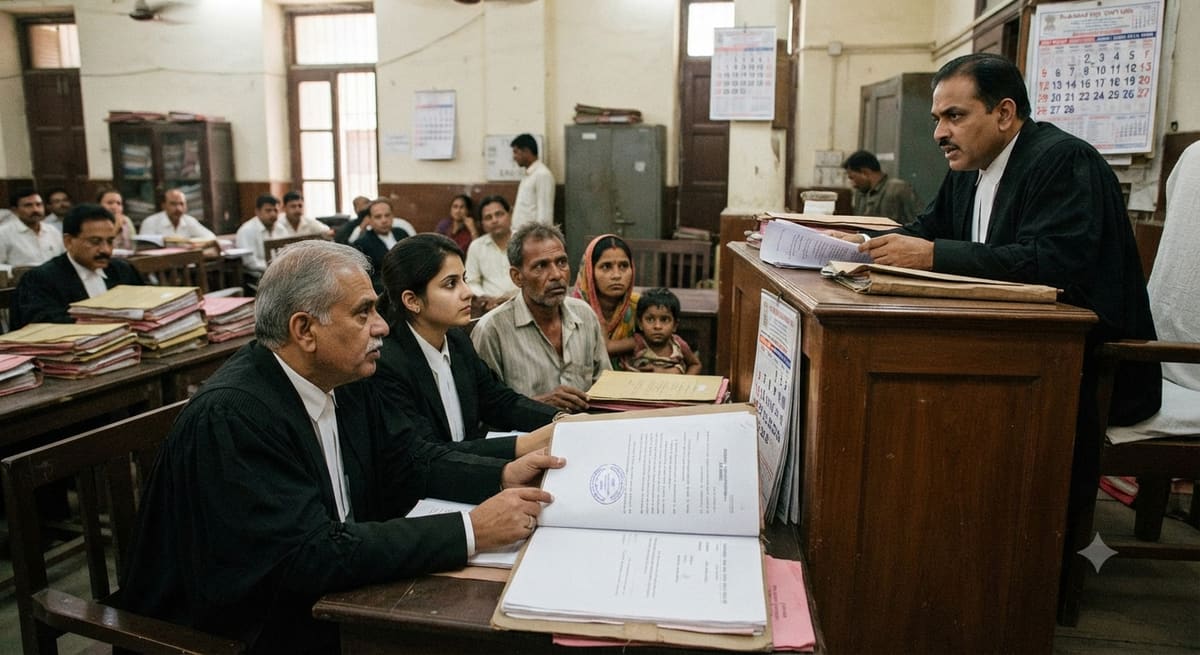
The Allahabad High Court has clarified that enforcement of maintenance arrears cannot proceed through coercive criminal measures like arrest or recovery warrants unless strictly compliant with civil execution procedures. This ruling reinforces the Supreme Court’s directive in Rajnesh v. Neha that maintenance orders must be executed as civil money decrees under the Code of Civil Procedure, not as criminal penalties.
Background & Facts
The Dispute
The applicant, Ajay Kumar, was ordered to pay monthly maintenance to his wife under Section 125 CrPC, which was later converted into a decree under Section 128 CrPC. Arrears accumulated over time, prompting the Family Court, Etah, to issue both a recovery warrant and an arrest warrant against him on 05.05.2026 to enforce payment.
Key Facts
- The original maintenance order was passed in Execution Case No. 48 of 2017.
- Arrears of maintenance had accumulated over several years, though no detailed statement of account was filed by the decree-holder.
- No opportunity was given to the applicant to explain his inability to pay or to propose a payment plan.
- The Family Court issued the impugned order on 05.05.2026 without recording reasons or considering the applicant’s financial position.
- The order directed the issuance of a recovery warrant under Section 128 CrPC and an arrest warrant under Section 421 CrPC.
Procedural History
- 2017: Original maintenance application filed under Section 125 CrPC.
- 05.05.2026: Family Court, Etah, passed order directing recovery warrant and arrest warrant against applicant.
- 10.05.2026: Applicant filed Application u/s 528 BNSS before the Allahabad High Court seeking quashing of the order.
- 03.06.2026: Hearing conducted before Justice Sanjay Kumar Pachori.
Relief Sought
The applicant sought quashing of the order dated 05.05.2026, cancellation of the arrest and recovery warrants, and direction to enforce the maintenance arrears only as a civil money decree under the Code of Civil Procedure.
The Legal Issue
The central question was whether arrest warrants and recovery warrants under Section 128 CrPC may be issued to enforce maintenance arrears without first exhausting the civil execution remedies under the Code of Civil Procedure, as mandated by the Supreme Court in Rajnesh v. Neha.
Arguments Presented
For the Applicant
Learned counsel for the applicant submitted that the Family Court’s order violated the settled law laid down in Rajnesh v. Neha (2021) 2 SCC 324, wherein the Supreme Court held that maintenance arrears must be enforced as a civil money decree under Sections 51, 55, 58, 60 and Order XXI of the CPC, and not through coercive criminal procedures like arrest or recovery warrants. He emphasized that the Family Court failed to consider the applicant’s financial capacity, ignored procedural safeguards under the CPC, and acted in contravention of the Supreme Court’s directive to treat maintenance as a civil obligation.
For the Respondent
The State did not file a counter affidavit, and the learned Government Advocate conceded that the matter involved a settled legal position. The Court noted that no opposing legal submission was made to justify the use of arrest or recovery warrants in this context.
The Court's Analysis
The Court observed that the Supreme Court in Rajnesh v. Neha had laid down a comprehensive framework for enforcement of maintenance orders, explicitly directing that such orders must be executed as money decrees under the CPC. The Court noted:
"The enforcement of maintenance orders shall be through the machinery of the Code of Civil Procedure, and not by invoking the coercive powers of criminal law, unless there is a clear case of wilful default after due opportunity."
The Court held that the Family Court’s decision to issue an arrest warrant and recovery warrant without first attempting execution under the CPC - such as attachment of property, sale of assets, or garnishment of wages - was a direct violation of the Supreme Court’s binding precedent. The Court further emphasized that arrest is an extreme measure that cannot be resorted to merely because arrears have accumulated, especially when no inquiry into the applicant’s means or intent was conducted.
The Court also noted that Section 128 CrPC does not empower a Family Court to bypass the procedural safeguards of the CPC. It merely provides an alternative mechanism for enforcement, not a substitute for civil execution. The Family Court’s failure to apply the correct legal framework rendered the impugned order illegal and unsustainable.
The Verdict
The applicant succeeded. The High Court quashed the order dated 05.05.2026 passed by the Principal Judge, Family Court, Etah, in Execution Case No. 48 of 2017. The arrest warrant and recovery warrant issued against the applicant are hereby cancelled. The Family Court is directed to enforce the maintenance arrears strictly in accordance with Sections 51, 55, 58, 60 and Order XXI of the Code of Civil Procedure, and may not resort to arrest or recovery warrants unless all civil remedies are exhausted and a finding of wilful default is recorded after a proper inquiry.
What This Means For Similar Cases
Civil Execution Is Mandatory Before Criminal Coercion
- Practitioners must now argue that any application for arrest or recovery warrant in maintenance cases must be preceded by a documented attempt at civil execution under the CPC.
- Courts must record findings on the debtor’s ability to pay before considering coercive measures.
Arrest Warrants Cannot Be Routine in Maintenance Cases
- The issuance of arrest warrants for maintenance arrears without a separate inquiry into wilful default is now legally untenable.
- Applications under Section 421 CrPC for arrest in maintenance cases must be accompanied by evidence of deliberate evasion, not mere non-payment.
Procedural Compliance Under CPC Is Non-Negotiable
- Family Courts must treat maintenance arrears as civil debts and follow the same execution procedures as any other money decree.
- Failure to comply with CPC procedures renders the enforcement order voidable, subject to quashing under Article 226.