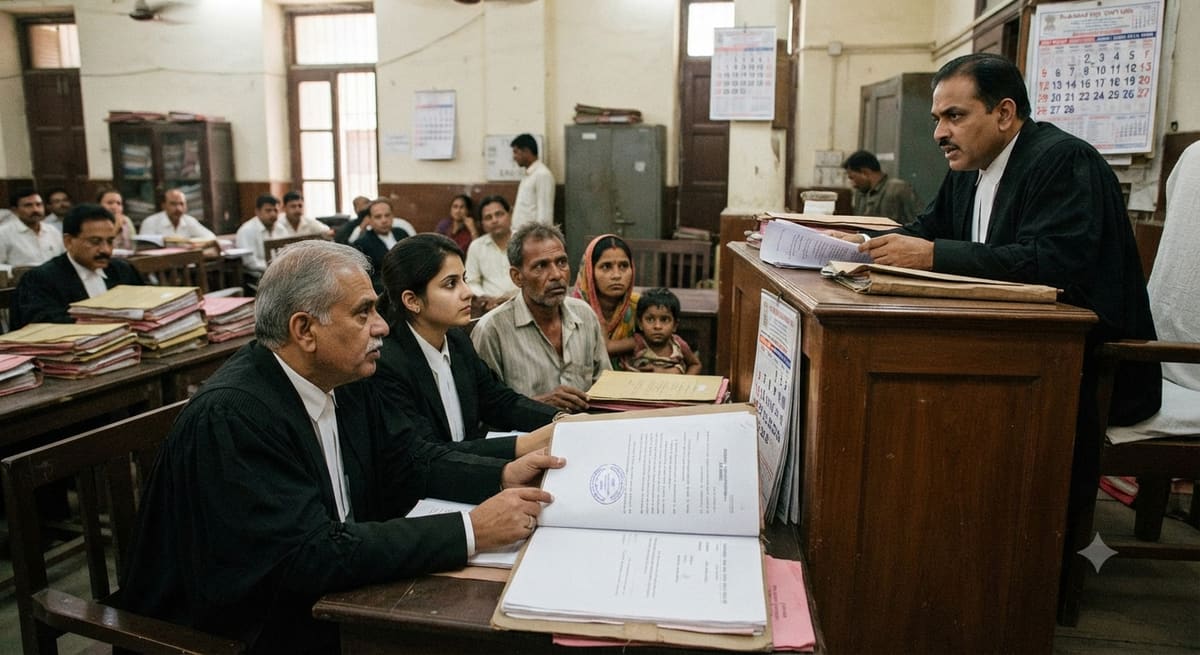
The Bombay High Court has established a clear procedural benchmark for staying execution of maintenance orders, requiring petitioners to deposit half their arrears and continue reduced monthly payments as a condition for relief. This ruling redefines the balance between enforcing judicial mandates and recognizing financial hardship in domestic maintenance cases.
Background & Facts
The Dispute
The applicant, Amol S/o Daulatrao Jagtap, sought to stay execution proceedings initiated against him for non-payment of maintenance ordered by the Family Court, Akola. The order directed him to pay Rs. 40,000 per month - Rs. 20,000 to his wife (Non-applicant No. 1) and Rs. 10,000 each to two minor children (Non-applicants Nos. 2 and 3). The applicant claimed he lacked sufficient means to meet this obligation and that the Family Court had passed the order without examining his assets and liabilities.
Procedural History
- Original Order: Family Court, Akola, passed maintenance order on income assessment
- Execution Initiated: Non-applicants initiated recovery proceedings for Rs. 12 lakhs in arrears
- Revision Filed: Applicant challenged the order before the Bombay High Court, Nagpur Bench, seeking stay of execution
Relief Sought
The applicant requested a stay of execution proceedings and sought relief on the grounds of financial incapacity, offering to deposit a portion of the arrears as a gesture of good faith.
The Legal Issue
The central question was whether a petitioner seeking stay of execution of a maintenance order must demonstrate more than mere financial hardship, and whether courts may impose a conditional stay requiring partial payment of arrears as a precondition.
Arguments Presented
For the Appellant
The applicant’s counsel argued that the Family Court failed to assess his current income, assets, or liabilities before fixing maintenance. He contended that the monthly obligation of Rs. 40,000 was unsustainable and that the arrears of Rs. 12 lakhs were disproportionate to his earning capacity. He offered to deposit a part of the arrears to show willingness to comply, but sought complete stay pending reassessment.
For the Respondent
The non-applicants, through their counsel, emphasized that the maintenance amount was reasonable and based on the applicant’s prior income. They argued that allowing a full stay without any deposit would defeat the purpose of maintenance as a statutory right meant to ensure subsistence for dependents. They opposed any relaxation that might delay justice to the wife and children.
The Court's Analysis
The Court examined the nature of maintenance under Section 125 CrPC and the principle that such orders are not punitive but protective. It noted that while financial hardship may be a relevant consideration, it cannot be used to evade statutory obligations. The Court rejected the applicant’s claim that the Family Court had ignored assets and liabilities, observing that the order was based on income assessment and was neither arbitrary nor excessive.
"The amount directed is not excessive and exorbitant one. The Family Court has considered the income of the applicant and passed a reasoned order."
The Court held that the applicant’s offer to deposit part of the arrears demonstrated a willingness to comply, but this alone was insufficient to warrant unconditional stay. It introduced a structured condition: partial payment of arrears as a quid pro quo for temporary relief. This approach balances the rights of dependents with the practical realities of the payer’s capacity, reinforcing that enforcement of maintenance is not absolute but conditional upon good faith compliance.
The Verdict
The applicant succeeded conditionally. The Court stayed execution of the maintenance order provided the applicant deposits 50% of the Rs. 12 lakh arrears within eight weeks and continues paying Rs. 10,000 to the wife and Rs. 7,000 to each child monthly. Failure to comply will permit full recovery of arrears.
What This Means For Similar Cases
Conditional Stay Requires Concrete Compliance
- Practitioners must now advise clients seeking stay of maintenance execution to prepare a concrete deposit plan, not just plead hardship
- Courts will likely impose similar 50% deposit conditions in comparable cases
- Oral assurances of willingness to pay are insufficient without demonstrable financial action
Monthly Payments Must Continue During Stay
- The Court’s bifurcation of arrears and ongoing payments sets a new precedent
- Applicants cannot suspend monthly obligations even while disputing arrears
- Failure to pay current installments triggers immediate revival of full execution
Maintenance Orders Are Presumed Valid Unless Clearly Unreasonable
- The burden shifts to the applicant to prove the maintenance amount is manifestly excessive
- Courts will not re-assess income unless there is clear evidence of material change
- Absence of asset-liability records does not invalidate an order based on income history