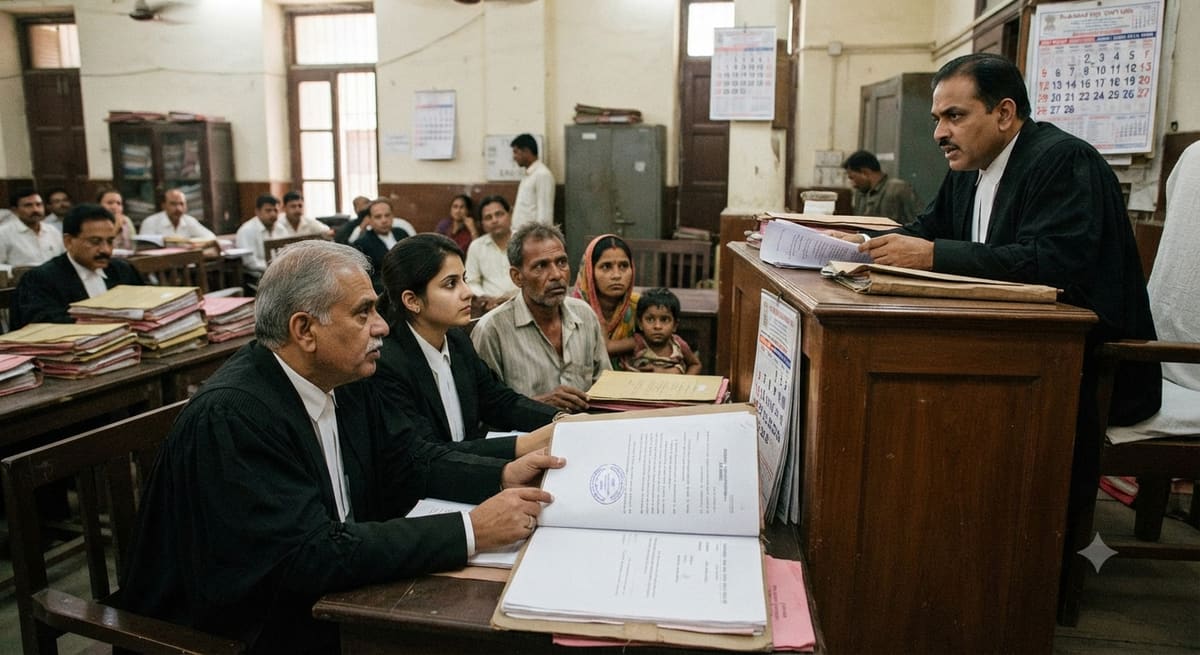
The Madhya Pradesh High Court has clarified that the one-year limitation under the first proviso to Section 125(3) of the CrPC applies to the filing of the application for recovery of arrears, not to the period of default itself. This ruling affirms that maintenance arrears dating back to the date of application may be recovered in full, provided the application for enforcement is filed within one year of the maintenance order.
Background & Facts
The Dispute
The petitioner, Hemant Dhote, a Scale-I Officer at Bank of Baroda, was ordered by the Family Court, Bhopal, to pay monthly maintenance of ₹15,000 to his wife, Smt. Nirmala Sharma, effective from the date of her application under Section 125 CrPC, i.e., 04.04.2018. The order was passed on 20.10.2023. The petitioner complied with future payments but refused to pay arrears from 04.04.2018 to the date of the order, contending that Section 125(3) CrPC barred recovery of maintenance beyond one year prior to the filing of the enforcement application.
Key Facts
- The respondent-wife filed the maintenance application under Section 125 CrPC on 04.04.2018
- The Family Court passed the maintenance order on 20.10.2023, directing payment from 04.04.2018
- An application under Section 125(3) CrPC for recovery of arrears was filed on 09.11.2023, within one month of the order
- The petitioner challenged the order in MP No. 5952/2025, which was dismissed by this Court on 31.10.2025
- The Family Court, by order dated 17.09.2025, rejected the petitioner’s application to recall the maintenance order, holding that the objection had already been adjudicated
- The petitioner refused to pay ₹2.00 lakh in arrears, prompting the Family Court to issue an arrest warrant on 09.02.2026
Procedural History
- 04.04.2018: Maintenance application filed by respondent under Section 125 CrPC
- 20.10.2023: Family Court ordered maintenance of ₹15,000/month from 04.04.2018
- 09.11.2023: Application under Section 125(3) CrPC filed for recovery of arrears
- 13.01.2025: Family Court directed deposit of arrears
- 17.09.2025: Family Court rejected petitioner’s recall application, holding it was an impermissible review
- 31.10.2025: Madhya Pradesh High Court dismissed MP No. 5952/2025, upholding the Family Court’s interpretation
- 09.02.2026: Family Court issued arrest warrant for wilful default of ₹2.00 lakh arrears
- 17.03.2026: Present writ petition filed before Madhya Pradesh High Court
- 18.03.2026: Judgment delivered by Justice Vivek Jain
- Pending: SLP(C) No. 19370/2025 before Supreme Court, admitted only for settlement exploration, no stay granted
Relief Sought
The petitioner sought quashing of the arrest warrant dated 09.02.2026, and a declaration that recovery of arrears beyond one year from the date of the enforcement application is barred under Section 125(3) CrPC. He also sought direction to proceed only under Section 128 CrPC for execution.
The Legal Issue
Can maintenance arrears be recovered under Section 125(3) CrPC for a period exceeding one year prior to the filing of the enforcement application, if the maintenance order itself is dated from the date of the original application and the enforcement application is filed within one year of the order?
Arguments Presented
For the Petitioner
The petitioner relied on the Rajasthan High Court’s decision in Smt. Vimla v. State of Rajasthan (1994 SCC Online Raj 650), arguing that the first proviso to Section 125(3) CrPC is mandatory and limits recovery to arrears within one year prior to the filing of the enforcement application. He contended that since the enforcement application was filed on 09.11.2023, only arrears from 09.11.2022 onwards were recoverable, and the order from 04.04.2018 was therefore illegal. He further argued that the Family Court should have proceeded under Section 128 CrPC for execution, not Section 125(3) for criminal contempt.
For the Respondent
The respondent argued that the maintenance order dated 20.10.2023 was issued with retrospective effect from 04.04.2018, as permitted by Rajnesh v. Neha (2021) 2 SCC 324. The enforcement application under Section 125(3) was filed within one month of the order, well within the one-year limit. The arrears were not being recovered from a date more than one year before the enforcement application, but from the date the obligation arose under the order. The refusal to pay despite clear means constituted wilful default, justifying the arrest warrant.
The Court's Analysis
The Court undertook a detailed analysis of the statutory framework and binding precedents. It emphasized that the first proviso to Section 125(3) CrPC imposes a limitation on the filing of the application for recovery, not on the period for which maintenance may be awarded. The Court held that the obligation to pay arises from the date the order is made, and the one-year window begins from that date.
"The Apex Court has held as under: 'The right to claim maintenance must date back to the date of filing the application, since the period during which the maintenance proceedings remained pending is not within the control of the applicant.'"
The Court relied on Rajnesh v. Neha (2021) 2 SCC 324 to affirm that Family Courts have discretion to award maintenance from the date of application, and such retrospective awards are valid. It further cited Poongodi v. Thangavel (2013) Supreme (SC) 918, which held that the first proviso does not extinguish the entitlement to maintenance for periods prior to one year if the application is timely filed.
The Court also referenced its own coordinate bench’s decision in Preme Chand v. Sita Bai (1995 MP 890), which held that if a higher court restores a maintenance order, the limitation period runs from the date of the restored order, not the original.
The Court rejected the petitioner’s argument that Section 128 CrPC was the exclusive remedy. It noted that Section 125(3) specifically provides for criminal proceedings against a person who wilfully defaults, and the petitioner, a salaried officer, had no financial incapacity. His refusal was deliberate and constituted a breach of statutory duty.
The Court concluded that the Family Court’s order was legally sound, the arrest warrant was justified, and the petitioner’s interpretation of the proviso was legally misconceived.
The Verdict
The petition was dismissed. The Madhya Pradesh High Court upheld the Family Court’s order dated 09.02.2026 issuing the arrest warrant against the petitioner for wilful default of ₹2.00 lakh in maintenance arrears. The Court clarified that the one-year limitation under Section 125(3) CrPC applies to the filing of the enforcement application, not the period of arrears. The petitioner was directed to pay the arrears and may then apply for recall of the warrant, which the Family Court must consider sympathetically.
What This Means For Similar Cases
Maintenance Arrears Are Not Time-Barred by the Date of Default
- Practitioners must argue that the one-year limitation under Section 125(3) CrPC begins from the date of the maintenance order, not the date of each monthly default
- If the order is retrospective to the date of application, and the enforcement application is filed within one year of the order, arrears for the entire period are recoverable
- The proviso does not cap recovery at one year of arrears; it caps the time to file the enforcement application
Arrest Warrants Are Lawful for Wilful Default by Employed Persons
- Courts may issue arrest warrants under Section 125(3) CrPC against employed individuals who refuse to pay despite clear means
- Financial capacity is not a defense to wilful default; the burden shifts to the defaulting party to prove inability
- Section 128 CrPC is not an alternative to Section 125(3) when the default is intentional and persistent
Procedural Compliance Is Non-Negotiable
- Applications under Section 125(3) must be filed within one year of the maintenance order to preserve the right to recover arrears
- Delayed enforcement applications, even if filed within one year of the last default, will be barred if the order was passed more than a year ago
- Courts will not entertain belated challenges to maintenance orders that have attained finality under Section 362 CrPC