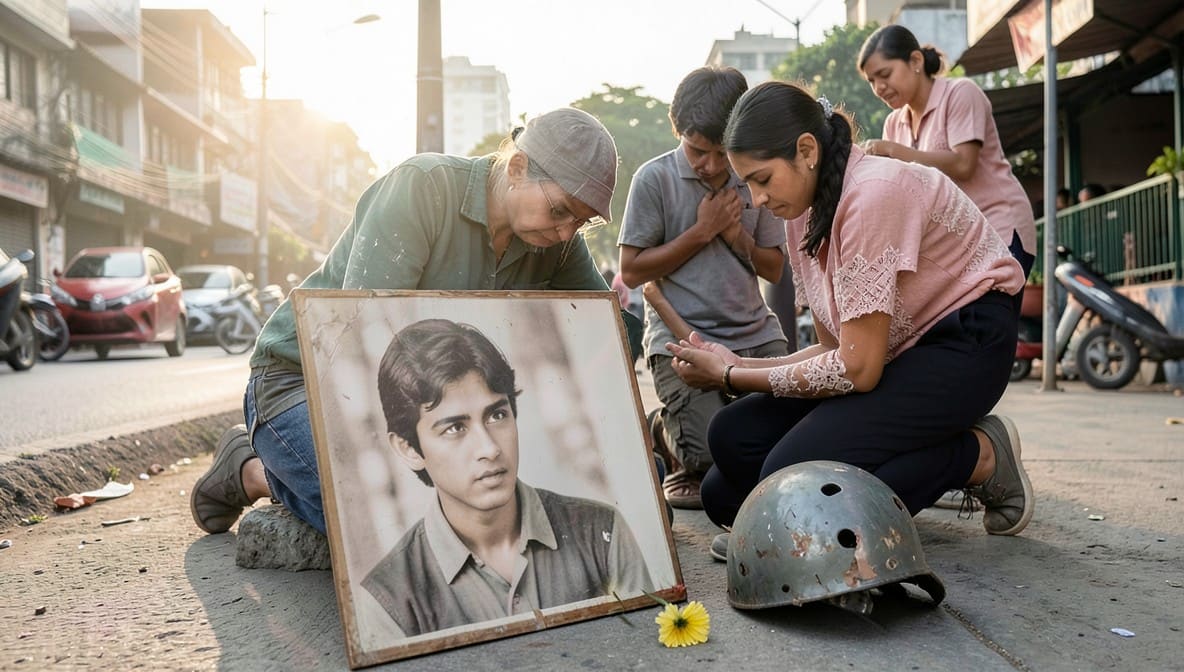
The Bombay High Court has affirmed that compensation for the death of a minor need not be contingent upon proof of future professional attainment. Even in the absence of evidence regarding the child’s intended career, courts may award loss of dependency based on notional income and established multipliers, reinforcing the principle that a child’s potential is not extinguished by lack of documentary proof.
Background & Facts
The Dispute
The claim arose from a motor accident on or about 1987 involving a six-year-old boy, the son of the Appellant, Smt. Kalinoonisa, and Respondent No.4, Rashid Noorkhan Pathan. The child died as a result of injuries sustained in the accident. The claim was filed before the Motor Accident Claims Tribunal, Thane, seeking compensation for loss of dependency, mental agony, funeral expenses, and loss of love and affection.
Key Facts
- The deceased child was six years old at the time of death in 1987
- No evidence was presented regarding the school he attended, his academic performance, or his future career aspirations
- The Appellant, the mother, was the sole claimant before the High Court, though the father was also a claimant before the Tribunal
- The Tribunal rejected the claim for future dependency, holding that there was no proof of what the child would have become
- The Tribunal awarded Rs.35,000 under conventional heads: mental agony, funeral expenses, and loss of love and affection
- No income proof, salary slips, or educational records were submitted by either party
Procedural History
- 1987: Motor accident occurred; claim filed before Motor Accident Claims Tribunal, Thane (Claim Case No.462 of 1987)
- 08.12.1997: Tribunal delivered judgment rejecting future dependency claim; awarded Rs.35,000 under conventional heads
- 2000: First Appeal No.636 of 2000 filed before the Bombay High Court seeking enhancement of compensation
- 30.04.2026: Oral judgment delivered by Justice Abhay Ahuja
Relief Sought
The Appellant sought enhancement of compensation by awarding loss of dependency based on notional income of Rs.30,000 per annum, applying a multiplier of 15, resulting in Rs.4,50,000, in addition to the Rs.35,000 already awarded. The total claim sought was Rs.4,85,000 inclusive of interest at 12% per annum from the date of filing.
The Legal Issue
The central question was whether compensation for loss of dependency can be awarded to the legal representatives of a deceased child aged six years in the absence of any evidence regarding his future earning capacity or educational trajectory.
Arguments Presented
For the Appellant
Ms. Ketki Gokhale, appearing for the Appellant, relied on Meena Devi v. Nunu Chand Mahto (2023) 1 SCC 204 and Smt. Sarla Varma v. Delhi Transport Corporation (2009) 6 SCC 121. She submitted that the Supreme Court had previously awarded Rs.5,00,000 in a case involving a 12-year-old child, even though the child’s future was speculative, by applying a notional income of Rs.30,000 and a multiplier of 15. She argued that the same principle must apply here, as the child’s age and dependency on parents were undisputed.
For the Respondent
Mr. Rajesh Ranglani, appearing for Respondent No.3 (Oriental Insurance Company), sought time to take instructions but did not contest the legal principle invoked. He did not present any counter-argument on the applicability of notional income or multiplier, nor did he challenge the precedents cited.
The Court's Analysis
The Court acknowledged that the Tribunal erred in rejecting the claim for loss of dependency solely on the ground that no evidence was adduced regarding the child’s future profession. The Court distinguished between the factual matrix in Meena Devi, where the child was described as a brilliant student in Class 5, and the present case, where no such evidence existed. However, the Court emphasized that the Supreme Court’s broader holding in Meena Devi was not confined to exceptional cases of academic excellence.
"The Hon’ble Supreme Court has not only reiterated the principle of considering the notional income including future prospects in the case of the deceased child but also approved the application of multiplier for calculating loss of dependency while granting compensation to the legal representatives of the deceased child."
The Court held that the absence of proof of future earnings does not negate the child’s inherent potential to earn. It adopted the notional income of Rs.30,000 per annum, as affirmed in Kishan Gopal v. Lala (2014) 1 SCC 244, and applied a multiplier of 15, consistent with Smt. Sarla Varma. The Court further held that since the child was six years old and wholly dependent, no deduction for personal expenses was warranted.
The Tribunal’s award of Rs.35,000 under conventional heads was upheld, as it was neither challenged nor found to be inadequate.
The Verdict
The Appellant and Respondent No.4 are entitled to enhanced compensation of Rs.4,85,000, comprising Rs.4,50,000 for loss of dependency and Rs.35,000 for conventional heads. Interest at 12% per annum shall accrue from the date of filing of the claim application until realization, to be distributed equally between the Appellant and Respondent No.4, less any amount already withdrawn. The enhanced amount shall be deposited with the Motor Accident Claims Tribunal, Thane, within six weeks. The judgment of the Tribunal is modified accordingly.
What This Means For Similar Cases
Notional Income Applies Even Without Academic Evidence
- Practitioners may now confidently argue for loss of dependency claims for deceased children under 10 years, even without school records, report cards, or parental testimony on future aspirations
- The notional income of Rs.30,000 per annum, coupled with a multiplier of 15, is now a recognized benchmark for young children in motor accident claims
Multiplier Is Not Conditional on Proven Potential
- Courts must not require proof of future career as a precondition for applying the multiplier
- The principle of compensating for lost future earnings is rooted in the child’s dependency, not their projected profession
- This removes a significant evidentiary burden on claimants in cases involving very young victims
Uniformity in Compensation Standards
- The judgment aligns Bombay HC’s approach with the Supreme Court’s jurisprudence, reducing forum shopping and inconsistent awards
- Insurance companies can no longer rely on absence of academic records to deny dependency claims
- Future claims should include a clear calculation sheet: notional income × multiplier + conventional heads