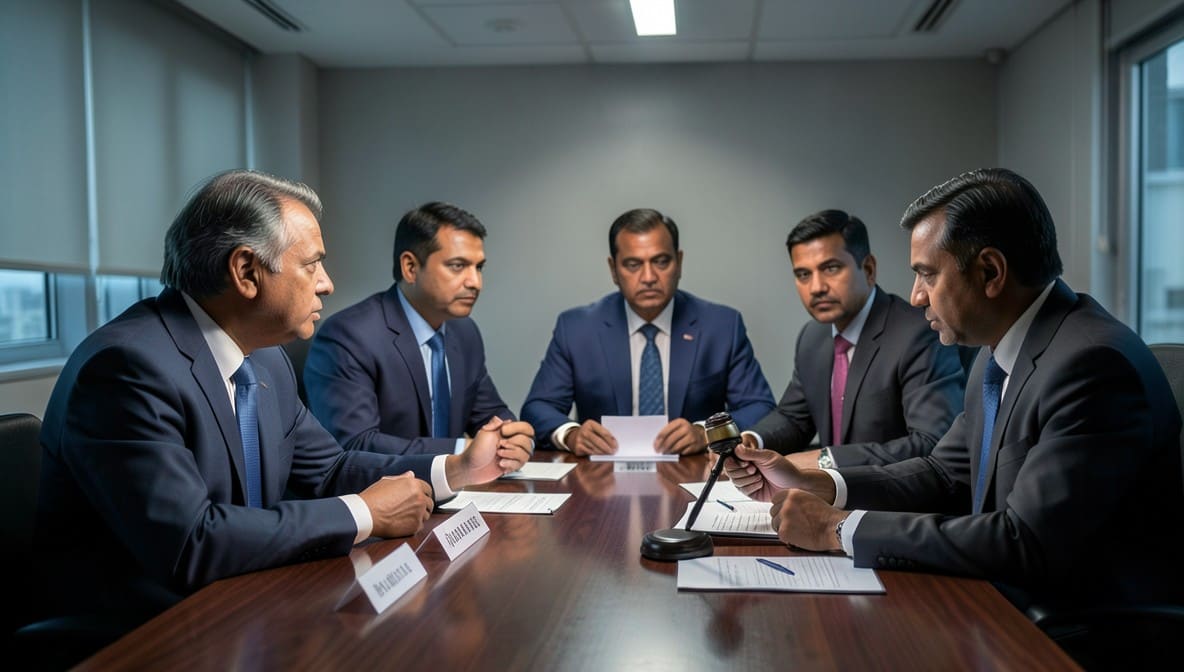
The National Company Law Appellate Tribunal has closed a Corporate Insolvency Resolution Process that had reached a complete stalemate, holding that continuation serves no meaningful insolvency purpose when all creditor claims stand settled or offered in full and only CIRP costs remain undetermined. The Tribunal exercised its inherent powers to override procedural non-compliance with Section 12A and Regulation 30A, directing payment of Rs. 18 lakhs to the operational creditor within two weeks and determination of CIRP costs by the Adjudicating Authority within four weeks.
Background & Facts
The Dispute
The appeal arose from an order dated 18.12.2024 passed by the National Company Law Tribunal, Jaipur Bench, dismissing an application filed under Section 12A of the Insolvency and Bankruptcy Code, 2016 read with Regulation 30A of the CIRP Regulations. The application sought withdrawal of the CIRP of Shalfeyo Industries Private Limited (Corporate Debtor). The Appellant, Deepak Modi, is the suspended director of the Corporate Debtor. The CIRP was initiated at the instance of Prime Impex, an operational creditor, on 16.08.2022. Axis Bank Limited was the sole financial creditor. Mr. Umang Jain was appointed as the Resolution Professional.
Key Facts
- Prime Impex initiated insolvency proceedings under Section 9 of the Code against Shalfeyo Industries Private Limited. The CIRP was admitted on 16.08.2022 and Mr. Umang Jain was appointed as Interim Resolution Professional, subsequently confirmed as Resolution Professional.
- Axis Bank submitted its claim as sole financial creditor (approximately Rs. 1.04 Crore) and the Committee of Creditors was constituted with Axis Bank as its sole member.
- In the 1st CoC meeting held on 15.09.2022, Axis Bank stated the Corporate Debtor had no meaningful assets and continuation of CIRP would serve no useful purpose, requesting steps for closure.
- The Appellant's personal property furnished as collateral to Axis Bank was sold and the Appellant deposited the balance outstanding, meeting the entire claim of the financial creditor by 24.09.2024 (payment of Rs. 1.28 Crore).
- Axis Bank withdrew its claim following full satisfaction. The RP reconstituted the CoC replacing Axis Bank with Prime Impex as sole member. This reconstitution was challenged and the Adjudicating Authority directed restoration of the CoC to its original composition with Axis Bank as financial creditor.
- During CIRP, the CoC decided on liquidation on 05.11.2022 when the CoC comprised only the operational creditor, despite two Expressions of Interest having been received.
- In the 6th CoC meeting on 18.09.2023, Axis Bank noted the insolvency proceedings originated from a claim of approximately Rs. 12 lakhs and had continued for about one and a half years. Axis Bank facilitated settlement between Deepak Modi and Prime Impex.
- The Appellant initially offered Rs. 8 lakhs plus return of materials valued at Rs. 4 lakhs, subsequently offering the entire claim of approximately Rs. 12 lakhs. The operational creditor declined, seeking additional compensation and litigation costs.
- The Appellant agreed to pay the entire claimed amount of Rs. 11.90 lakhs to Prime Impex and placed a demand draft (No. 722222 dated 03.12.2024) towards the said amount. The Appellant also provided a draft of Form FA and undertook to pay RP fees and expenses as determined by the Adjudicating Authority.
- The withdrawal application in Form FA was filed as IA (IBC) No. 549/JPR/2024 on 20.11.2024 by the Appellant in his capacity as suspended director.
Procedural History
- 16.08.2022: CIRP admitted by NCLT Jaipur Bench in CP (IB) No. 79/9/JPR/2020
- 15.09.2022: 1st CoC meeting held
- 05.11.2022: CoC resolved for liquidation
- 11.08.2023: NCLT order restoring CoC to original composition with Axis Bank as sole member
- 18.09.2023: 6th CoC meeting where Axis Bank facilitated settlement
- 20.11.2024: Withdrawal application filed under Section 12A (IA 549/JPR/2024)
- 18.12.2024: NCLT dismissed withdrawal application citing Glass Trust Company LLC v. Byju Raveendran (2024 SCC OnLine SC 3032) - application filed by suspended director not RP, lacked 90% CoC approval
- 05.05.2026: NCLAT recorded settlement discussions ongoing but deadlock on CIRP costs
- 19.05.2026: Settlement talks failed
- 01.07.2026: Appellant offered Rs. 17 lakhs to operational creditor plus CIRP costs as determined
- 29.07.2026: Appellant filed Affidavit in Compliance undertaking payment of Rs. 1.28 Crore to Axis Bank (paid), Rs. 17 lakhs to Prime Impex, and CIRP costs as determined
- 05.08.2026: Hearing where Appellant enhanced offer to Rs. 18 lakhs, agreed by Prime Impex
- 07.09.2026: NCLAT judgment disposing of appeal
The Parties' Positions
Appellant (Deepak Modi): The CIRP has reached a complete stalemate. All substantive claims are discharged or capable of satisfaction. Financial creditor paid in full. Operational creditor offered full claimed amount plus enhancement. Only surviving issue is CIRP costs, which Appellant undertakes to pay as determined. Continuation serves no insolvency resolution purpose.
Respondent No. 1 (RP): CIRP prolonged due to repeated disputes and lack of cooperation. CoC restored to Axis Bank, which consented to liquidation. No effective resolution emerged. Liquidation application pending. Section 12A application dismissed. Parties failed to arrive at workable settlement. Proceedings reached complete stalemate.
Respondent No. 2 (Axis Bank): Entire financial exposure discharged by Appellant by 24.09.2024. No subsisting claim. Withdrew claim in October 2022. Cannot be fastened with costs incurred after withdrawal. Supports early closure per proposed settlement (Rs. 18 lakhs to Prime Impex plus CIRP costs).
Respondent No. 3 (Prime Impex): Original withdrawal application non-compliant with Regulation 30A - Form FA unsigned, no bank guarantee for CIRP costs. NCLT rightly dismissed per Glass Trust Company. Willing to accept Rs. 18 lakhs and execute Form FA upon payment of CIRP costs as determined.
Relief Sought
The Appellant sought closure of CIRP subject to determination and payment of legitimate CIRP costs, RP fees and expenses as determined by the Adjudicating Authority, arguing continued continuation serves no meaningful purpose.
The Legal Issue
The central question was whether the NCLAT can close a CIRP that has reached a procedural stalemate where all creditor claims stand settled or offered in full, but the statutory withdrawal mechanism under Section 12A read with Regulation 30A cannot be completed due to non-crystallisation of CIRP costs and refusal of the operational creditor to provide the mandated bank guarantee.
Arguments Presented
For the Appellant
Counsel submitted the matter reached a complete stalemate notwithstanding repeated efforts to end the CIRP. Axis Bank itself acknowledged the account remained regular and CIRP was unnecessarily prolonged. The Appellant made bona fide settlement efforts, offering the entire operational creditor claim and furnishing Form FA. The operational creditor declined to forward Form FA. The RP declined settlement insisting on determination of fees by the Adjudicating Authority. The Appellant has no objection to such determination. As on date, substantive claims are fully discharged or capable of satisfaction. The only surviving issue concerns CIRP/RP expenses. The Appellant consistently expressed willingness to pay any amount found legitimately payable. Continued continuation serves no useful purpose when financial creditor dues stand settled, operational creditor claim offered in full, and remaining issue resolvable by determination of legitimate fees.
For the Respondents
RP: The Appellant presented a distorted account. CIRP prolonged due to repeated disputes and lack of cooperation. CoC restored to Axis Bank which consented to liquidation. No effective progress towards resolution or revival. 10th CoC meeting recorded Section 12A application dismissed, Axis Bank sought return of security documents, RP recorded no possibility of settlement. Proceedings reached complete stalemate.
Axis Bank: Entire exposure discharged by 24.09.2024. Withdrew claim in October 2022, ceased to be CoC member from 07.10.2022. CIRP costs claimed (~Rs. 35 lakhs against original operational debt of ~Rs. 12 lakhs) require independent scrutiny under Regulation 34B. Axis Bank cannot bear costs incurred after its withdrawal. Supports disposal per proposed settlement.
Prime Impex: Original application non-compliant with Regulation 30A - Form FA unsigned, no bank guarantee. NCLT rightly dismissed per Glass Trust Company. Amendment to IBC effective 26.05.2026 does not cure defects. Willing to accept Rs. 18 lakhs and execute Form FA upon payment of CIRP costs as determined.
The Court's Analysis
The NCLAT examined the entire factual matrix and identified peculiarities demonstrating the futility of continuing the CIRP. The Tribunal noted the CIRP was initiated on a relatively small operational debt of about Rs. 11.90 lakhs. The sole financial creditor had been paid in full. The sole operational creditor was offered Rs. 18 lakhs against its original claim of Rs. 11.90 lakhs as full and final settlement. There were no other creditors. No resolution plan was available. The Appellant agreed to pay CIRP costs pending adjudication in IA No. 160/2023.
The Tribunal acknowledged the Adjudicating Authority's reliance on Glass Trust Company LLC v. Byju Raveendran and Others (2024 SCC OnLine SC 3032) was legally relevant when the original withdrawal application was considered. The statutory requirements of Form FA, CoC approval, and CIRP-cost security/bank guarantee under Section 12A and Regulation 30A cannot ordinarily be ignored. However, the present question had evolved beyond procedural compliance.
"The Appellant is now expressly undertaking to pay the CIRP costs as determined by the Adjudicating Authority, and the determination of those costs is already pending before the NCLT. Therefore, the legitimate interest of the RP in recovery of properly determined CIRP costs is protected without requiring the CIRP itself to continue indefinitely."
The Tribunal observed a procedural stalemate: the Form FA cannot be filed because CIRP costs are not crystallised and are disputed between Appellant and RP, pending with the Adjudicating Authority. The bank guarantee amount for Form FA cannot be determined. The operational creditor is unwilling to provide the bank guarantee. In this situation, the Section 12A procedure is not a feasible option.
"Keeping the CIRP alive is not serving any purpose nor it would be in accordance with the objectives of the Code which seeks to resolve the insolvency and keep it as a going concern. We are of the view that, the company is a viable entity and keeping the CIRP alive merely because the earlier statutory withdrawal mechanism could not be completed, would be huge wastage of precious resources in terms of time of Tribunals which could be productively used to dispose other important proceedings."
The Tribunal concluded that in the peculiar circumstances, continuation of the CIRP would serve no meaningful purpose and would only result in further wastage of precious resources.
The Verdict
The NCLAT allowed the appeal in part and disposed of it with the following directions: (i) The CIRP proceedings against Shalfeyo Industries Pvt. Ltd. are closed subject to the Appellant paying Rs. 18 lakhs to Prime Impex (Respondent No. 3) within two weeks of the order as full and final settlement; (ii) The Adjudicating Authority shall determine the CIRP costs in IA No. 160/2023 within four weeks from receipt of the order, after considering the RP's claim and the Appellant's submissions; (iii) The Appellant shall pay the CIRP costs as determined by the Adjudicating Authority within two weeks from that order. Pending IAs, if any, are closed. No order as to costs.
What This Means For Similar Cases
Procedural Stalemate Does Not Mandate Perpetual CIRP
The judgment establishes that when a CIRP reaches a complete procedural stalemate - where all creditor claims are settled or offered in full, no resolution plan exists, and only CIRP costs remain undetermined - the Appellate Tribunal may exercise inherent powers to close the process despite non-compliance with Section 12A procedural requirements. Practitioners should argue that the Code's objective of resolution and value maximisation is defeated by continuing a moribund CIRP.
- The Tribunal prioritised the economic reality of full creditor satisfaction over procedural rigidity
- Inherent powers can override Section 12A/Regulation 30A defects when the statutory mechanism is rendered infeasible by circumstances
- The viability of the corporate debtor as a going concern supports closure over liquidation
CIRP Costs Determination Can Be Decoupled From CIRP Continuation
The NCLAT's direction to determine CIRP costs in a pending application (IA No. 160/2023) while closing the CIRP itself provides a template for resolving cost disputes without perpetuating the insolvency process.
- CIRP costs are legitimate statutory expenses that must be determined and paid
- Determination can proceed before the Adjudicating Authority post-closure
- The appellant's undertaking to pay determined costs protects the RP's legitimate interest
- This approach prevents cost disputes from becoming a tool to indefinitely extend CIRP
Enhanced Settlement Offers Can Supersede Original Claims
The operational creditor's acceptance of Rs. 18 lakhs against an original claim of Rs. 11.90 lakhs, coupled with the financial creditor's full satisfaction, demonstrated that the commercial purpose of the CIRP had been achieved.
- Settlement amounts exceeding original claims indicate creditor satisfaction
- The Tribunal recognised the enhanced offer as full and final settlement
- Operational creditor's willingness to execute Form FA post-payment validates the closure mechanism
- Financial creditor's withdrawal and lack of continuing interest removes the primary CoC member's objection