The Gauhati High Court has dismissed an appeal filed by five accused persons convicted of murder and rioting in a case arising from a violent land dispute over the construction of a community hall. The Court rejected arguments of private defence and upheld the Trial Court's conviction under Sections 143 and 302 of the Indian Penal Code, 1860, affirming life imprisonment for the accused.
Background & Facts
The Dispute
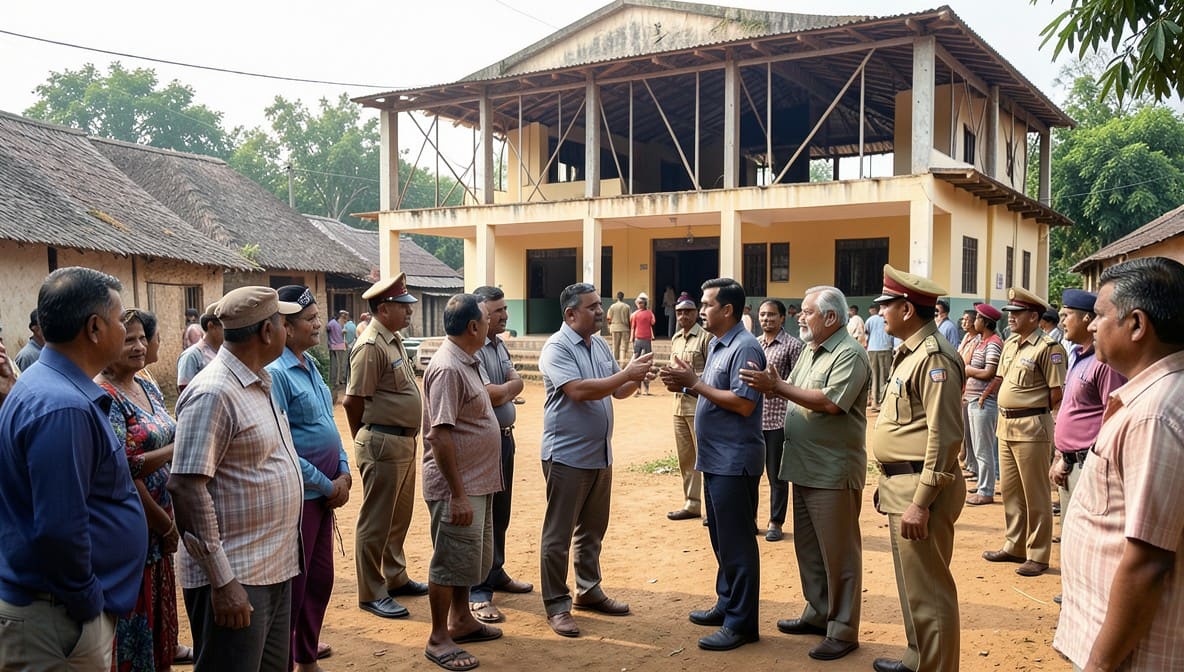
The dispute centered around a plot of land in Morigaon, Assam, where villagers had proposed to construct a community hall. The land was donated by Kula Pator, Bhadra Pator, and Gupta Pator to the village through a deed executed on 17.05.2013. The foundation stone for the community hall was laid on 24.05.2013. On 26.05.2013, the accused persons demolished the foundation pillars and posts of the proposed community hall, leading to a violent confrontation.
Key Facts
- The accused persons were family members, including Brajeswar Bordoloi (appellant No.1), Sushil Bordoloi (appellant No.2), Shanti Bordoloi (appellant No.3), Ranjan Bordoloi (appellant No.4), and Jayanta Bordoloi (appellant No.5).
- The deceased, Bolu Bangthai, and PW-2, Katiram Bangthai, intervened to stop the demolition of the community hall's foundation.
- The accused assaulted the deceased and PW-2 with sharp weapons such as dao, axe, and spade, resulting in the death of Bolu Bangthai and injuries to Katiram Bangthai.
- The FIR was lodged on 26.05.2013 at 7:30 p.m., while the incident occurred at 10:40 a.m. on the same day.
- The post-mortem report (PW-1) confirmed that the death was due to cardio-respiratory failure following haemo-pneumothorax and head injuries caused by sharp and heavy weapons.
- The accused were arrested and produced before the Magistrate, with injuries noted on appellant No.1 and appellant No.4.
Procedural History
- 26.05.2013: FIR lodged at Morigaon Police Station.
- 31.10.2013: Charge-sheet filed by the investigating agency.
- 29.06.2015: Charges framed against the accused.
- 02.06.2022: Judgment delivered by the Sessions Judge, Morigaon, convicting the accused under Sections 143, 302, and 324 IPC.
- 08.06.2022: Sentence imposed by the Sessions Judge.
- Present Appeal: Filed before the Gauhati High Court challenging the conviction and sentence.
Relief Sought
The appellants sought acquittal, arguing that they acted in the exercise of the right of private defence of property and body. They also contended that the prosecution failed to prove the charges beyond reasonable doubt due to discrepancies in evidence and lack of forensic examination of seized weapons and blood-stained earth.
The Legal Issue
The central question was whether the accused persons were entitled to the right of private defence under Sections 96 to 106 of the Indian Penal Code, 1860, and whether the prosecution proved the charges of murder and rioting beyond reasonable doubt.
Arguments Presented
For the Appellant/Petitioner
The learned counsel for the appellants argued that the accused exercised their right of private defence of property and body, as they were in possession of the land and acted to protect it from intrusion. The counsel relied on the following judgments:
- Kartarey and Ors. v. State of U.P. (1976) 1 SCC 172: Emphasized the importance of showing the alleged weapon of offence to the medical witness to determine if the injuries could have been caused by that weapon.
- Ganesh Datt v. State of Uttarakhand (2014) 12 SCC 389: Held that failure to send blood-stained earth for forensic examination leads to doubt about the situs of the crime.
- SK. Yusuf vs. State of West Bengal (2011) 11 SCC 754: Held that failure to send the weapon of crime for chemical analysis is fatal to the prosecution case.
- Joy Devaraj v. State of Kerala (2024) SCC OnLine SC 966: Held that minor discrepancies in the evidence of eyewitnesses do not necessarily discredit their testimony.
- Jai Prakash Tiwari v. State of Madhya Pradesh (2022) SCC OnLine SC 966: Emphasized the importance of the statement recorded under Section 313 Cr.P.C in providing a reasonable opportunity to the accused to explain the incriminating material.
- Lakshmi Singh & Ors. v. State of Bihar (1976) 4 SCC 394: Held that the prosecution must explain injuries sustained by the accused during the occurrence.
- Darshan Singh v. State of Punjab and Anr. (2010) 2 SCC 333: Laid down the principles governing the right of private defence.
The counsel also argued that the prosecution failed to explain the injuries sustained by the accused persons and that the ocular evidence was inconsistent and unreliable.
For the Respondent/State
The learned Additional Public Prosecutor argued that the ocular evidence of eyewitnesses, including PW-2 who was injured in the assault, was consistent and reliable. The prosecution relied on the following judgments:
- Om Pal & Ors. vs. State of U.P (now State of Uttarakhand): Held that the testimony of an injured eyewitness is accorded special status and should be relied upon unless there are strong grounds for rejection.
- Anil Kumar vs. The State of Kerala (2023): Held that the benefit of Exception 4 to Section 300 IPC is not applicable where the offender takes undue advantage of the situation.
- Guru @ Gurubaran & Ors. vs. State Rep. by Insp. Of police: Held that the accused cannot take the benefit of Exception 4 to Section 300 IPC if they were armed and the occurrence did not take place in the heat of passion.
The prosecution argued that the defence did not lead any evidence to establish the right of private defence and that the ocular evidence was overwhelming.
The Court's Analysis
The Court examined the evidence led by the prosecution, including the testimony of eyewitnesses PW-2, PW-7, PW-8, and PW-9, who deposed to having seen the accused assaulting the deceased and PW-2 with sharp weapons. The Court noted that the ocular evidence was consistent and trustworthy, and there was no reason to disbelieve the version of the eyewitnesses.
The Court rejected the argument of the accused that they exercised the right of private defence, as they failed to establish even on a preponderance of probability that they had ownership or possession of the land at the time of the incident. The Court observed that the accused did not lead any evidence to support their claim of possession or to establish that their act of demolishing the foundation pillars was lawful.
The Court also rejected the contention that the prosecution failed to explain the injuries sustained by the accused. The Court noted that the injuries were minor and superficial, and the ocular evidence was clear, cogent, and reliable. The Court held that the failure to send the blood-stained earth or the alleged weapon of crime for forensic examination did not affect the prosecution case, as the ocular evidence was overwhelming.
The Court distinguished the judgments relied upon by the appellants, noting that the facts of those cases were at variance with the present case. The Court held that the assault on the deceased and PW-2 was not sudden or without pre-meditation, as the accused were verbally restrained from demolishing the foundation pillars. The nature of the assault indicated that the accused acted with the knowledge and intent to cause death.
"The assault on the deceased and the PW-2 was made with sharp cutting weapons such as ‘dao’ and axe, at a time when the accused were verbally being restrained from demolishing posts set up for a community hall. The accused had entered the plot of land to destroy a property which the village would commonly own, and it can not be said that they did not expect resistance from the villagers."
The Court concluded that the prosecution proved the charges beyond reasonable doubt and that the accused were not entitled to the benefit of the right of private defence.
The Verdict
The Gauhati High Court dismissed the appeal filed by the accused persons. The Court upheld the conviction and sentence imposed by the Sessions Judge, Morigaon. The Court directed that the Trial Court records be sent back along with the copy of the order.
The appellants were convicted under:
- Section 143 IPC: Punishment for membership of an unlawful assembly.
- Section 302 IPC: Punishment for murder.
- Section 324 IPC: Punishment for voluntarily causing hurt by dangerous weapons or means.
The Court imposed:
- Life imprisonment for the offence under Section 302 IPC.
- Fine of Rs. 50,000 for the offence under Section 302 IPC, with a default sentence of 1 year in case of non-payment.
- 30 days rigorous imprisonment for the offence under Section 143 IPC.
- 1 year rigorous imprisonment for the offence under Section 324 IPC.
What This Means For Similar Cases
Right of Private Defence Is Not Automatic
-
The right of private defence under Sections 96 to 106 IPC is not a blanket immunity. It must be established by cogent evidence that the accused were in possession of the property and acted to protect it from unlawful intrusion.
-
The accused must lead evidence to support their claim of possession or ownership of the property. Mere assertion is insufficient.
-
The right of private defence does not extend to retaliation or revenge. It is limited to acts done in good faith to repel unlawful aggression.
Ocular Evidence Prevails Over Technical Infirmities
- Minor discrepancies in the evidence of eyewitnesses do not necessarily discredit their testimony, especially when the evidence is consistent and reliable.
- The failure to send seized articles for forensic examination does not automatically vitiate the prosecution case if the ocular evidence is overwhelming and reliable.
- The Court emphasized that the testimony of an injured eyewitness is accorded special status and should be relied upon unless there are strong grounds for rejection.
Prosecution Must Explain Injuries on Accused
- The prosecution must explain injuries sustained by the accused during the occurrence, especially in cases where the defence raises the plea of private defence.
- The failure to explain such injuries may lead to the conclusion that the prosecution has suppressed the genesis of the occurrence or that the witnesses are unreliable.
- However, the Court clarified that the failure to explain minor or superficial injuries may not affect the prosecution case if the ocular evidence is clear and reliable.