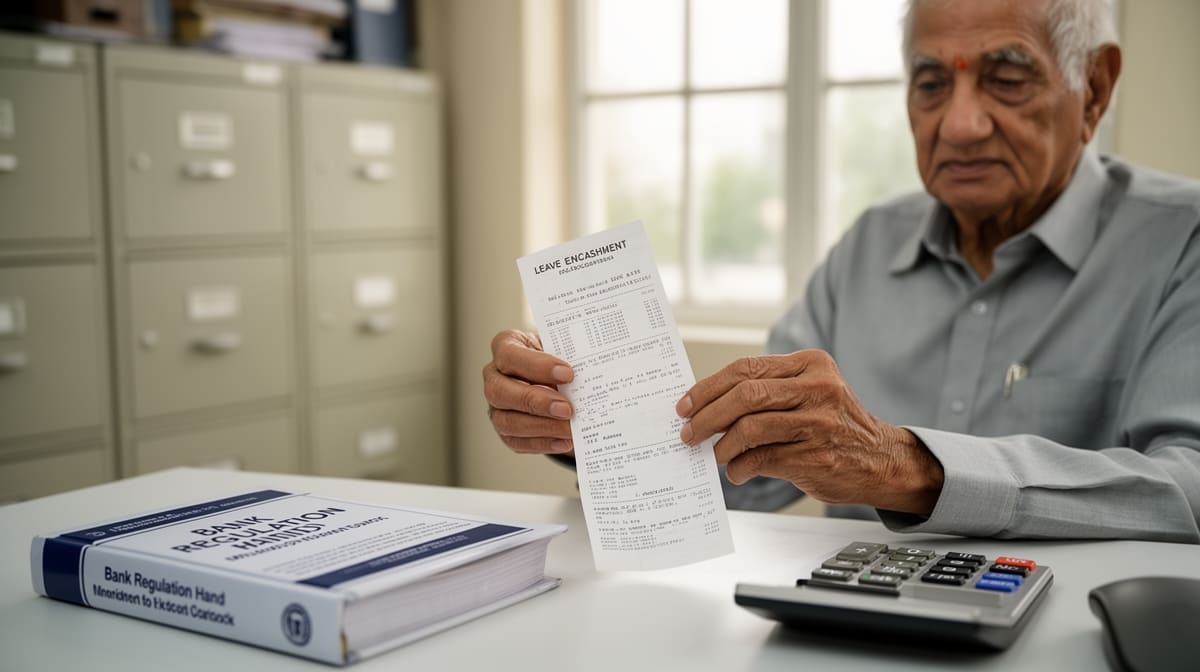
A retired Southern Railway loco pilot has successfully challenged the arbitrary reduction of his leave encashment entitlement, after the Central Administrative Tribunal held that administrative errors in record-keeping cannot be visited upon the employee. The judgment reinforces the doctrine of legitimate expectation in public service matters and mandates strict compliance with statutory verification timelines.
Background & Facts
The Dispute
The applicant, K.K. Rajan, a retired Loco Pilot (Passenger) with the Southern Railway, sought payment of leave salary for 297 days of Leave on Average Pay (LAP) and 74 days of Leave on Half Average Pay (LHAP), as reflected in his September 2017 pay slip. The Railway Administration, however, reduced his entitlement to just 8 days of LAP and 15 days of LHAP via Annexure-A10, citing alleged errors in leave recording between 1998 and 2017. The dispute arose from conflicting records maintained manually and digitally, with no clear reconciliation or timely verification as mandated by law.
Key Facts
- Applicant joined railway service as Khalasi in 1983 and retired on superannuation on 30.11.2017 after 34 years of service.
- On 30.06.2014, he raised a grievance regarding anomalies in his leave records.
- On 06.11.2014, the grievance was addressed, and Annexure-A1 confirmed his leave balance as of December 2012 (second half) as LAP-255 days and LHAP-86 days.
- Annexure-A2(c) (Leave Statement for 2012) corroborated the same figures.
- His September 2017 pay slip (Annexure-A6(c)) showed LAP-297 days and LHAP-74 days.
- His October 2017 pay slip (Annexure-A7) suddenly showed LAP-85 days and LHAP-31 days, with no explanation provided.
- On 06.12.2017, immediately after retirement, he submitted a representation (Annexure-A8) seeking encashment of 297 days LAP.
- On 19.12.2017, the Senior Divisional Personnel Officer issued Annexure-A10, reducing his LAP to 8 days and LHAP to 15 days, citing an alleged error from 1998.
- The respondents admitted that leave data from 20.02.2005 to 01.03.2010 was not entered into the computer system, but claimed manual records were correct.
- The applicant was paid Rs. 52,400/- as Cash Equivalent of Leave Salary (CELS) based on the reduced balance.
Procedural History
- 30.06.2014: Grievance raised in official register regarding leave discrepancies.
- 06.11.2014: Grievance redressed; leave balance of LAP-255 and LHAP-86 certified.
- September 2017: Pay slip (Annexure-A6(c)) shows LAP-297, LHAP-74.
- October 2017: Pay slip (Annexure-A7) shows sudden drop to LAP-85, LHAP-31.
- 06.12.2017: Representation filed by applicant seeking full encashment.
- 19.12.2017: Annexure-A10 issued reducing leave balance to LAP-8, LHAP-15.
- 16.03.2026: Original Application No. 180/01017/2018 decided by CAT Ernakulam.
The Parties' Positions
For the Applicant: Argued that the certified leave balances in Annexure-A1 (2014) and Annexure-A6(c) (September 2017) created a legitimate expectation. He was not responsible for administrative failures in data entry between 2005 - 2010. The sudden reduction from 297 to 85 days in one month was arbitrary and unexplained. The doctrine of promissory estoppel applied.
For the Respondents: Claimed that a clerical error in 1998 (Mysore Division) had inflated his leave balance from 41 to 141 days. This error was carried forward and compounded by non-entry of leave data from 2005 - 2010 in the digital system. The corrected balance, verified during settlement, was LAP-8 and LHAP-15. The applicant had been paid Rs. 52,400/- as per the corrected figure.
Relief Sought
The applicant sought: (i) Declaration that denial of 297 days LAP was illegal and arbitrary; (ii) Declaration that he was entitled to 297 days LAP; (iii) Quashing of Annexure-A10; (iv) Direction to pay leave salary for 297 days LAP and 74 days LHAP; (v) Interest at 12% p.a. from retirement date; (vi) Direction to reconsider his representation without reliance on Annexure-A10; (vii) Costs of the application.
The Legal Issue
The central question was whether a retired government employee can be deprived of leave encashment entitlement based on administrative errors in record-keeping, when the same entitlement was repeatedly certified in official pay slips and grievance records over several years, thereby creating a legitimate expectation.
Arguments Presented
For the Appellant
The applicant relied on the doctrine of legitimate expectation and promissory estoppel, citing State of Haryana v. Bhajan Lal and Union of India v. R. S. Sharma. He argued that the certified leave balances in Annexure-A1 (2014) and Annexure-A6(c) (2017) were official records, acted upon by him in planning his service and retirement. The burden of proof lay on the administration to prove fraud or gross misconduct by the employee, which was absent. The failure to verify service under Rule 47 of the Railway Services (Pension) Rules, 1993 was a systemic failure, not his fault.
For the Respondent
The respondents contended that the leave records were inherently flawed due to manual and digital discrepancies, and that the corrected balance was the only accurate figure. They cited State of U.P. v. Rajendra Prasad to argue that administrative errors can be rectified even post-retirement. They claimed the applicant had no vested right to an erroneous figure and that payment of Rs. 52,400/- was fair compensation.
The Court's Analysis
The Tribunal conducted a meticulous review of the chronology of leave records and found the respondents’ explanation inconsistent and implausible. The sudden drop in leave balance from 297 days in September 2017 to 85 days in October 2017 - a reduction of 212 days in a single month - was not only unexplained but also mathematically inexplicable under any leave accrual rule. The further reduction to 8 days in November 2017 compounded the arbitrariness.
"These discrepancies point to serious shortcomings/deficiencies in the maintenance of leave records of the applicant on the part of the respondents."
The Tribunal noted that the respondents had themselves certified the leave balance of LAP-255 and LHAP-86 as of December 2012 in response to the applicant’s 2014 grievance. This certification, made during the course of official duty, was not a casual remark but an authenticated record. The Tribunal held that the applicant had a legitimate expectation to be paid based on these certified figures.
The respondents’ claim that leave data from 2005 - 2010 was missing from the computer system was rejected as a justification for penalizing the employee. The Tribunal emphasized that Rule 47 of the Railway Services (Pension) Rules, 1993 mandated verification of service after 18 years and five years before retirement - i.e., in 2001 and 2012 respectively. The failure to conduct such verification was a breach of statutory duty by the administration.
"Had the applicant known the correct status of leave balance as contended by the respondents, he would have regulated availing of leave in subsequent years to accumulate adequate balance prior to superannuation for encashment."
The Tribunal held that the applicant could not be held liable for administrative negligence. The burden to rectify errors and discipline erring officials lay squarely with the employer. The doctrine of promissory estoppel applied: the state cannot go back on its official representations when an individual has acted in reliance on them.
The Verdict
The Original Application was allowed. The order dated 19.12.2017 (Annexure-A10) was quashed. The respondents were directed to treat the leave balance as of 31.12.2012 - LAP-255 days and LHAP-86 days - as the baseline for recalculation. The leave salary shall be recalculated based on actual accrual and availed leave from January 2013 to November 2017, and paid within three months from the date of receipt of this order. Simple interest at 8% per annum shall accrue from the expiry of the three-month period until actual payment. No costs were awarded.
What This Means For Similar Cases
Legitimate Expectation Overrides Administrative Corrections
- Practitioners representing retired public servants must argue that certified pay slips and grievance redressal records create a binding legitimate expectation.
- Even if records are later found to be erroneous, the state cannot unilaterally revise entitlements without proving fraud or gross misconduct by the employee.
Rule 47 Verification Is Mandatory, Not Discretionary
- All government departments must conduct mandatory service verification under Rule 47 of Railway Services (Pension) Rules, 1993 at 18 years and 5 years before retirement.
- Failure to do so renders subsequent corrections invalid against the employee.
- This applies equally to other services governed by similar pension rules (e.g., Postal, Telecom).
Administrative Errors Are Not Employee’s Burden
-
Employees cannot be penalized for system failures, data entry lapses, or software glitches.
-
Disciplinary action, if warranted, must be initiated against erring officials - not the employee.
-
Legal notices and representations must be treated as official acknowledgments of record accuracy unless proven otherwise.
-
Always request certified leave statements and pay slips as evidence in service disputes.
-
File grievances early and preserve all official responses - they become critical evidence of legitimate expectation.
-
Cite State of Haryana v. Bhajan Lal and Union of India v. R. S. Sharma to reinforce the doctrine of promissory estoppel.