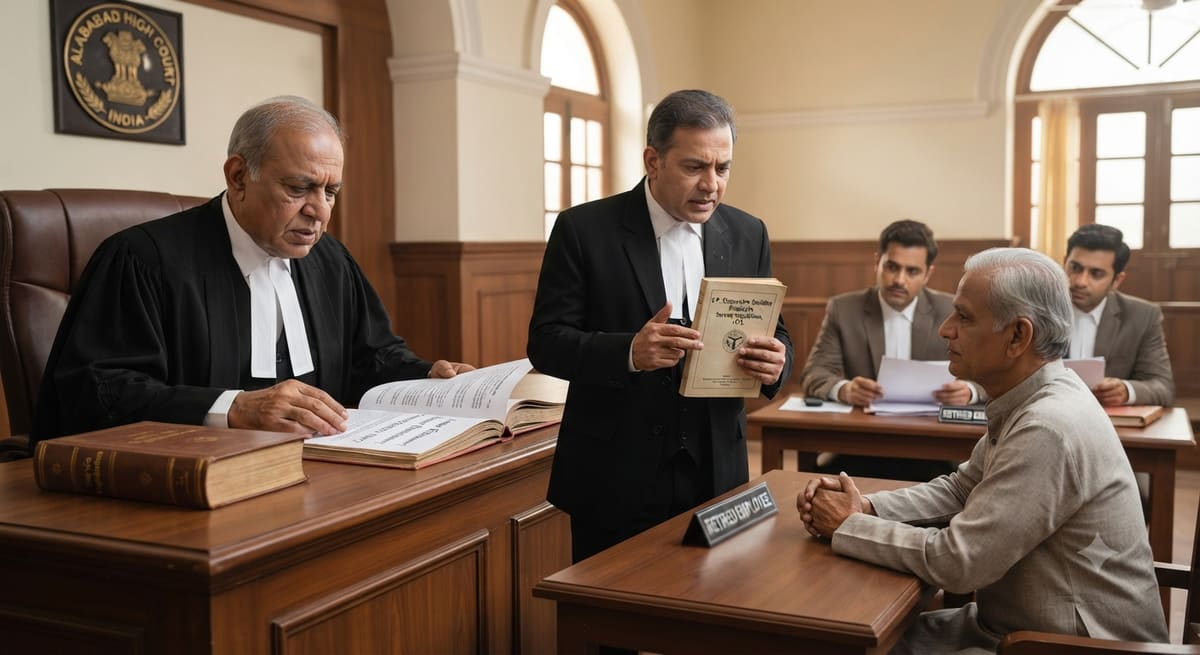
The Allahabad High Court has affirmed that the withholding of leave encashment pending disciplinary proceedings is legally untenable where no statutory provision authorizes such withholding. This ruling reinforces the principle that earned service benefits are not subject to contingent forfeiture merely due to pending investigations, offering critical clarity for public sector employees across Uttar Pradesh.
Background & Facts
The Dispute
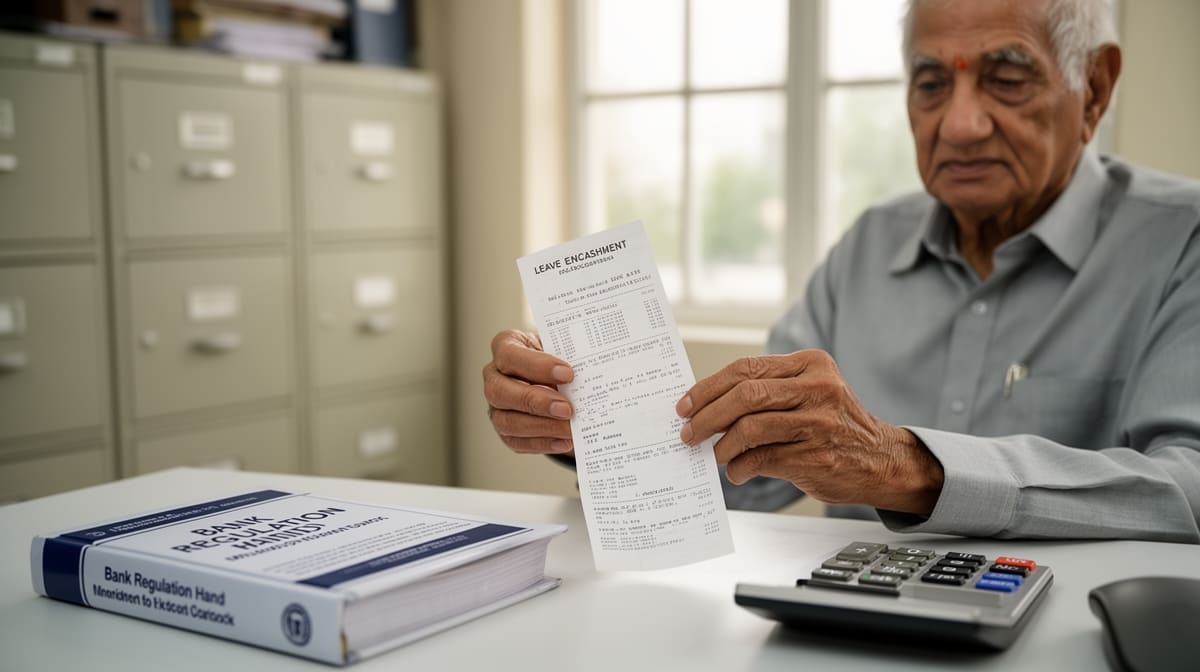
The petitioner, Amar Nath Verma, a former employee of the Pradeshik Cooperative Dairy Federation Limited, sought payment of his pending leave encashment amount following his superannuation on 31.01.2024. Despite completing his service tenure, the respondents withheld the payment on the ground that a disciplinary inquiry had been initiated against him.
Key Facts
The petitioner was employed under the U.P. Cooperative Societies Employees Service Regulations, 1975
He superannuated on 31.01.2024 after completing his service
A charge sheet dated 19.10.2022 was served upon him, initiating disciplinary proceedings
The inquiry proceedings remain pending as of the date of judgment
The petitioner claimed entitlement to leave encashment as per the service regulations
No specific provision under the U.P. Cooperative Societies Employees Service Regulations, 1975 permits withholding of leave encashment during pending inquiry
Procedural History
19.10.2022: Charge sheet issued initiating disciplinary proceedings
31.01.2024: Petitioner superannuated and applied for leave encashment
2024 (prior to filing): Request for payment rejected by respondent authorities on grounds of pending inquiry
2026: Writ Petition No. 6448 of 2026 filed before the Allahabad High Court, Lucknow Bench
Relief Sought
The petitioner sought a direction to the respondents to pay the full amount of leave encashment due, along with interest at an appropriate rate from the date of superannuation (31.01.2024) until actual payment.
The Legal Issue
The central question was whether the respondents could lawfully withhold payment of leave encashment under the U.P. Cooperative Societies Employees Service Regulations, 1975 solely on account of pending disciplinary inquiry proceedings, in the absence of any express statutory provision authorizing such withholding.
Arguments Presented
For the Petitioner
Learned counsel for the petitioner argued that leave encashment is a statutory benefit accrued upon superannuation and forms part of the final settlement of service dues. He contended that withholding such dues pending inquiry, without any enabling provision in the service regulations, violates the principles of natural justice and the right to property under Article 300A of the Constitution. He relied on the precedent set in Writ A No. 3679 of 2024, Pradeep Kumar Upadhyay v. State of U.P., where a similar issue was decided in favor of the employee.
For the Respondent
The State Counsel submitted that the disciplinary inquiry was serious in nature and that withholding the encashment was a precautionary measure to ensure potential recovery of dues if the inquiry resulted in adverse findings. However, no specific regulation or rule was cited to substantiate the legal authority for such withholding.
The Court's Analysis
The Court examined the U.P. Cooperative Societies Employees Service Regulations, 1975 and found no provision that permits the withholding of leave encashment during the pendency of disciplinary proceedings. The Court emphasized that benefits such as leave encashment are not contingent upon the outcome of an inquiry unless explicitly so provided by law.
"There is no provision with regard to U.P. Cooperative Societies Employees Service Regulations 1975 whereunder the amount of leave encashment can be withheld by opposite parties only pending inquiry proceedings."
The Court further noted that the pendency of an inquiry, however serious, cannot override the statutory right to earned benefits. It distinguished between the right to receive dues and the potential for future recovery through recovery proceedings, if warranted by the inquiry outcome. The Court also affirmed the precedent in Pradeep Kumar Upadhyay, reinforcing that administrative convenience cannot override statutory rights.
The Court explicitly clarified that it was not expressing any opinion on the merits of the pending inquiry, which was to proceed independently.
The Verdict
The petition was allowed at the admission stage. The Court directed the Managing Director/Chairman (Adm./Committee), Pradeshik Cooperative Dairy Federation Limited, Lucknow, to pay the petitioner the full amount of leave encashment due, along with interest at the rate of 7% per annum from the date of superannuation (31.01.2024) until actual payment. Payment was to be made within three months from the date of judgment. Parties were directed to bear their own costs.
What This Means For Similar Cases
Leave Encashment Is a Statutory Right, Not a Privilege
Practitioners representing public sector employees must assert that leave encashment is a vested right upon superannuation, irrespective of pending disciplinary proceedings
Any withholding must be grounded in an express statutory provision - silence in the regulations means no power to withhold
This principle applies uniformly across all service regulations under the State of Uttar Pradesh unless explicitly otherwise stated
Pending Inquiry Does Not Suspend Earned Benefits
Employers cannot use pending inquiries as a tool to delay or deny statutory dues
If recovery is warranted post-inquiry, it must be pursued through separate recovery proceedings, not by withholding at the time of exit
Employees may now claim interest from the date of superannuation if payment is delayed, as affirmed by this judgment
Precedent Binding Across U.P. Government and Cooperative Sectors
The judgment in Pradeep Kumar Upadhyay has been affirmed and extended to cooperative societies under the State
All departments and bodies governed by the U.P. Cooperative Societies Employees Service Regulations, 1975 must now comply with this ruling
Legal notices demanding leave encashment should now cite this judgment as binding authority