The Gauhati High Court has delivered a decisive ruling affirming that newly created judicial posts cannot be absorbed into an ongoing recruitment process initiated under prior service rules. The judgment reinforces the principle that recruitment must align with the cadre strength and reservation quotas as mandated by the Supreme Court, particularly where statutory amendments have altered the framework.
Background & Facts
The Dispute
The petitioners, four serving Judicial Officers of the Mizoram Judicial Service, challenged a Notification dated 17.11.2025 issued by the Registrar (Vigilance)-cum-In-charge, Recruitment Cell, Gauhati High Court. The Notification clubbed one of two newly created Grade-I posts in the Mizoram Judicial Service with an existing recruitment drive initiated under Advertisement No. 21.05.2025, thereby increasing the number of vacancies from one to two without issuing a fresh advertisement.
Key Facts
- The sanctioned strength of Grade-I posts (District Judges) in Mizoram Judicial Service was 16 as of 31.05.2024.
- Of these, 2 posts were earmarked for Limited Departmental Competitive Examination (LDCE) and 4 for direct recruitment.
- On 31.05.2024, an advertisement was issued for 1 vacancy arising from the impending retirement of Shri Joel Joseph Denga on 30.06.2024.
- Ms. Abigail Hmingthanpari was selected on 19.03.2025 but her appointment was cancelled on 09.04.2025.
- On 21.05.2025, a revised advertisement was issued for 2 vacancies: the cancelled post and the anticipated retirement of Shri Vanlalenmawia on 31.03.2026.
- On 14.10.2025, the Gauhati High Court set aside the cancellation of Ms. Hmingthanpari’s appointment in WP(C) No. 2271/2025, reinstating her and reducing the vacancy to one.
- On 20.08.2025, the Government of Mizoram created 2 new Grade-I posts, increasing the total sanctioned strength to 18.
- The Supreme Court’s judgment in All India Judges Association & Ors. v. Union of India & Ors. (2025 SCC OnLine SC 1184), delivered on 15.12.2025, mandated that LDCE quota be increased from 10% to 25% of the cadre strength.
- The Mizoram Judicial Service (Seventh Amendment) Rules were notified on 24.02.2026, formally implementing the 25% LDCE quota.
- On 17.11.2025, the High Court issued a Notification clubbing one of the two newly created posts with the existing recruitment, increasing the vacancies to two.
- 21 candidates were called for the written examination based on this revised vacancy count.
Procedural History
- 31.05.2024: Advertisement issued for 1 vacancy in Grade-I Mizoram Judicial Service.
- 19.03.2025: Appointment of Ms. Abigail Hmingthanpari.
- 09.04.2025: Cancellation of her appointment.
- 21.05.2025: Revised advertisement issued for 2 vacancies.
- 14.10.2025: Gauhati HC set aside cancellation of Ms. Hmingthanpari’s appointment.
- 20.08.2025: Government of Mizoram created 2 new Grade-I posts.
- 17.11.2025: Notification clubbing one new post with existing recruitment.
- 19.11.2025: 21 candidates called for written examination.
- 06.04.2026: Hearing and judgment delivered by the Gauhati High Court.
The Parties' Positions
Petitioners: Argued that the two new posts, created after the Supreme Court’s judgment but before the amended rules, could not be filled through an advertisement issued under the old quota. They contended that clubbing violated the 25% LDCE quota and amounted to filling a "future vacancy," which is impermissible under Prem Singh v. Haryana State Electricity Board.
Respondents: Defended the clubbing as administratively necessary, citing the advertisement’s clause that vacancy numbers were "indicative" and subject to change. They argued no mala fides existed and that issuing a fresh advertisement would cause undue delay and administrative burden.
Relief Sought
The petitioners sought quashing of the Notification dated 17.11.2025, restoration of the original vacancy count of one post, and direction to conduct the written examination for only one vacancy, preserving the 25% LDCE quota for the two newly created posts.
The Legal Issue
Can a newly created judicial post, arising after a Supreme Court directive to increase the LDCE quota but before formal amendment of service rules, be absorbed into a recruitment process initiated under the prior quota without violating the principles of fair recruitment and statutory compliance?
Arguments Presented
For the Petitioner
Mr. K.N. Choudhury, Sr. Advocate, relied on All India Judges Association v. Union of India (2025 SCC OnLine SC 1184) to argue that the 25% LDCE quota must be recalibrated based on the revised cadre strength of 18 posts, entitling 4.5 posts to LDCE and 4.5 to direct recruitment. He contended that the two new posts, created post-judgment, were "future vacancies" and could not be filled under an advertisement issued under the old regime. He cited Prem Singh v. Haryana State Electricity Board (1996) 4 SCC 319, holding that recruitment cannot be initiated for future vacancies, only for existing or anticipated ones. He further argued that the petitioners, as serving officers, were denied the opportunity to compete for promotion under the LDCE quota, violating their right to equal opportunity under Article 14.
For the Respondent
Mr. T.J. Mahanta and Ms. P. Bhattacharya argued that the advertisement of 21.05.2025 explicitly stated that the number of vacancies was "indicative" and subject to change. They emphasized administrative convenience and the absence of mala fides. They contended that the Supreme Court’s directive in All India Judges Association allowed ongoing processes to continue under the rules applicable at the time of advertisement, and that clubbing was a reasonable administrative adjustment to avoid duplication and delay.
The Court's Analysis
The Court examined the temporal sequence of events and the legal framework established by the Supreme Court. It noted that while the judgment in All India Judges Association was delivered on 15.12.2025, the service rules were amended only on 24.02.2026. However, the Court held that the directive to increase the LDCE quota to 25% was binding immediately upon pronouncement, even before formal rule amendment.
"The 25% quota for LDCE had to be calibrated afresh in accordance with the judgment and the amended Rules and 1(one) out of the 2(two) newly created post could not have been clubbed with the recruitment process which was kick-started with the advertisement dated 21.05.2024."
The Court distinguished between "anticipated" and "future" vacancies. The retirement of Shri Vanlalenmawia on 31.03.2026 was a valid anticipated vacancy. But the two posts created on 20.08.2025 were not vacancies at the time of the advertisement - they were future additions to the cadre. The Court held that absorbing them into the existing recruitment process circumvented the statutory mandate to recalculate quotas based on the new cadre strength.
The Court rejected the respondents’ reliance on the "indicative" clause in the advertisement, stating that such flexibility cannot override constitutional and statutory mandates. It emphasized that the Supreme Court’s directions were not merely advisory but transformative, requiring structural compliance.
The Court also dismissed the objection on maintainability, noting that dismissal of a writ petition under Article 32 does not bar a fresh petition under Article 226 by different petitioners with distinct grievances.
The Verdict
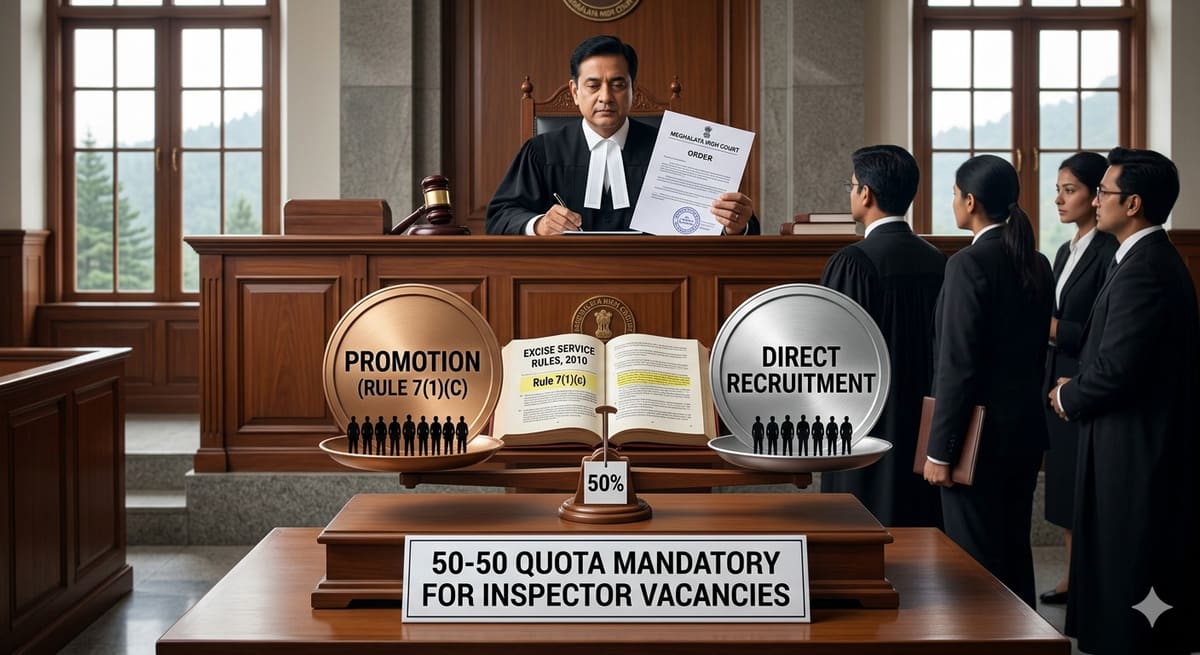
The writ petition was allowed. The Notification dated 17.11.2025, clubbing one of the two newly created posts with the recruitment process under Advertisement dated 21.05.2025, was quashed. The written examination shall proceed for only one vacancy - the anticipated retirement of Shri Vanlalenmawia. The two newly created posts must be filled through a separate recruitment process, with 50% of the posts (i.e., one post) reserved for LDCE and the other for direct recruitment, in accordance with the 25% quota of the revised cadre strength of 18 posts. The Registrar (Vigilance) shall issue a fresh notification within four weeks.
What This Means For Similar Cases
LDCE Quota Must Be Recalibrated Post-Judgment
- Practitioners must ensure that any recruitment process initiated after a Supreme Court directive altering reservation quotas must reflect the revised cadre strength, even if formal rules are pending amendment.
- Administrative convenience cannot override statutory compliance with judicial mandates.
- The 25% LDCE quota is not a discretionary guideline but a constitutional imperative under Article 14 and Article 16.
Future Vacancies Cannot Be Filled Through Prior Advertisements
- Recruitment drives can only cover existing or anticipated vacancies - not future increases in cadre strength.
- Any attempt to absorb new posts into old advertisements constitutes a violation of Prem Singh v. Haryana SEB and invites judicial intervention.
- Legal notices challenging such clubbing must be filed promptly, as the doctrine of laches may apply if delay prejudices the recruitment process.
Administrative Flexibility Has Limits
- Clauses in advertisements stating "vacancies are indicative" do not permit deviation from statutory or judicially mandated quotas.
- High Courts and State Governments must issue fresh advertisements when cadre strength changes, even if the change is minor.
- Delay in rule amendment does not excuse non-compliance with binding judicial directions.