The Himachal Pradesh High Court has clarified that in civil boundary disputes, any demarcation report must be based exclusively on the latest revenue settlement records. Failure to adhere to this mandatory procedure renders the report legally invalid, regardless of the qualifications of the person conducting it. This ruling reinforces procedural rigor in land litigation and sets a binding standard for trial and appellate courts.
Background & Facts
The Dispute
The plaintiff, Ved Parkash, filed a civil suit seeking a permanent injunction against the defendants, Madan Lal and others, to restrain them from constructing on and encroaching upon a portion of Khasra No. 2264 measuring 10 marlas, bearing Khewat No. 318 and Khatauni No. 456 as recorded in the Jamabandi for 1981-82. The plaintiff claimed that he had left a northern portion of this land vacant for repairs, sewerage outlets, and water pipes, and that the defendants threatened to build over it and block these utilities. An alternative prayer sought removal of any encroachment and demolition of unauthorized construction.
Key Facts
- The plaintiff purchased 10 marlas of land (approximately 191.98 sq. meters) as per Jamabandi records.
- The copy of Khatauni Badobast Jadid (Ext.P-2) showed the plaintiff in possession of 214.27 sq. meters - significantly more than the purchased area.
- The defendants, owners of adjacent Khasra No. 2265, constructed their building before the suit was filed.
- The plaintiff alleged encroachment on the northern portion marked ABCD in red on the site plan.
- The defendants denied encroachment, asserting that the plaintiff was already in possession of more land than legally owned.
- The plaintiff’s claim of encroachment was based on a demarcation report prepared by a Local Commissioner.
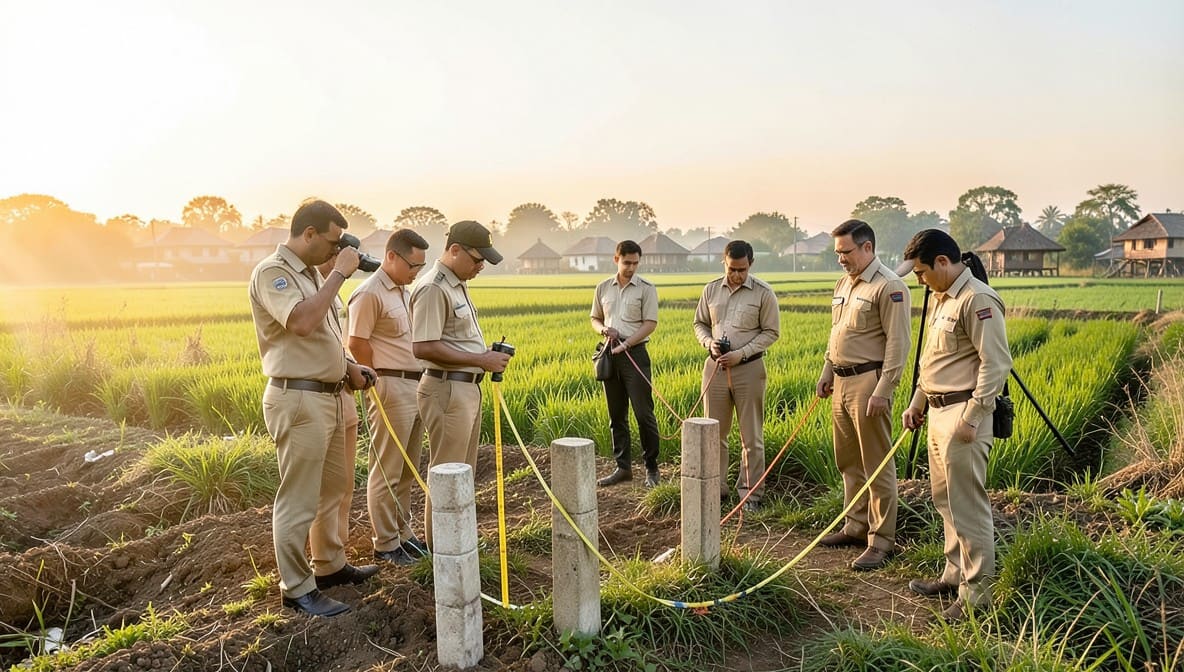
- The defendants submitted a demarcation report by S.S. Chauhan, a Revenue Officer, conducted under the Collector’s order, showing no encroachment.
Procedural History
- 30.11.2000: Learned Sub Judge, First Class, Court No. II, Amb, decreed the plaintiff’s suit based on the Local Commissioner’s report.
- 02.05.2008: Learned Additional District Judge, Fast Track Court, Una, set aside the trial court’s decree, rejecting the Local Commissioner’s report and accepting the report of S.S. Chauhan.
- 11.08.2008: Division Bench of the HP High Court admitted the appeal on two substantial questions of law.
- 17.03.2026: Appeal heard and reserved.
- 30.04.2026: Judgment delivered.
The Parties' Positions
Plaintiff (Appellant): Argued that the Local Commissioner’s report was reliable and correctly identified encroachment. Contended that the appellate court erred in rejecting it without appointing a fresh commissioner.
Defendants (Respondents): Argued that the Local Commissioner relied on outdated records (1891-92 and 1910-11) instead of the last settlement (1991-92). Asserted that S.S. Chauhan’s report, prepared as per statutory procedure, was accurate and conclusive.
Relief Sought
The appellants sought reversal of the appellate court’s order, restoration of the trial court’s decree, and a permanent injunction restraining the respondents from encroaching upon the suit land.
The Legal Issue
The central question was whether a demarcation report in a civil boundary dispute is legally valid if conducted using revenue records from an earlier settlement, rather than the most recent one, and whether a court may dismiss a suit upon rejecting such a report without appointing a fresh Local Commissioner when another valid report is available on record.
Arguments Presented
For the Appellant
Mr. Sanjeev Kuthiala, Senior Advocate, submitted that the trial court correctly relied on the Local Commissioner’s report, which was corroborated by oral evidence. He argued that once a court rejects a commissioner’s report, it is bound under Bali Ram v. Mela Ram to appoint a fresh commissioner, especially when the plaintiff has no control over the commissioner’s error. He cited Gopal Krishan v. Jagtamba Prasad and Kangru Ram v. Sriram to support the proposition that dismissal of a suit without appointing a new commissioner amounts to denying justice.
For the Respondent
Mr. Diwan Singh Negi contended that the Local Commissioner’s report was vitiated because it relied on records from 1891-92 and 1910-11, contrary to the mandatory requirement under the High Court Rules to use the last settlement record (1991-92). He emphasized that S.S. Chauhan, a Revenue Officer, had conducted a lawful demarcation in accordance with the Collector’s order and the HP Land Records Manual. He argued that where a valid, legally compliant report is available, the court is not obligated to appoint a fresh commissioner under Order 26 Rule 9 CPC, as held in Jagdish Ram v. Satpal.
The Court's Analysis
The Court undertook a detailed examination of the procedural requirements for demarcation under Chapter 1-M of the High Courts Rules and Orders, and the HP Land Records Manual. It held that demarcation must be conducted strictly in accordance with the instructions issued for the last settlement, and that deviation from this procedure renders the report legally unsustainable.
"The instruction No. I supra prescribe the manner of actual demarcation of the land. There does not appear to be any other alternative recognised method of demarcation of land to ensure its correctness; therefore, prescribing the only approved method of demarcation of land, this instruction is required to be essentially complied with, failing which the demarcation will be vitiated."
The Court noted that the Local Commissioner’s report (Ext.LC-1) explicitly referenced the 1978-79 consolidation records, yet also relied on the 1891-92 and 1910-11 Aks Shajra, which were not the last settlement. This dual reliance violated the mandatory procedure laid down in Kamal Dev v. Hans Raj and State of H.P. v. Laxmi Nand. The report failed to include the required copy of the current settlement field map, did not record party statements on the spot, and did not explain discrepancies in area measurements - all mandatory under the rules.
The Court further held that the report of S.S. Chauhan, a Revenue Officer, was not merely admissible but superior because it was conducted under the Collector’s authority and strictly followed the 1991-92 settlement records. The report included detailed methodology, dimensions in Karu Kan, and compliance with the procedural checklist.
"...the Court had the option to decide the dispute either by appointing a new Commission or placing reliance upon another demarcation report adduced on record by the defendants. Since, in the instant case, there was another evidence, on the basis of which the controversy at hand could be decided by the Court below, ignoring the report of the Local Commissioner appointed by it, the learned Court below committed no illegality by not issuing a new Commission."
The Court distinguished Bali Ram on the ground that in that case, the only evidence available was the rejected report. Here, a valid, legally compliant report existed. The Court also rejected reliance on Kangru Ram and Gopal Singh, noting they involved different statutory regimes and were not applicable.
The Verdict
The appeal was dismissed. The High Court upheld the appellate court’s judgment dated 02.05.2008, which set aside the trial court’s decree. The Court held that the Local Commissioner’s report was invalid due to non-compliance with mandatory demarcation procedures under the HP Land Records Manual. The report of S.S. Chauhan was accepted as legally valid and conclusive. No further demarcation was ordered, as the existing report was sufficient to resolve the dispute. The plaintiff’s claim of encroachment was rejected.
What This Means For Similar Cases
Demarcation Reports Must Rely on Last Settlement Records
- Practitioners must verify that any demarcation report cited in boundary disputes references the most recent settlement record (e.g., 1991-92, 2005-06, etc.) - not outdated Aks Shajra.
- Reports relying on pre-consolidation or pre-settlement records (e.g., 1891-92, 1910-11) are inadmissible and will be rejected outright.
- Courts must scrutinize the methodology section of demarcation reports for compliance with Chapter 1-M of High Court Rules.
Appointment of Fresh Commissioner Is Not Mandatory If Valid Alternative Exists
- A court is not obligated to appoint a new Local Commissioner merely because one report is rejected.
- If a legally compliant demarcation report is available from a Revenue Officer or other competent authority, the court may rely on it under Order 26 Rule 9 CPC.
- Parties must challenge such alternative reports promptly; silence or failure to contest may be construed as acceptance.
Documentary Evidence Overrides Oral Testimony in Boundary Disputes
- Oral testimony of parties or witnesses cannot override a properly conducted revenue demarcation.
- Where a party’s possession exceeds the area recorded in the Jamabandi, the court must question the legitimacy of the claim - as the plaintiff here was shown in possession of 214.27 sq. meters despite owning only 191.98 sq. meters.
- Courts must reconcile discrepancies between Jamabandi, Field Book, and actual possession before accepting any claim of encroachment.