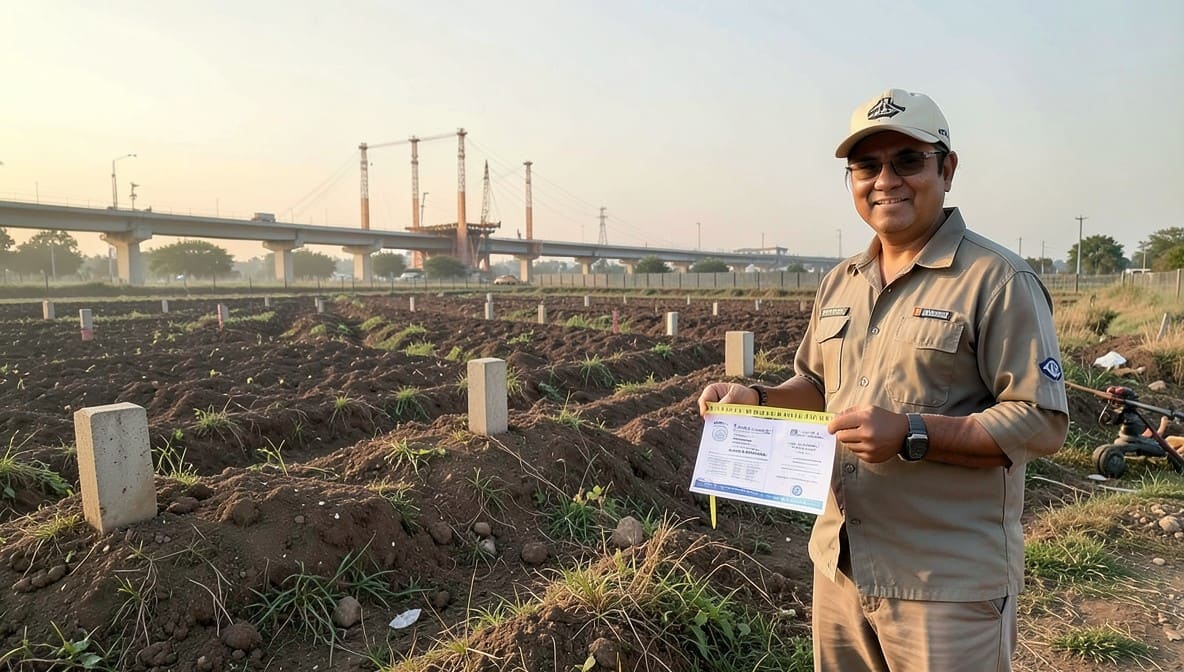
A significant clarification has emerged from the Madurai Bench of the Madras High Court on the legal standing of land purchasers who have not completed revenue mutation. The Court held that procedural lapses in updating land records cannot override substantive ownership established through documented transfer, especially in the context of compulsory acquisition. This ruling reinforces the principle that title, not merely revenue entries, governs rights in acquisition proceedings.
Background & Facts
The Dispute
The petitioner, S. Rajeshwari, challenges the validity of a land acquisition notification issued under the Land Acquisition Act, 1894, for the construction of a State Highway in Virudhunagar District. The notification, published in the Tamil Nadu Government Gazette Extraordinary No. 86 dated 09.03.2023, lists the landowners as Mariyappan Nadar and ten others. The petitioner, however, asserts that she purchased the entire property - Survey No. 1230/1A1A, measuring 2.25 cents (994.5 sq. ft.) - from these original owners in 2010 through a registered sale deed.
Key Facts
- The petitioner executed a registered sale deed (Document No. 324 of 2010) dated 22.01.2010, purchasing the land from Mariyappan Nadar and the other ten co-owners.
- Despite the sale, the petitioner did not initiate or complete the process of mutation of revenue records in her name.
- As a result, the revenue records continued to reflect Mariyappan Nadar and others as the owners at the time of the acquisition notification.
- The acquisition authority relied solely on the revenue records to identify landowners and issued the notification under Section 15(1) of the Land Acquisition Act.
- The petitioner was not named in the notification and was not offered compensation.
- The petitioner’s property is located in Tiruthangal Taluk, Virudhunagar District.
Procedural History
- 22.01.2010: Petitioner purchases land via registered sale deed (Doc. No. 324 of 2010).
- 09.03.2023: Gazette notification under Section 15(1) published, listing original sellers as landowners.
- 21.04.2025: Notice under Section 19(2) issued, initiating possession proceedings.
- 24.03.2026: Writ Petition filed under Article 226 seeking quashing of notification and restraint on possession.
- 24.03.2026: Hearing before the Madurai Bench of the Madras High Court.
The Parties' Positions
Petitioner’s Position: The petitioner contends that she is the true and lawful owner of the land since 2010, evidenced by the registered sale deed. Her failure to mutate the records was an administrative oversight, not a legal abandonment of title. She argues that the acquisition authorities acted illegally by ignoring documentary proof of ownership and relying solely on outdated revenue entries.
Respondents’ Position: The State, through the Special Government Pleader, acknowledges that the petitioner purchased the land but argues that non-mutation of records renders her claim legally untenable under revenue law. However, the State concedes that the petitioner may be granted an opportunity to prove her title.
Relief Sought
The petitioner seeks:
- Quashing of the Gazette notification dated 09.03.2023 under Section 15(1)
- Quashing of the Section 19(2) notice dated 21.04.2025
- A direction restraining respondents from taking possession of Survey No. 1230/1A1A
- Recognition of her ownership and entitlement to compensation
The Legal Issue
Can a land purchaser, who holds a registered sale deed but has not completed revenue mutation, be excluded from compensation in a land acquisition proceeding solely on the ground of non-mutation?
Arguments Presented
For the Petitioner
The petitioner’s counsel argued that ownership is established by title, not by revenue records. Citing State of Haryana v. Rattan Singh, the petitioner emphasized that acquisition authorities must examine substantive ownership, not merely administrative entries. The failure to mutate records does not extinguish ownership rights, especially where the transfer is documented and registered. The petitioner’s exclusion from the notification violates principles of natural justice and Article 14 of the Constitution.
For the Respondent
The State did not contest the petitioner’s factual claim of purchase. The Special Government Pleader conceded that the petitioner had a legitimate interest in the property but maintained that mutation is a mandatory prerequisite under the Tamil Nadu Land Reforms Act and the Revenue Code. However, the State offered to allow the petitioner to present her documents before the acquiring authority.
The Court's Analysis
The Court examined the distinction between revenue records and legal title. It observed that revenue records are prima facie evidence of possession and ownership, but they are not conclusive. The Court emphasized that in land acquisition, the focus must be on actual ownership, particularly when the claimant holds a registered instrument of transfer.
"The fact that the petitioner has not completed the mutation of revenue records does not negate her title, which is established by a registered sale deed dated 22.01.2010. The acquisition authorities cannot ignore documentary proof of ownership merely because administrative formalities remain incomplete."
The Court noted that the State’s own conduct - offering the petitioner an opportunity to establish title - implicitly acknowledged the validity of her claim. The Court held that denying compensation on the basis of non-mutation would amount to penalizing the petitioner for an administrative lapse, not a legal defect in title.
The Court further held that the principles of natural justice require that any person with a demonstrable interest in the land be given a fair opportunity to be heard before acquisition proceedings proceed. The petitioner’s exclusion from the notification process violated this fundamental right.
The Verdict
The writ petition is disposed of with directions. The petitioner is directed to appear before the 4th respondent - the Special District Revenue Officer (Land Acquisition), Highways Department, Madurai - on 26.03.2026 with all original documents, including the registered sale deed (Doc. No. 324 of 2010), to establish her ownership. The 4th respondent shall consider the petitioner’s claim, notwithstanding the absence of mutation, and pass appropriate orders regarding her entitlement to compensation. The respondents are restrained from taking possession of Survey No. 1230/1A1A until such orders are passed. No costs are awarded.
What This Means For Similar Cases
Ownership Trumps Revenue Records in Acquisition
- Practitioners must now argue that registered sale deeds constitute conclusive proof of ownership in acquisition proceedings, irrespective of mutation status
- Acquisition authorities cannot rely solely on revenue records to exclude claimants with documented title
- Failure to mutate records is an administrative irregularity, not a legal bar to compensation
Procedural Fairness Is Non-Negotiable
- Landowners must be given a fair hearing before acquisition notices are issued or possession taken
- Authorities must proactively verify ownership through documentary evidence, not just revenue rolls
- Petitioners in similar cases may now seek immediate interim relief to prevent dispossession pending adjudication of title
Practical Steps for Claimants
- Immediately file a mutation application if not already done, even while pursuing acquisition claims
- Preserve all original sale deeds, payment receipts, and correspondence with sellers
- File writ petitions under Article 226 if excluded from acquisition notices despite holding registered title
- Seek interim injunctions to prevent possession until title is adjudicated