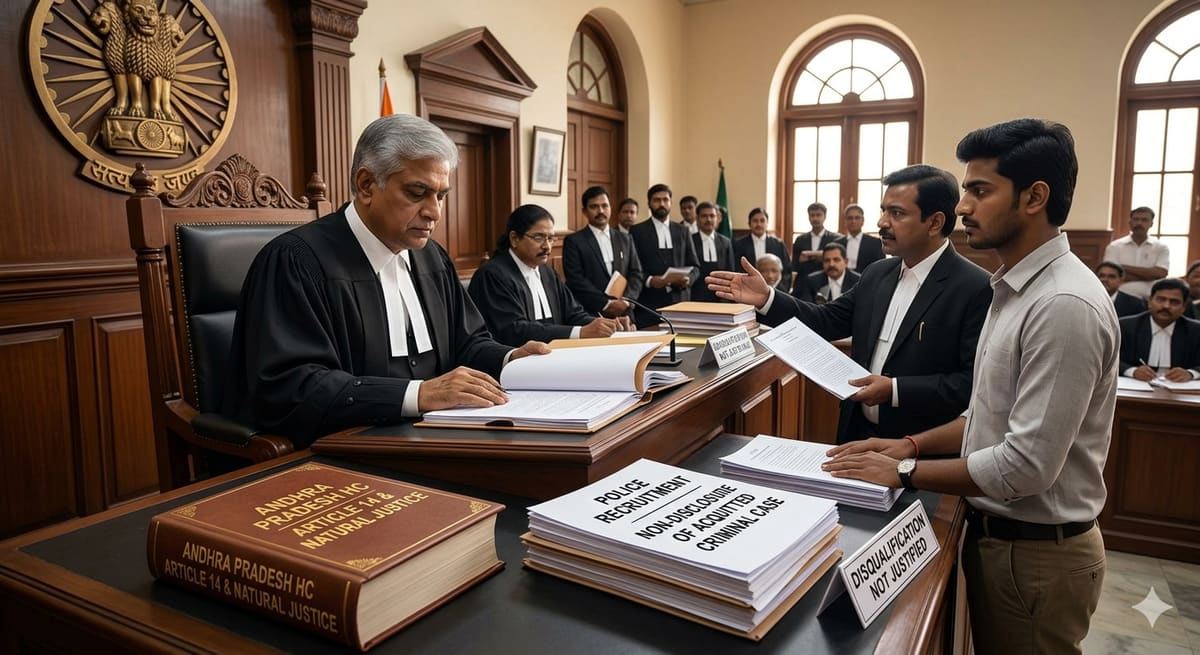
The Kerala High Court has set a significant precedent by directing the removal of an individual's name from the Rowdy History Sheet, holding that mere pendency of criminal cases - especially those stayed by courts - does not justify inclusion under Paragraph 259 of the Kerala Police Manual. The judgment underscores that only specific categories of anti-social conduct, as enumerated in the Manual, warrant such inclusion, reinforcing protections against arbitrary stigmatization by law enforcement agencies.
Background & Facts
The Dispute
The petitioner, an Advocate practicing at the Pathanamthitta Bar, challenged the decision of the District Police Chief, Pathanamthitta (first respondent), to retain his name in the Rowdy History Sheet maintained by the Pathanamthitta Police Station. The petitioner contended that his inclusion was unjustified, given that most of the 13 criminal cases filed against him - primarily at the instance of his estranged wife - had resulted in acquittals, discharges, or refer charges by the investigating agency. Only two cases remained pending, both of which were stayed by the High Court.
Key Facts
- The petitioner, aged 48, is an Advocate practicing in Pathanamthitta District.
- His estranged wife, allegedly in a relationship with a police officer, filed 13 criminal cases against him between 2005 and 2023.
- Case Outcomes:
- Acquitted: 4 cases
- Discharged: 2 cases
- Refer Charges: 5 cases (allegations found false by investigating agency)
- Pending: 2 cases (both stayed by the High Court)
- Pending Cases at Pathanamthitta:
- Case 1 (2014): Offences under Section 294(b) IPC and Section 120(o) Kerala Police Act
- Case 2 (2023): Offences under Sections 341, 323, and 506(i) IPC
- Pending Cases at Kollam:
- Case 1: Related to matrimonial disputes (status undisclosed)
- Case 2 (2005): Status not disclosed by the first respondent
- The petitioner submitted representations dated 10.01.2020 and 02.07.2025 to the first respondent, requesting removal of his name from the Rowdy History Sheet, but these were rejected.
Procedural History
- 10.01.2020: First representation submitted to the District Police Chief (Ext.P3)
- 02.07.2025: Second representation submitted (Ext.P4), acknowledged via receipt dated 02.07.2025
- 22.07.2025: First respondent submitted a report (Ext.P6) justifying retention of the petitioner’s name
- 25.11.2025: First respondent issued a communication (Ext.P8) rejecting the petitioner’s request
- 27.01.2026: High Court stayed proceedings in Crl.M.C No. 603/2026 (Ext.P1)
- 19.08.2025: High Court stayed proceedings in Crl.M.C No. 7433/2025 (Ext.P2)
- 14.07.2026: Present writ petition (W.P.(C) No. 16030/2026) filed and allowed
Relief Sought
The petitioner sought:
- Quashing of the first respondent’s decision to retain his name in the Rowdy History Sheet
- A direction to the first respondent to remove his name from the Rowdy History Sheet of Pathanamthitta Police Station
The Legal Issue
The central question was whether the inclusion of an individual’s name in the Rowdy History Sheet under Paragraph 259 of the Kerala Police Manual is justified merely on the basis of pending criminal cases, especially when:
- The majority of cases have resulted in acquittals, discharges, or refer charges
- The remaining cases are stayed by the High Court
- The pending cases do not fall under the specific categories of anti-social conduct enumerated in the Manual
Arguments Presented
For the Petitioner
- False Implication: The petitioner argued that 11 out of 13 cases filed against him resulted in acquittals, discharges, or refer charges, indicating a concerted attempt to falsely implicate him.
- Lack of Justification: The pending cases did not fall under any of the 12 categories of rowdyism listed in Paragraph 259 of the Kerala Police Manual, rendering his inclusion arbitrary.
- Judicial Stay: Both pending cases were stayed by the High Court, further undermining the justification for retaining his name.
- Reputation Harm: Inclusion in the Rowdy History Sheet stigmatizes the petitioner, an Advocate, and adversely affects his professional standing.
For the Respondent
- Criminal Background: The first respondent contended that the petitioner’s involvement in 13 criminal cases (including 2 at Kollam) justified his inclusion in the Rowdy History Sheet.
- Pending Cases: Emphasized that two cases remained pending, though stayed, and that one Kollam case arose from matrimonial disputes.
- Discretion of Police: Argued that the police authorities have the discretion to retain names in the Rowdy History Sheet based on the overall criminal background, even if some cases resulted in acquittals or discharges.
The Court's Analysis
The Court undertook a detailed examination of Paragraph 259 of the Kerala Police Manual, which enumerates 12 specific categories of rowdyism warranting inclusion in the Rowdy History Sheet. The Court observed:
"A reading of the aforesaid Regulation of the Kerala Police Manual would make it clear that the three cases said to be pending against the petitioner would not come under any of the categories narrated thereunder."
Key principles established by the Court:
-
Specificity of Conduct: Inclusion in the Rowdy History Sheet requires conduct falling under one of the 12 enumerated categories of anti-social behavior. Mere pendency of cases, especially those not proven, does not suffice.
-
Acquittals and Discharges: Cases resulting in acquittals, discharges, or refer charges (where allegations were found false) cannot be reckoned for inclusion in the Rowdy History Sheet. The Court held:
"As regards the cases in which the petitioner has been acquitted or discharged by the Competent Court of law, the first respondent is not justified in reckoning those cases for considering the inclusion of the name of the petitioner in the Rowdy History Sheet."
-
Judicial Stay: The fact that the two pending cases were stayed by the High Court further weakened the justification for retaining the petitioner’s name.
-
False Implication: The Court noted that the majority of cases (11 out of 13) resulted in favorable outcomes for the petitioner, suggesting a pattern of false implication. This undermined the credibility of the first respondent’s decision.
-
Discretion of Police: While acknowledging the discretion of police authorities, the Court emphasized that such discretion must be exercised judiciously and in accordance with the law. Arbitrary inclusion based on unproven allegations violates principles of natural justice and Article 21 of the Constitution.
The Verdict
The writ petition was allowed. The Court directed the first respondent to:
- Remove the petitioner’s name from the Rowdy History Sheet of Pathanamthitta Police Station
- Pass necessary orders to this effect
The judgment did not impose any monetary relief or costs but emphasized the stigmatizing effect of such inclusion on the petitioner’s professional and personal life.
What This Means For Similar Cases
Inclusion in Rowdy History Sheet Requires Specific Conduct
- Enumerated Categories: Police authorities cannot include an individual’s name in the Rowdy History Sheet merely because criminal cases are pending. The conduct must fall under one of the 12 specific categories listed in Paragraph 259 of the Kerala Police Manual.
- Pending Cases: Even if cases are pending, they must relate to anti-social conduct (e.g., eve-teasing, affray, intimidation) to justify inclusion. Cases stayed by courts or unrelated to such conduct do not warrant inclusion.
Acquittals and Discharges Cannot Be Reckoned
- Favorable Outcomes: Cases resulting in acquittals, discharges, or refer charges (where allegations were found false) must be excluded from consideration for inclusion in the Rowdy History Sheet.
- Burden of Proof: Police authorities must justify inclusion based on proven conduct, not mere allegations. This protects individuals from arbitrary stigmatization.
Judicial Scrutiny of Police Discretion
- Article 226 Remedy: Individuals aggrieved by inclusion in the Rowdy History Sheet can challenge the decision under Article 226 of the Constitution, as demonstrated in this case.
- Natural Justice: The judgment reinforces that police discretion must be exercised fairly and transparently, failing which courts will intervene to protect fundamental rights.
Implications for Legal Practitioners
- Advocates and Professionals: The judgment is particularly significant for legal practitioners, as inclusion in the Rowdy History Sheet can adversely affect professional reputation. Practitioners can now challenge arbitrary inclusions with greater confidence.
- False Cases: The judgment provides recourse for individuals falsely implicated in multiple cases, especially in matrimonial disputes or personal vendettas.
Practitioners should note:
- Documentary Evidence: Maintain records of acquittals, discharges, and refer charges to challenge inclusion.
- Judicial Stay: Highlight stay orders to argue that pending cases lack merit.
- Specificity: Argue that the conduct does not fall under the enumerated categories in the Kerala Police Manual.