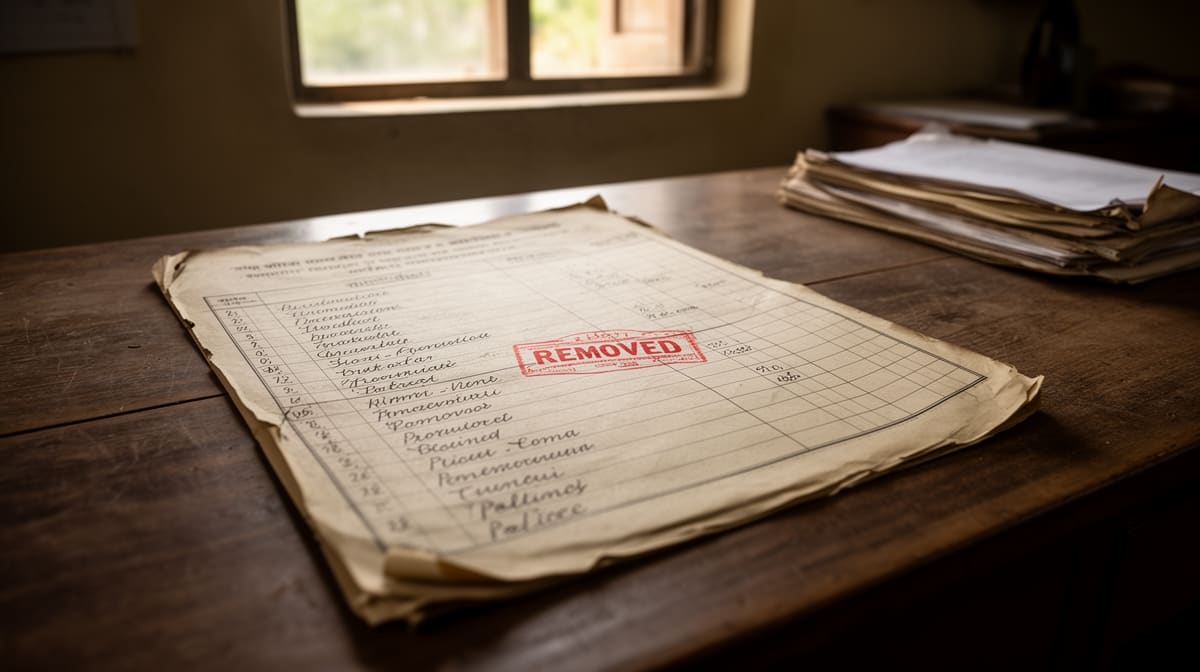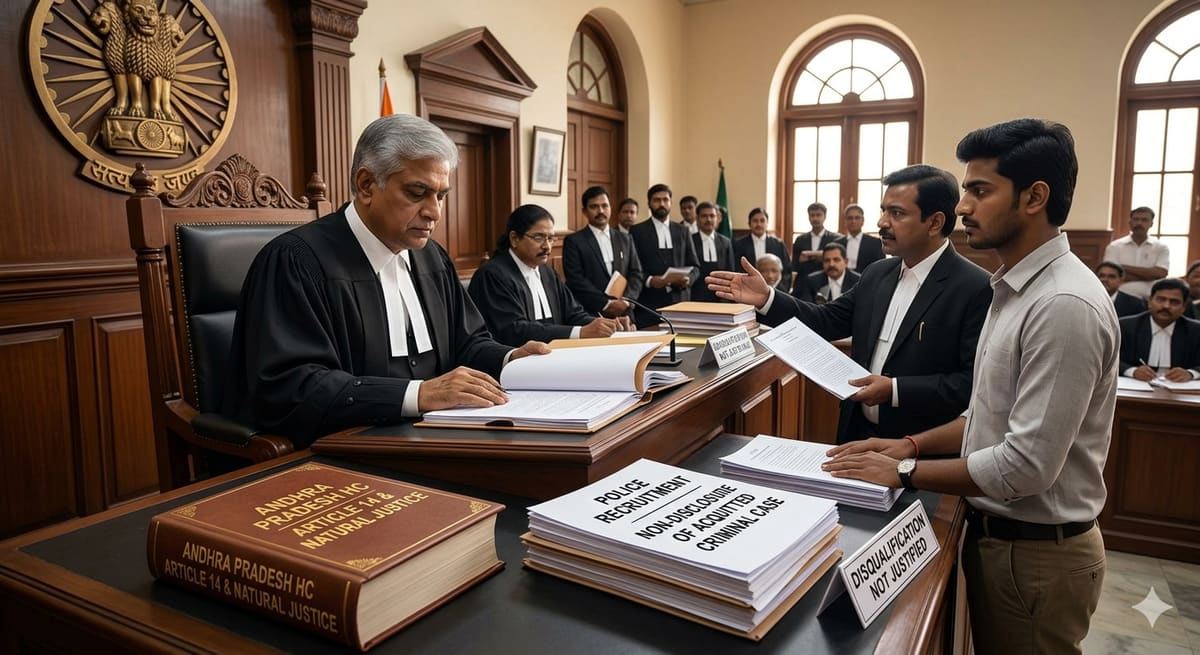
The Andhra Pradesh High Court has delivered a decisive ruling affirming that the continued maintenance of a rowdy sheet against an individual after full acquittal in a criminal case violates constitutional guarantees of dignity, liberty, and equality. This judgment clarifies that police authorities cannot rely on past allegations, even if unproven, to sustain stigmatizing administrative records once judicial innocence is established.
Background & Facts
The Dispute
The petitioner, Pali Srinivas @ Sreenu, a resident of Visakhapatnam, was named as an accused in Crime No.79 of 2014 under Sections 307 and 323 read with Section 34 of the Indian Penal Code. An order dated 23.03.2014, issued by the Assistant Commissioner of Police, East Sub-Division, Visakhapatnam, resulted in the creation of a rowdy sheet against him in the M.R. Peta Zone, II Town Police Station. The rowdy sheet was maintained as a preventive police record, ostensibly to monitor his conduct.
Key Facts
- The petitioner was arraigned in Crime No.79 of 2014 on allegations of attempt to murder and hurt
- A trial was conducted before the Sessions Court, resulting in a judgment of acquittal dated 17.05.2019 (S.C. No.30 of 2015)
- The petitioner was also implicated in Crime No.215 of 2015 under Sections 384 and 506(1) IPC, which was later compromised and closed
- Despite the acquittal and compromise, the rowdy sheet remained active on police records
- No other criminal case was pending against the petitioner at the time of filing the writ petition
- The petitioner had no prior criminal convictions or pending charges
Procedural History
- 23.03.2014: Rowdy sheet opened against petitioner by Assistant Commissioner of Police, East Sub-Division, Visakhapatnam
- 17.05.2019: Sessions Court acquitted petitioner in Crime No.79 of 2014 (S.C. No.30 of 2015)
- 2020: Crime No.215 of 2015 was disposed of as compromised
- 2025: Petitioner filed Writ Petition No.34021/2025 under Article 226 seeking quashing of the rowdy sheet
- 04.05.2026: Hearing before the High Court of Andhra Pradesh at Amaravati
The Parties' Positions
The petitioner contended that the continued existence of the rowdy sheet after acquittal was arbitrary, discriminatory, and violative of his fundamental rights under Articles 14, 19 and 21 of the Constitution. He relied on the precedent set in W.P. Nos.21247/2016 and batch dated 15.07.2022, where the same High Court had held that rowdy sheets cannot be sustained post-acquittal.
The State, through the Assistant Government Pleader, admitted that both criminal cases against the petitioner had been finally disposed of - one by acquittal and the other by compromise. The State did not dispute that no active investigation or pending case required the petitioner’s continued monitoring.
Relief Sought
The petitioner sought:
- A declaration that the maintenance of the rowdy sheet post-acquittal is illegal and unconstitutional
- A writ of mandamus directing the respondents to delete and close the rowdy sheet
- An interim order suspending all proceedings under the rowdy sheet until final disposal
The Legal Issue
The central question was whether the police can lawfully maintain a rowdy sheet against an individual after they have been fully acquitted in a criminal case, and whether such continued record-keeping violates Articles 14, 19 and 21 of the Constitution.
Arguments Presented
For the Petitioner
The petitioner’s counsel argued that a rowdy sheet is a stigmatizing administrative tool that impacts reputation, employment, and social standing. Once a court of law has declared a person innocent beyond reasonable doubt, the basis for such a record vanishes. Reliance was placed on W.P. Nos.21247/2016 and batch dated 15.07.2022, where the Andhra Pradesh High Court held that police cannot retain rowdy sheets after acquittal, as it amounts to punishment without trial. The petitioner emphasized that the rowdy sheet was not based on any ongoing threat or credible intelligence, but solely on a concluded and resolved case.
For the Respondent
The State did not contest the factual position that both criminal cases were closed - one by acquittal and the other by compromise. The Assistant Government Pleader conceded that no active investigation or pending case justified the continuation of the rowdy sheet. The State offered no legal justification for retaining the record post-acquittal and did not cite any statutory provision authorizing such retention.
The Court's Analysis
The Court examined the nature and purpose of rowdy sheets, noting they are not statutory instruments but administrative records created under police discretion. However, such discretion is not unfettered and must conform to constitutional norms.
"When a Court of law has declared the petitioner to be not guilty, no rowdy sheet can be continued by the police authority."
The Court held that the continued existence of the rowdy sheet after acquittal transforms a procedural record into a de facto punishment, effectively branding the petitioner as a "rowdy" despite judicial exoneration. This violates the presumption of innocence, a core component of Article 21. The Court further observed that such records, even if not formally punitive, have tangible consequences - affecting employment, travel, and social dignity - thereby infringing Article 19(1)(g) and Article 14 by creating an arbitrary classification between acquitted persons and others.
The Court distinguished rowdy sheets from criminal records maintained under the National Crime Records Bureau, which are based on convictions. A rowdy sheet, by its very nature, is premised on suspicion or prior allegations - but once those allegations are judicially rejected, the foundation collapses.
The Court also noted that the State had not demonstrated any public interest or security rationale for retaining the record. The absence of any pending case or credible threat rendered the continuation of the rowdy sheet wholly unjustified.
The Verdict
The writ petition was allowed. The High Court quashed the rowdy sheet opened against the petitioner in M.R. Peta Zone, II Town Police Station, Visakhapatnam, on the basis of Crime No.79 of 2014. The respondents were directed to delete and close the rowdy sheet immediately. No costs were awarded. All interim applications were closed.
What This Means For Similar Cases
Rowdy Sheets Are Not Permanent Records
- Practitioners must now argue that any rowdy sheet based solely on acquitted or compromised cases must be deleted upon proof of acquittal
- Police departments cannot rely on "historical suspicion" to justify retention of such records
- A single acquittal is sufficient to extinguish the legal basis for a rowdy sheet, regardless of prior allegations
Judicial Acquittal Trumps Administrative Discretion
-
The judgment reinforces that judicial findings override police assessments in matters affecting personal liberty
-
Administrative records that carry stigma must be reviewed post-acquittal - failure to do so invites constitutional challenge
-
Legal aid organizations and civil society groups can now use this precedent to file mass petitions for deletion of improperly maintained rowdy sheets
-
Where a person has been acquitted, a formal application for deletion of the rowdy sheet should be filed with the concerned police station and, if ignored, followed by a writ petition under Article 226
-
The burden now shifts to the State to justify retention - not on the individual to prove innocence
-
This ruling applies equally to compromised cases where no conviction occurred