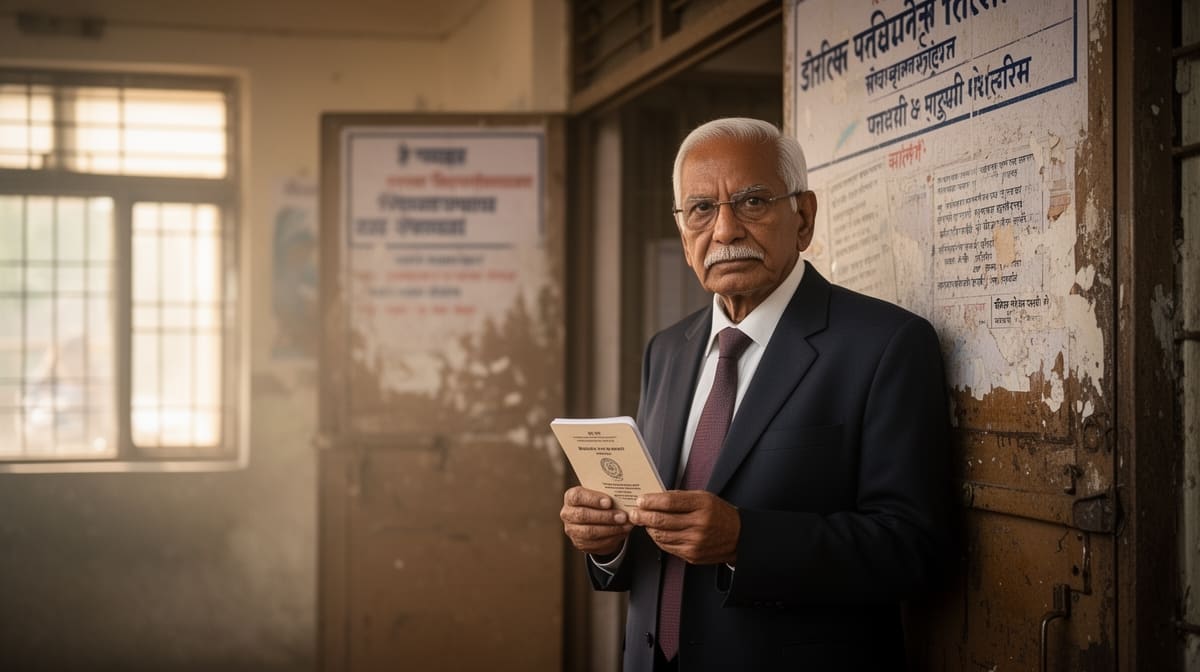
The Allahabad High Court has reaffirmed that interim pension cannot be arbitrarily halted pending final adjudication of a retired employee’s claim. In a clear directive, the Court ordered monthly disbursement of interim pension with strict timelines for arrears and personal liability for non-compliance, reinforcing the principle that pensionary benefits are not subject to administrative discretion once entitlement is prima facie established.
Background & Facts
The Dispute
The petitioner, Bharat Prasad, served as Sangrah Amin and superannuated on 30.06.2014. Upon retirement, he began receiving interim pension. However, this payment was abruptly discontinued without any formal order, explanation, or statutory justification. The petitioner filed representations seeking restoration, which were ignored until a letter dated 26.09.2025 was issued by the Naib Tehsildar, Sardar Nagar, Chauri Chaura (Respondent No. 4), directing the Sub-Divisional Officer, Chauri Chaura (Respondent No. 3), to cease payment of interim pension on the ground that a writ petition filed by the petitioner remained pending.
Key Facts
- The petitioner retired on superannuation on 30.06.2014
- Interim pension was paid from 30.06.2014 until its unilateral stoppage
- No formal order was passed by any competent authority to discontinue the interim pension
- The petitioner filed a writ petition before the High Court challenging the denial of full pension
- As of the date of judgment, no adverse order had been passed in that pending writ petition
- On 26.09.2025, Respondent No. 4 issued a letter directing cessation of interim pension
- On 15.05.2026, Respondent No. 3 issued an order sanctioning interim pension for the period 01.05.2025 to 31.10.2025 - a six-month lump sum payment
- The Standing Counsel admitted that this payment was made "as per prevailing practice" without citing any legal provision
Procedural History
- 30.06.2014: Petitioner superannuated and began receiving interim pension
- 26.09.2025: Naib Tehsildar issued letter directing stoppage of interim pension
- 15.05.2026: Sub-Divisional Officer issued order granting interim pension for six months (01.05.2025 - 31.10.2025)
- 21.04.2026: High Court passed interim order directing respondents to make payment or show cause by 19.05.2026
- 19.05.2026: Hearing held; Court found the six-month lump-sum payment legally unsustainable
Relief Sought
The petitioner sought restoration of interim pension from the date of its stoppage, payment of all arrears, and a direction for monthly disbursement until final disposal of the pending writ petition.
The Legal Issue
Can interim pension be stopped merely because a writ petition challenging final pension is pending, and can payment be made in lump-sum for multiple months without statutory authority?
Arguments Presented
For the Petitioner
The petitioner’s counsel argued that interim pension is a statutory entitlement pending final adjudication, and its discontinuation without any order violates the principles of natural justice and Article 14 of the Constitution. He emphasized that the petitioner had been receiving interim pension since retirement, and its unilateral stoppage was arbitrary. The six-month lump-sum payment issued on 15.05.2026 was not based on any rule or circular but on ad hoc practice, rendering it legally invalid.
For the Respondent/State
The Standing Counsel conceded that no statutory provision was cited to justify the stoppage or the lump-sum payment. He stated that the six-month payment was made as per "prevailing practice" in the department, without any formal rule or order authorizing such disbursement. No legal basis was offered for the cessation of payments.
The Court's Analysis
The Court observed that the petitioner had been receiving interim pension since retirement, and no order had been passed by any competent authority to terminate it. The mere pendency of a writ petition does not justify withholding statutory benefits. The Court emphasized that interim pension is not a discretionary grant but a provisional payment pending final determination of entitlement.
"The mere pendency of a writ petition cannot be a ground to stop interim pension, especially when no adverse order has been passed in that proceeding."
The Court further rejected the notion that interim pension could be paid in lump-sum for six months as a matter of departmental practice. Such practice, without statutory backing, cannot override legal principles. The Court held that interim pension must be paid monthly as and when it falls due, to ensure financial stability and prevent arbitrary administrative action.
The Court also imposed personal liability on Respondent No. 3 - the Sub-Divisional Officer - for any failure to comply with the payment schedule, making him personally responsible for interest payments.
The Verdict
The petitioner succeeded. The Court issued a mandamus directing Respondent No. 3 to pay interim pension on a monthly basis, commencing June 2026, by the 10th of every calendar month. Arrears of interim pension must be paid within three weeks from the date of judgment. In case of delay, Respondent No. 3 shall pay interest from his own pocket. The writ petition was disposed of finally.
What This Means For Similar Cases
Interim Pension Is Not Discretionary
- Practitioners representing retired government employees must argue that interim pension is a statutory right pending final decision, not a privilege subject to administrative whim
- Any stoppage without a reasoned order violates Article 14 and the principle of legitimate expectation
- Departmental "practices" without statutory basis cannot override constitutional rights
Monthly Disbursement Is Mandatory
- Lump-sum payments for multiple months, even if made voluntarily, are legally unsustainable
- Payments must be made monthly, aligned with the due date of each installment
- Failure to pay monthly triggers personal liability for interest - a critical litigation risk for officials
Personal Liability for Non-Compliance Is Now Clear
- The Court’s imposition of personal liability on the Sub-Divisional Officer sets a precedent for accountability
- Officers must now treat interim pension orders as judicial mandates, not administrative suggestions
- Legal advisors should warn departments that non-compliance may result in personal financial consequences