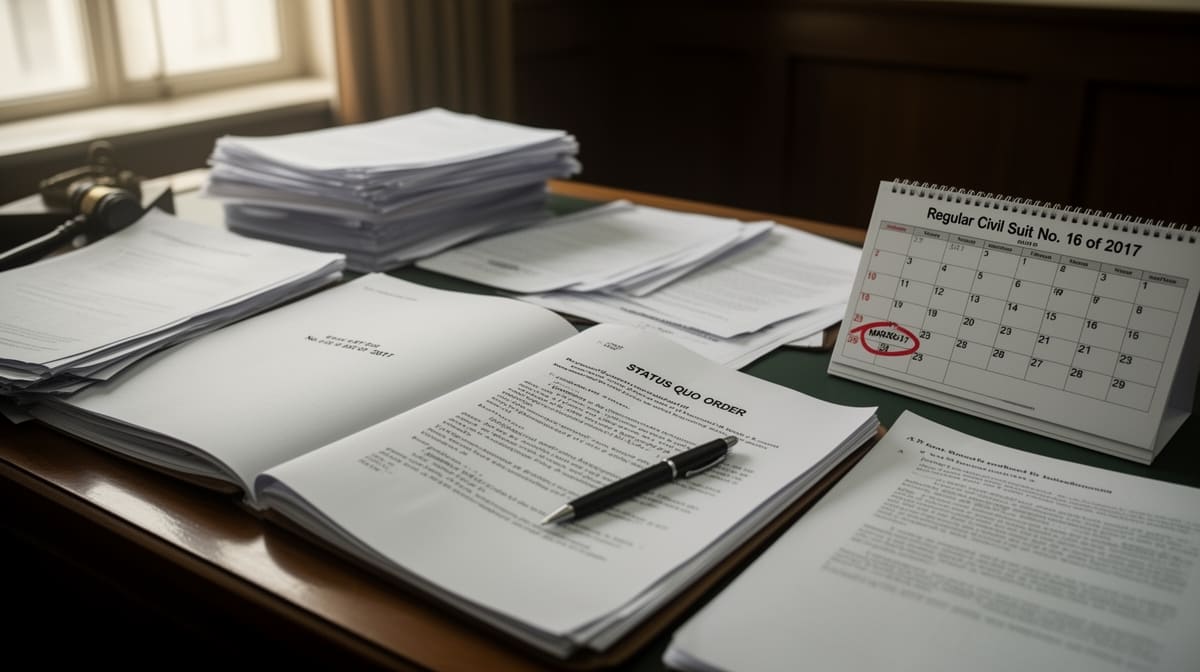
The Bombay High Court has delivered a decisive ruling affirming that interim orders founded on procedural illegality cannot be preserved through a stay, even temporarily. This judgment reinforces the principle that judicial authority must not be used to sustain unlawful acts, regardless of the parties’ convenience or alleged prejudice.
Background & Facts
The Dispute
The dispute arose from multiple civil suits filed by financial institutions and a professional services firm against Anil D. Ambani and others, alleging breach of contractual obligations, financial misrepresentation, and failure to repay loans. The plaintiffs sought urgent interim relief, including injunctions restraining the defendants from disposing of assets.
Procedural History
The Single Judge of the Bombay High Court, in three consolidated suits, granted interim injunctions on 24 December 2025. These orders were issued without:
- Proper notice to all parties
- Adequate opportunity to be heard
- Detailed reasoning on the balance of convenience or irreparable harm
The appellants - Bank of Baroda, IDBI Bank, Indian Overseas Bank, and BDO India LLP - filed appeals challenging the legality of these interim orders. They contended the Single Judge’s orders were ex parte in effect and violated fundamental principles of natural justice.
Relief Sought
The appellants sought the setting aside of the interim orders and dismissal of the applications that led to them. The respondents sought a stay of the appellate court’s eventual order, arguing that abrupt enforcement would cause irreparable commercial harm.
The Legal Issue
The central question was whether an interim order that suffers from procedural illegality - such as denial of hearing or lack of reasoned order - can be preserved by granting a stay, or whether such an order must be immediately set aside to prevent perpetuation of judicial illegality.
Arguments Presented
For the Appellant
The appellants relied on State of Haryana v. Bhajan Lal and K. Veeraswami v. Union of India to argue that interim orders lacking procedural fairness are void ab initio. They emphasized that natural justice is non-negotiable, and courts cannot validate illegal orders by delaying their invalidation. The absence of reasons rendered the orders non-appealable in substance, violating Article 14 and Article 21.
For the Respondent
The respondents contended that the interim orders were necessary to preserve the status quo and prevent asset dissipation. They cited Rajesh Kumar v. State of Haryana to argue that stays are routinely granted to avoid hardship, even if the underlying order is flawed. They claimed the appellants had not demonstrated immediate prejudice and that a four-week stay would not undermine public interest.
The Court's Analysis
The Division Bench examined the nature of interim orders under Order XXXIX Rule 1 and 2 of the CPC and held that such orders are not immune from scrutiny merely because they are temporary. The Court observed that the Single Judge’s orders were passed without affording the respondents an opportunity to respond, rendering them procedurally defective.
"An order passed without affording a hearing is not merely irregular - it is void. To stay such an order is not to preserve justice; it is to institutionalize injustice."
The Court distinguished between procedural delays and substantive illegality. While delays may be excused under equitable principles, procedural illegality - especially denial of hearing - strips the order of legal validity. The Court further held that the respondents’ request for a stay amounted to seeking judicial endorsement of an unlawful act, which courts cannot permit under any circumstance.
The Bench emphasized that judicial authority must not be used to perpetuate illegality, even for a short duration. The principle of nemo iudex in causa sua and the doctrine of rule of law demanded immediate invalidation.
The Verdict
The appellants prevailed. The Court held that interim orders tainted by procedural illegality cannot be stayed, and set aside the December 2025 orders. The applications for interim relief were dismissed outright, and the request for a four-week stay was rejected as an attempt to legitimize an unlawful judicial act.
What This Means For Similar Cases
Procedural Compliance Is Non-Negotiable
- Practitioners must now insist on recorded reasons and notice in every interim application
- Courts will not tolerate ex parte or summary orders lacking hearing
- Any interim order without a hearing is vulnerable to immediate setting aside
Stay Cannot Shield Illegal Orders
- Applications for stay of interim orders must now address legality, not just hardship
- Courts will deny stays where the underlying order violates natural justice
- A request to "buy time" for an illegal order will be viewed as an abuse of process
Judicial Accountability in Interim Relief
- Judges granting interim injunctions must record reasons on balance of convenience, irreparable harm, and notice
- Failure to do so invites appellate intervention and invalidation
- This judgment elevates procedural rigor as a threshold requirement for interim relief