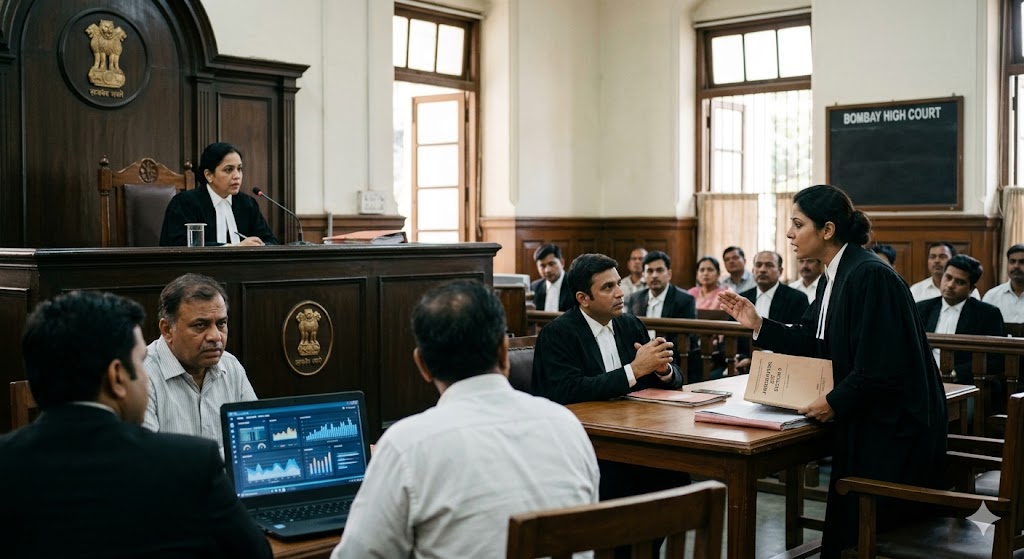
The Bombay High Court has clarified that interim relief under Section 9 of the Arbitration and Conciliation Act, 1996 cannot be granted to reinstate a terminated party when a third party has already taken over operational control of the subject matter. The judgment underscores that preservation of the subject matter of arbitration does not extend to reversing established commercial realities, especially where monetary compensation remains an adequate remedy.
Background & Facts
The Dispute
The dispute arose from a 2021 Agreement between M/s Morning Star Shipping and Trading Pvt Ltd (Petitioner) and Vhyaghreshwar Minerals Industrial Producer Co-operative Society Limited (Respondent) for the raising and sale of bauxite ore from the Mahal Mirya Mine. The Petitioner was granted rights to extract up to 1,50,000 metric tons annually for eight years, paying Rs. 3 crores upfront - Rs. 1.5 crores as non-refundable goodwill and Rs. 1.5 crores as advance royalty adjustable against future royalty payments at Rs. 80 per MT. The Petitioner engaged AGP Minechem Pvt Ltd, owned by the Respondent’s Chairman, as its excavation contractor.
Procedural History
- January 2021: Agreement executed for bauxite extraction and sale.
- 2021 - 2025: Petitioner extracted only 274,789.502 MT against expected 600,000 MT.
- November 2025: Respondent terminated the Agreement citing non-payment of Rs. 20 lakh, delayed royalty, under-extraction, and failure to submit a bank guarantee for enhanced mining capacity.
- November 24, 2025: Respondent entered into a new agreement with AGP Minechem, which commenced mining operations.
- December 26, 2025: Petitioner invoked arbitration.
- January 7, 2026: Petitioner filed Section 9 petition seeking injunction and access to ILMS portal.
Relief Sought
The Petitioner sought: (i) injunction against interference with mining operations; (ii) restraint on obstructing transport of already-excavated bauxite; (iii) access to ILMS portal for transit passes; (iv) compliance with GST registration obligations; and (v) ad-interim relief pending arbitration.
The Legal Issue
The central question was whether Section 9 of the Arbitration and Conciliation Act, 1996 permits a court to grant interim measures that would displace a third party already operating the subject matter of arbitration, where the aggrieved party can be adequately compensated through monetary damages.
Arguments Presented
For the Petitioner
The Petitioner argued that the termination was illegal under Clause 23 of the Agreement, which required a three-month notice and limited termination to illegal mining or non-payment of royalty - neither of which occurred. It contended that the entire Rs. 3 crores had been paid, and royalty was fully adjusted against advance. It claimed ownership of 15,515 MT of excavated ore worth Rs. 5 crores and asserted that blocking ILMS access and GST compliance violated contractual obligations under Clause 20. Reliance was placed on Arcelor Mittal Nippon Steel India Ltd v. Essar Bulk Terminal Ltd to argue that courts retain power to grant interim relief even after tribunal constitution.
For the Respondent
The Respondent countered that the Petitioner had failed to pay Rs. 20 lakh, delayed royalty payments beyond January 2023, and under-extracted by over 400,000 MT, causing substantial loss. It emphasized that the new contractor, AGP Minechem, had already commenced operations, paid Rs. 1 crore in government royalties, and was not a party to the petition. It argued that the Petitioner’s delay in approaching the court (over six weeks post-termination) and the absence of irreparable harm negated the need for interim relief.
The Court's Analysis
The Court examined the nature of relief sought under Section 9, emphasizing that its purpose is to preserve the subject matter of arbitration - not to restore the status quo ante. The Court noted that the Petitioner’s claim of Rs. 5 crores worth of ore lying at the site was implausible given the Petitioner’s own records showing minimal extraction in 2025. The Court observed that the new contractor had been operating for over three months, had invested Rs. 1 crore in statutory dues, and was not impleaded in the petition.
"The stage of preserving the mining site, which is subject matter of arbitration, has already surpassed. What Petitioner now expects is restoration of status quo ante."
The Court distinguished Arcelor Mittal as inapplicable, noting that case dealt with interim relief after tribunal constitution but before operations commenced. Here, operations were fully underway. The Court held that irreparable loss was absent because damages could be awarded in arbitration. The balance of convenience heavily favored the new contractor, who had acted in good faith and incurred significant expenditure. The Court further noted that the Petitioner’s claim of malafide termination by the Respondent’s Chairman, while potentially relevant for damages, did not establish a prima facie case for injunctive relief.
The Verdict
The Petitioner’s application for interim measures was rejected. The Court held that monetary compensation is an adequate remedy where third-party operations are already established, and reinstatement is not permissible under Section 9. The Court constituted a sole arbitrator to adjudicate all disputes, including claims for refund of goodwill, advance royalty, and damages for unlawful termination.
What This Means For Similar Cases
Interim Relief Cannot Override Third-Party Operations
- Practitioners must assess whether a third party has already assumed operational control before seeking injunction under Section 9.
- Courts will not grant mandatory injunctions that displace independent contractors not party to the arbitration agreement.
- Delay in filing Section 9 petitions weakens the claim for urgent relief, especially where the subject matter is perishable or time-sensitive.
Damages Are Sufficient Where Monetary Compensation Is Feasible
- The burden shifts to the applicant to prove that damages are inadequate - not merely inconvenient.
- Claims involving ownership of extracted goods (e.g., minerals, inventory) must be supported by verifiable records; speculative valuations will be disregarded.
- Parties should prioritize arbitration invocation and seek damages, not reinstatement, when operational control has changed hands.
Procedural Compliance in Arbitration Matters
- Parties must strictly adhere to notice periods and contractual conditions before invoking termination.
- Oral variations to written contracts (e.g., royalty adjustments) require documentary proof; courts will not infer novation without evidence.
- Courts will not adjudicate factual disputes on interim applications - these must be reserved for the arbitral tribunal.