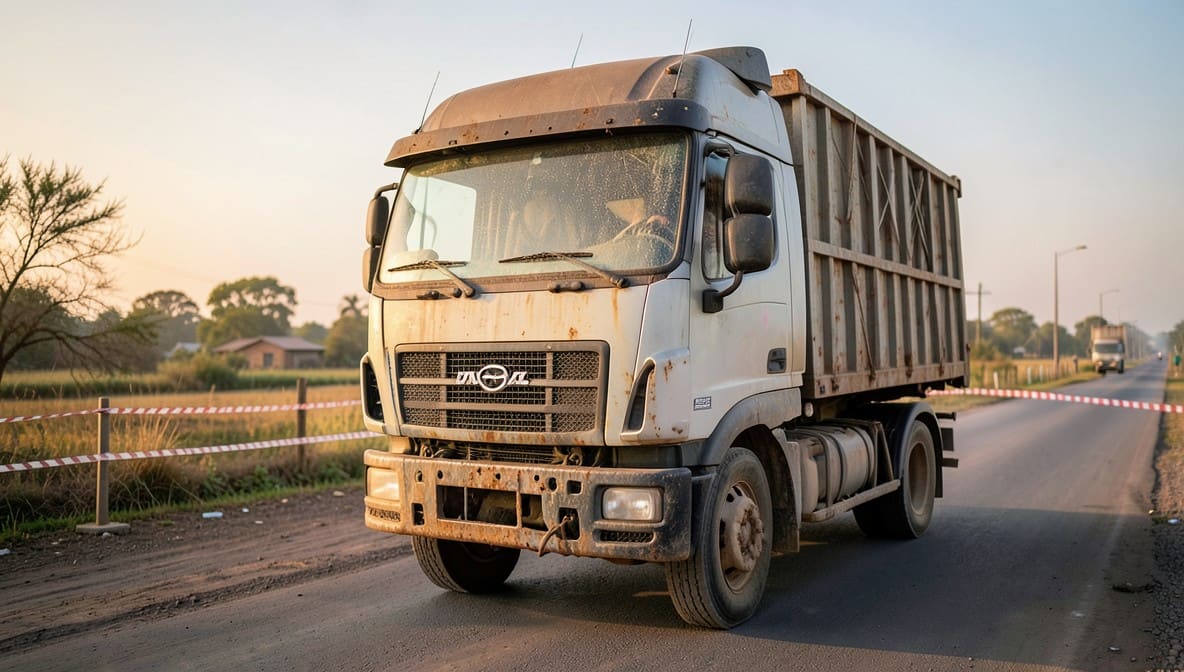
The High Court of Kerala has reinforced a critical safeguard for property rights in criminal proceedings by striking down an onerous bank guarantee condition imposed on the owner of a seized tanker lorry. The judgment underscores that prolonged detention of vehicles without reasonable justification violates the principle of proportionality and invites unnecessary depreciation, a concern long recognized by the Supreme Court.
Background & Facts
The Dispute
The petitioner, Hashib Shaheen, is the registered owner of a tanker lorry bearing registration number KL 29C 5236. The vehicle was seized by Balussery Police Station on 3 February 2024 under Crime No. 121/2024, following allegations that it was used to dump waste in public premises, thereby violating Sections 270 and 279 of the Indian Penal Code, Sections 219S and 219H of the Kerala Panchayat Raj Act, 1994, Section 120(e) of the Kerala Police Act, and Sections 183 and 132(1) of the Motor Vehicles Act, 1988.
Procedural History
The petitioner applied before the Judicial Magistrate First Class-II, Perambra, for interim custody of the vehicle. The Trial Court, by its order dated 17 June 2025 (Annexure-V), granted interim custody subject to several conditions. Condition (iii) required the petitioner to furnish a bank guarantee of ₹2,00,000. The petitioner challenged this condition as excessive and unjustified, given that the vehicle had been in police custody for nearly two years without trial.
Relief Sought
The petitioner sought the setting aside of Condition (iii) of the Trial Court’s order, arguing that the prolonged exposure of the vehicle to weather conditions was causing irreversible damage and depreciation. He invoked the precedent in Sunderbhai Ambalal Desai v. State of Gujarat to assert his right to interim custody without unreasonable financial burdens.
The Legal Issue
The central question was whether a court may impose a bank guarantee of ₹2,00,000 as a condition for interim custody of a seized vehicle when the vehicle has been in custody for nearly two years and no trial has commenced, and whether such a condition is consistent with the Supreme Court’s directive in Sunderbhai Ambalal Desai.
Arguments Presented
For the Petitioner
The petitioner’s counsel relied on Sunderbhai Ambalal Desai v. State of Gujarat, where the Supreme Court held that courts must grant interim custody of seized vehicles to their owners to prevent depreciation due to prolonged detention. He emphasized that the vehicle, a tanker lorry, is particularly vulnerable to rust and mechanical failure when left exposed to the elements. He argued that the bank guarantee of ₹2,00,000 was disproportionate, especially since the alleged offences were non-bailable but not inherently violent or financial in nature.
For the Respondent
The Public Prosecutor did not contest the factual assertion that the vehicle had been in custody for two years. However, he argued that the bank guarantee was a reasonable safeguard to ensure the vehicle’s production before the court and to deter potential misuse. He contended that the Trial Court had exercised discretion appropriately and that the High Court should not interfere absent manifest illegality.
The Court's Analysis
The Court examined the principle of proportionality under Article 21 and the doctrine of natural justice, noting that the right to property, though not a fundamental right, remains protected under constitutional governance. The Court observed that the vehicle had been in custody for nearly two years without trial, and no evidence suggested the petitioner was likely to abscond or tamper with evidence.
"The Hon'ble Supreme Court has categorically directed that the court should always grant interim custody of the vehicles to its owners subject to conditions in order to avoid the vehicles getting ruined."
The Court held that the bank guarantee of ₹2,00,000 was arbitrary and disproportionate. It distinguished between a reasonable undertaking for production and an onerous financial barrier that effectively denies access to interim custody. The Court invoked its inherent powers under Section 528 of the Bharatiya Nagarik Suraksha Sanhita, 2023, to modify the condition, replacing the bank guarantee with a personal bond of ₹5,00,000 with two solvent sureties, which is a standard and less burdensome mechanism.
The Court clarified that this order does not preclude confiscation proceedings, but it must not be used as a tool to penalize the owner during pendency. The focus, it emphasized, must remain on preserving the asset’s value until adjudication.
The Verdict
The petitioner succeeded. The High Court set aside Condition (iii) of the Trial Court’s order and replaced it with a personal bond of ₹5,00,000 with two solvent sureties. The Court held that prolonged detention of vehicles without trial cannot justify onerous financial conditions, and interim custody must be granted to prevent irreversible depreciation.
What This Means For Similar Cases
Interim Custody Is a Right, Not a Privilege
- Practitioners must now assert interim custody as a default right under Sunderbhai Ambalal Desai whenever a vehicle has been seized for over one year without trial.
- Courts cannot impose bank guarantees as a routine condition; personal bonds with sureties are the preferred and constitutionally sound alternative.
Depreciation Is a Legally Recognized Harm
- Evidence of vehicle condition (photographs, mechanic reports, depreciation schedules) must be submitted to substantiate claims of damage.
- Delay in trial becomes a material factor in determining whether interim custody should be granted, regardless of the nature of the alleged offence.
Inherent Powers Are a Tool for Justice, Not Just Procedure
- Section 528 of the Bharatiya Nagarik Suraksha Sanhita, 2023 empowers High Courts to modify conditions that are manifestly unjust, even if the Trial Court’s order is not legally flawed.
- This judgment expands the scope of inherent powers beyond procedural correction to include substantive protection of property rights.