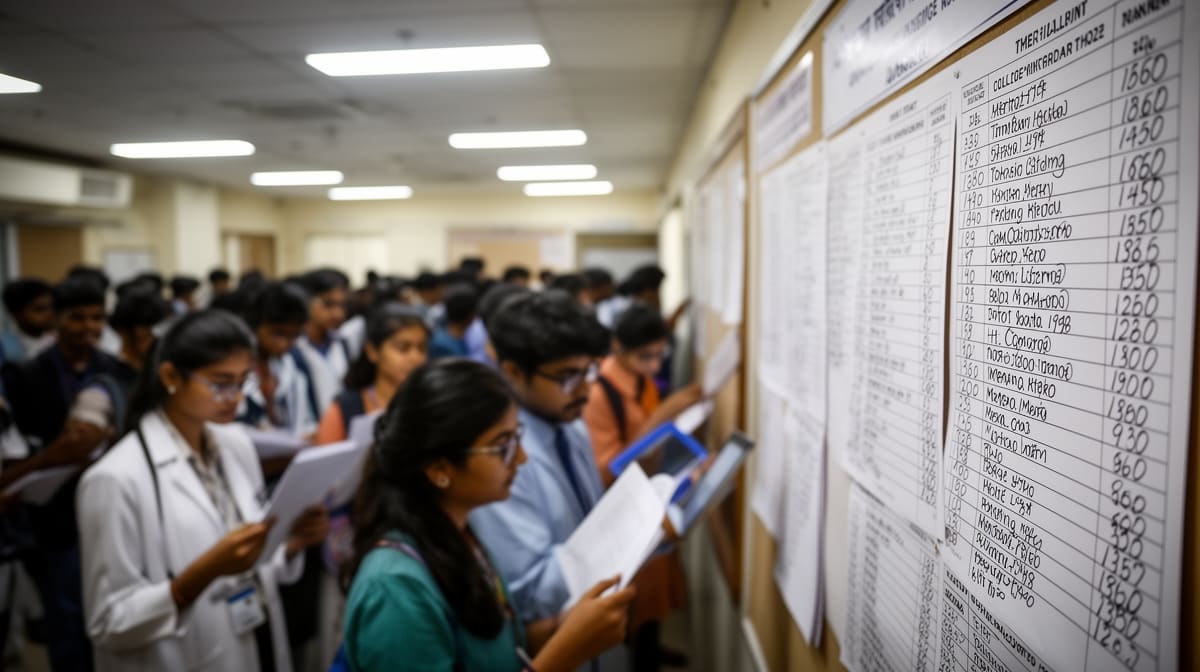
The Madhya Pradesh High Court has clarified that preferential treatment for candidates who completed their MBBS within the state cannot persist beyond the first round of PG admissions under the NRI quota. This ruling reinforces the constitutional mandate of merit-based allocation and curbs arbitrary classification in educational admissions.
Background & Facts
The Dispute
The petitioners, medical graduates who completed their MBBS from institutions outside Madhya Pradesh, challenged the allotment list issued on 16.02.2026 for PG admissions under the NRI quota. They contended that the list continued to prioritize candidates who had completed their MBBS in Madhya Pradesh, despite a prior court order directing that such preference be limited to the first round of counselling.
Procedural History
- 03.09.2025: State notified Condition No.5 in Schedule I of the Madhya Pradesh Chikitsa Shiksha Pravesh Niyam, 2018, restricting NRI quota eligibility to MBBS graduates from MP medical colleges.
- 13.02.2026: In WP No.3499/2026 and WP No.4078/2026, the Court issued an interim order permitting petitioners to participate in counselling, subject to merit, and directed respondents to clarify the scope of Condition No.5.
- 16.02.2026: The State published the impugned allotment list for the third round of counselling, continuing to allocate seats preferentially to MBBS graduates from MP institutions.
- 17.02.2026: Petitioners filed the present writ petition challenging the list as violative of prior court directions and constitutional guarantees.
Relief Sought
The petitioners seek quashing of the 16.02.2026 allotment list and a direction to re-allot seats strictly on the basis of inter-se merit, without any state-of-origin preference.
The Legal Issue
The central question was whether Condition No.5 of the 2018 Admission Rules, which grants preference to MBBS graduates from Madhya Pradesh medical colleges, can lawfully continue to operate in the second and third rounds of NRI quota counselling, or whether its application is constitutionally restricted to the first round only.
Arguments Presented
For the Petitioner
The petitioners relied on the Court’s earlier order dated 13.02.2026, which had implicitly recognized that Condition No.5 was a temporary measure to protect domicile candidates in the initial phase. They argued that continuing the preference in subsequent rounds violated Articles 14, 16, and 19(1)(g) by creating an arbitrary classification between otherwise equally qualified candidates. They cited P.A. Inamdar v. State of Maharashtra to assert that merit must be the sole criterion in postgraduate medical admissions.
For the Respondent/State
The State contended that Condition No.5 was never intended to be permanent and had been explicitly relaxed after the first round, as clarified in its reply to the earlier petition. It argued that in the third round, 53 seats were filled by MBBS graduates from MP institutions only because they were available and eligible, and the remaining 93 seats were opened to all candidates based on merit. The State maintained that the allotment list complied with both its own clarification and the Court’s prior directions.
The Court's Analysis
The Court examined the State’s own admission policy and its prior submissions in the earlier petition. It noted that the State had unequivocally stated in its reply that Condition No.5 applied only to the first round, and that subsequent rounds were open to all eligible candidates. The Court emphasized that constitutional equality under Article 14 prohibits persistent discrimination based on the location of prior education when no rational nexus exists with the objective of the quota.
"It is clear that Condition No.5 at Serial No.3 of Schedule I... is applicable only for the first round of counselling. For the second and third rounds of counselling, the said condition stands relaxed, and the seats are open for all eligible candidates."
The Court found that the impugned list, by continuing to prioritize state MBBS graduates even when higher-ranked candidates from outside the state were available, directly contradicted the State’s own admission policy and the Court’s prior direction. The Court rejected the argument that preference was justified due to "availability" of state candidates, noting that such reasoning, if accepted, would effectively nullify the relaxation of the condition. The Court held that once the condition is relaxed, merit alone must govern allocation.
The Verdict
The petitioners prevailed. The Court held that Condition No.5 cannot operate beyond the first round of counselling and that merit must be the sole criterion in subsequent rounds. The allotment list was found inconsistent with the State’s own clarification and the Court’s prior order. The Court issued notice to the State but stayed any final admission pending final disposal.
What This Means For Similar Cases
Merit Must Override Regional Preference in Subsequent Rounds
- Practitioners must challenge any admission list that continues state-of-origin preferences after the first round, even if such candidates are "available."
- Institutions cannot justify discrimination by claiming "availability" of preferred candidates - once a condition is relaxed, merit becomes the exclusive determinant.
Clarification in Official Replies Becomes Binding
- Official submissions made in court proceedings, even if not part of the original notification, form part of the binding policy framework.
- Any deviation from such clarifications can be challenged as arbitrary and violative of prima facie fairness under Article 14.
NRI Quota Admissions Are Not Exempt from Constitutional Scrutiny
- Educational institutions cannot invoke "quota" as a shield against constitutional equality.
- The P.A. Inamdar principle applies fully: merit must be the primary, and often sole, criterion in PG medical admissions, regardless of funding source or quota category.