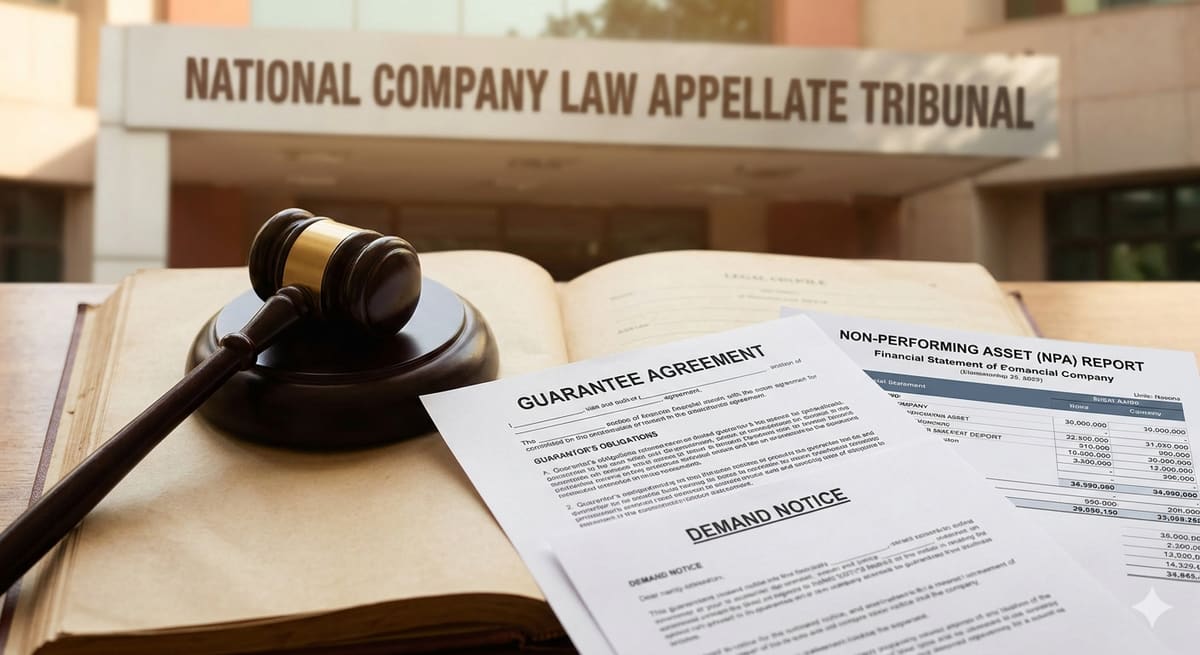
The National Company Law Appellate Tribunal has overturned a massive claim admission, declared the information memorandum materially defective and recognised the guarantor’s sub-rogation rights, thereby resetting the corporate insolvency resolution process for Gujarat Hydrocarbons and Power SEZ Ltd.
Background & Facts
The Dispute
The case consolidates three sets of appeals arising from the Corporate Insolvency Resolution Process (CIRP) of Gujarat Hydrocarbons and Power SEZ Limited (the "Corporate Debtor" or "GHPSL"). The sole asset of GHPSL is a leasehold SEZ parcel (the "Demised Premises") taken from Gujarat Industrial Development Corporation (GIDC), which also acts as lessor, operational creditor and statutory regulator. The dispute centres on (i) the quantum of the claim admitted for the sole financial creditor SREI Infrastructure Finance Ltd (SREI), (ii) the classification of Assam Company India Limited (ACIL) - the corporate guarantor - as an unsecured related-party creditor, (iii) the feasibility of a resolution plan that assumes de-notification of the SEZ land without GIDC’s consent, and (iv) GIDC’s locus to challenge the plan.
Key Facts
- 17.08.2007: GHPSL incorporated to develop, operate and maintain a sector-specific SEZ at Vilayat, Bharuch, Gujarat.
- 2011: GHPSL availed a credit facility of ₹100 crore from SREI; ACIL executed a corporate guarantee dated 05.01.2011.
- 14.11.2017: SREI filed a claim of ₹648.80 crore in the CIRP of ACIL.
- 28.11.2017: Interim Resolution Professional reduced the claim to ₹357.29 crore.
- 23.07.2018: NCLT, Guwahati reduced the claim further to ₹241.27 crore, holding penal interest cannot be capitalised.
- 01.02.2019: NCLAT affirmed the reduction (Company Appeal No. 291/2018).
- 20.09.2018: Resolution plan for ACIL approved; SREI paid ₹38.87 crore to SREI under the plan.
- 18.11.2020: Section 7 application filed by SREI against GHPSL; CIRP commenced.
- 18.11.2020: RP admitted SREI’s claim at ₹1,885.08 crore in GHPSL’s CIRP.
- 30.08.2021: Resolution plan of Zaveri & Co. Pvt. Ltd. approved by the Committee of Creditors (CoC).
- 13.09.2023: Adjudicating Authority dismissed IA-1764/2021 (suspended director) and IA-596/2022 (ACIL) and imposed costs of ₹50,000 on the suspended director.
- 19.09.2023: Same Authority approved the resolution plan.
- 13.12.2021: GIDC terminated the lease deed during the moratorium.
- 08.08.2024: NCLAT remanded GIDC’s objections; Supreme Court upheld on 20.08.2024.
- 19.02.2025: Composite order approving the plan and dismissing IA-136/2022 and IA-5224/2024 was issued.
- 31.08.2026: NCLAT delivered the present judgment, setting aside the composite order and related approvals.
Procedural History
- 12.06.2019: Original application filed before CAT (not directly relevant to the present appeals).
- 23.07.2018: NCLT, Guwahati reduced SREI’s claim in ACIL CIRP.
- 01.02.2019: NCLAT affirmed the reduction.
- 20.09.2018: ACIL resolution plan approved; ₹38.87 crore paid to SREI.
- 18.11.2020: Section 7 petition filed by SREI against GHPSL; RP admitted claim of ₹1,885.08 crore.
- 13.09.2023: IA-1764/2021 (suspended director) and IA-596/2022 (ACIL) dismissed; costs imposed.
- 19.09.2023: Resolution plan of Zaveri & Co. approved.
- 08.08.2024: NCLAT remanded GIDC’s objections; Supreme Court upheld on 20.08.2024.
- 19.02.2025: Composite order approving the plan and dismissing IA-136/2022 & IA-5224/2024.
- 31.08.2026: Present judgment delivered.
Parties' Positions
- Appellant (suspended director, Kanwar Raj Bhagat): Contended that the ₹1,885.08 crore claim is erroneous, that ACIL should be treated as a secured creditor to the extent of ₹38.87 crore, and that the information memorandum (IM) is vitiated.
- Appellant (ACIL/Assam Company India Ltd.): Relied on the Supreme Court’s BRS Ventures decision, asserting sub-rogation under Section 140, Indian Contract Act, and sought recognition as a secured creditor for ₹38.87 crore.
- Appellant (GIDC): Asserted locus to challenge the plan on grounds of illegal lease termination, lack of consent for change of land-use, and incomplete de-notification of the SEZ.
- Respondent (SREI): Maintained that the RP correctly verified the claim and that the plan’s commercial wisdom should not be interfered with.
- Respondent (Resolution Professional): Argued that verification of claims is a statutory duty independent of prior adjudications and that the plan complies with Section 30(2) of the IBC.
- Respondent (Successful Resolution Applicant - Zaveri & Co.): Stressed that the plan is viable, that the lease deed permits change of use with consent, and that the CoC’s commercial wisdom is non-justiciable.
Relief Sought
- Set aside the impugned orders dated 13.09.2023.
- Quash the admission of SREI’s claim of ₹1,885.08 crore.
- Recognise ACIL as a secured financial creditor for ₹38.87 crore.
- Declare the resolution plan void and order a fresh CIRP with a corrected IM.
- Set aside the cost of ₹50,000 imposed on the suspended director.
The Legal Issue
What is the correct quantum of the financial creditor’s claim when a prior adjudication has fixed a lower amount, does the resolution professional have a duty to reconcile the claim with that adjudication, can the guarantor be treated as a secured creditor under Section 140, Indian Contract Act, and does a statutory lessor have locus to challenge a resolution plan that presumes de-notification of SEZ land without its consent?
Arguments Presented
For the Appellant(s)
- The RP’s admission of ₹1,885.08 crore disregards the final adjudicated figure of ₹241.27 crore in the ACIL CIRP, violating the verification duty articulated in Swiss Ribbons v. Union of India and Axis Bank v. Samruddhi Realty.
- Under Section 140, Indian Contract Act, ACIL, having paid ₹38.87 crore on behalf of the guarantor, is sub-rogated to SREI’s rights to that extent, as affirmed in BRS Ventures Ltd. v. SREI (2024).
- GIDC’s lease deed (Clause 3.3(v)) requires its prior consent for any change of land-use; the resolution plan proceeds without such consent and without the Development Commissioner’s de-notification certificate, rendering the plan infeasible under Section 30(2)(e) of the IBC and Regulation 38 of the CIRP Regulations.
- The IM omitted material facts - the inflated claim, ACIL’s secured status, and the pending de-notification - violating the statutory requirement of a complete IM under Section 29, IBC.
For the Respondent(s)
- The RP is statutorily empowered to verify claims independently; reliance on a prior adjudication is not mandated, and the RP’s verification was in accordance with the IBC and its Regulations.
- The CoC’s commercial wisdom, once the plan is approved, is non-justiciable except on the limited grounds enumerated in Section 30(2) and Section 61(3); the plan’s viability is a commercial assessment, not a legal infirmity.
- The lease deed itself permits a change of use subject to consent; the plan assumes consent will be obtained, which is a permissible commercial risk.
- The Supreme Court’s BRS Ventures decision did not address the quantum of the claim; therefore, the claim remains as admitted.
The Court's Analysis
The Tribunal first examined the statutory framework governing claim verification. It reiterated that a resolution professional must “collate, verify and correctly determine the amount of a claim” (Swiss Ribbons paras 88-91) and that the adjudicating authority may “look behind” a claim where “the correctness is squarely put in issue by a judicially settled figure” (Axis Bank paras 49-50). The RP’s mechanical admission of ₹1,885.08 crore therefore breached its fiduciary duty because the same debt had been judicially reduced to ₹241.27 crore in the ACIL CIRP, a figure affirmed by the NCLT and NCLAT.
"We find that the Information Memorandum was fundamentally incorrect as SREI's claim of about ₹1,885 crores was admitted despite earlier judicial determination reducing the recoverable debt."
The Court then turned to the doctrine of sub-rogation. It held that the Supreme Court’s BRS Ventures ratio confirms that payment by the guarantor gives rise to sub-rogation only to the extent of the amount actually recovered. Consequently, ACIL is a secured creditor for ₹38.87 crore, ranking pari-passu with other secured creditors.
Regarding GIDC’s locus, the Tribunal noted that the appellant is a statutory body and the lease deed expressly conditions any change of use on its prior consent. The plan’s reliance on an unverified de-notification, without the Development Commissioner’s certificate, contravenes Section 30(2)(e) and Regulation 38, which demand a “closer examination of feasibility” where statutory approvals are required (Greater Noida v. Prabhjit Singh Soni). The Court therefore rejected the argument that the CoC’s commercial wisdom shields the plan from scrutiny.
The Tribunal also addressed procedural deficiencies. The composite order of 19.02.2025 dismissed GIDC’s objections by a mere reference to paragraph 10.2, without discrete findings, violating the requirement of reasoned decisions under Section 61(3). The lack of disclosure in the IM about the de-notification process further vitiated the CIRP, as the IM must contain “all material litigation and ongoing investigations” (Section 29, IBC).
In sum, the Tribunal concluded that (i) the inflated claim must be set aside, (ii) ACIL’s secured status recognised, (iii) the resolution plan is infeasible and must be vacated, and (iv) a fresh CIRP must commence with a corrected IM.
The Verdict
The NCLAT allowed the appeals in part:
- Set aside the order dated 13.09.2023 and the admission of SREI’s claim of ₹1,885.05 crore.
- Direct SREI’s recoverable claim to be ₹241.27 crore, reduced by the ₹38.87 crore already recovered in the ACIL CIRP.
- Declare Assam Company India Ltd. (ACIL) a secured financial creditor for ₹38.87 crore, ranking pari-passu with other secured creditors.
- Set aside the resolution plan of Zaveri & Co. Pvt. Ltd.; the plan shall not be implemented.
- Order a fresh invitation of Expression of Interest and preparation of a corrected Information Memorandum reflecting the true claim, the secured status of ACIL, and the pending de-notification of the SEZ land.
- Set aside the cost of ₹50,000 imposed on the suspended director.
- Exclude the period from 18.11.2020 (admission of GHPSL into CIRP) to the date of this judgment from the limitation period under Section 12, IBC.
- Direct the Adjudicating Authority to appoint a new Resolution Professional within two weeks and to maintain status-quo on title, possession and use of the Demised Premises until further orders.
What This Means For Similar Cases
Claim Verification Must Align With Prior Judicial Determinations
- Resolution professionals must reconcile newly admitted claims with any final adjudications in related insolvency proceedings.
- Failure to do so invites judicial review and possible setting aside of the claim.
- Practitioners should obtain certified copies of prior orders and ensure the RP’s verification reflects those figures.
Information Memorandum Must Be Complete and Accurate
- The IM must disclose all material facts, including pending regulatory approvals and the exact status of assets.
- Omission of such facts can render the entire CIRP void, as the plan would be based on a “conditionally inaccurate” foundation.
- Counsel should audit the IM against statutory check-lists under Section 29, IBC and the CIRP Regulations before submission.
Statutory Lessor/Regulator Has Locus to Challenge Feasibility
- When a resolution plan depends on land owned by a statutory body, the body can challenge the plan on grounds of lack of consent and incomplete de-notification.
- Courts will scrutinise feasibility under Section 30(2)(e) and may set aside plans that presume statutory approvals.
- Practitioners must obtain explicit consent or certify the status of such approvals before drafting the plan.