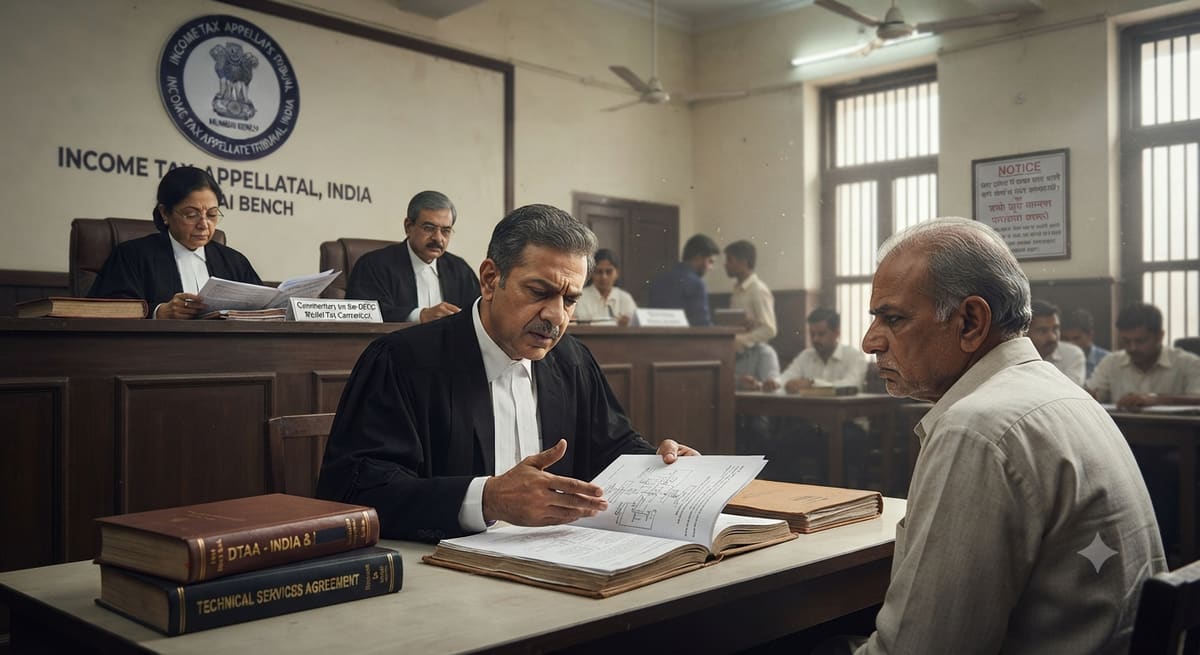
The Income Tax Appellate Tribunal (ITAT), Mumbai, has delivered a significant ruling on the taxability of fees received by a Singapore-based entity for management support services provided to its Indian subsidiary. The Tribunal held that such fees do not qualify as Fees for Technical Services (FTS) under Article 12(4)(b) of the India-Singapore Double Taxation Avoidance Agreement (DTAA) unless the 'make available' condition is satisfied. This decision reaffirms the consistent stance taken by the ITAT in prior assessment years, providing clarity on the interpretation of FTS under tax treaties.
Background & Facts
The Dispute
The appellant, Tech Data (Singapore) Pte. Limited, a non-resident corporate entity incorporated in Singapore, entered into a service agreement with its Indian subsidiary, Tech Data Advanced Private Limited (formerly known as Tech Data Advanced Solutions (India) Private Limited). The agreement involved providing management and business support services, including strategic business advisory, IT services, finance, logistics, branding, tax, treasury, legal, ethics and compliance, human resources, trade compliance, and corporate services. The assessee treated the fees received for these services as business receipts and, in the absence of a Permanent Establishment (PE) in India, did not offer them to tax.
Key Facts
- The assessee is a tax resident of Singapore and does not have a PE in India.
- The service agreement between the assessee and its Indian subsidiary has been in place since prior assessment years.
- The assessee received Rs. 42,16,596 for the assessment year 2022-23 for the services rendered.
- The services were categorized into 12 distinct areas, none of which involved the transfer of technical knowledge, know-how, or skill.
- The compensation structure was cost plus markup at 7.5% as per the agreement.
Procedural History
- 16.01.2025: The Assessing Officer (AO) framed a draft assessment order, treating the receipt as FTS under Section 9(1)(vii) of the Income Tax Act, 1961 and Article 12(4) of the India-Singapore DTAA. The AO contended that the services fell under managerial, technical, or consultancy services, and the 'make available' condition was not applicable to managerial and consultancy services.
- The assessee filed objections before the Dispute Resolution Panel (DRP).
- DRP Order: The DRP endorsed the AO's view, despite acknowledging that the ITAT had decided the issue in favour of the assessee in prior years. The DRP aimed to keep the issue alive for potential departmental appeals.
- 16.01.2025: The final assessment order was passed in pursuance of the DRP's directions.
- 18.06.2026: The appeal was heard by the ITAT, Mumbai.
- 30.06.2026: The ITAT pronounced its order, allowing the appeal.
Relief Sought
The assessee sought a declaration that the receipt of Rs. 42,16,596 was not taxable as FTS under the India-Singapore DTAA and Section 9(1)(vii) of the Act. The assessee relied on the consistent rulings of the ITAT in prior assessment years, where identical issues were decided in its favour.
The Legal Issue
The central question before the ITAT was whether the fees received by the assessee for providing management and business support services to its Indian subsidiary qualified as FTS under:
- Section 9(1)(vii) of the Income Tax Act, 1961, and
- Article 12(4)(b) of the India-Singapore DTAA.
Specifically, the Tribunal had to determine whether the 'make available' condition under Article 12(4)(b) of the DTAA was satisfied, thereby rendering the fees taxable as FTS.
Arguments Presented
For the Appellant
- The assessee contended that the services rendered were support services and did not involve the transfer of technical knowledge, know-how, skill, experience, or processes to the Indian subsidiary.
- It was argued that the 'make available' condition under Article 12(4)(b) of the DTAA was not satisfied, as the services did not enable the Indian subsidiary to independently apply the technology or knowledge without further assistance from the assessee.
- The assessee relied on the consistent rulings of the ITAT in prior assessment years (2019-20, 2020-21, 2021-22, and 2023-24), where identical issues were decided in its favour.
- It was submitted that the AO and DRP erred in treating the receipt as FTS without examining whether the services satisfied the 'make available' condition.
For the Respondent
- The Departmental Representative (DR) argued that the services provided by the assessee fell under the ambit of managerial, technical, or consultancy services, thereby qualifying as FTS under Article 12(4) of the DTAA.
- It was contended that the 'make available' condition was not applicable to managerial and consultancy services, as these did not involve the transfer of technology or know-how.
- The DRP, while acknowledging the ITAT's favourable rulings in prior years, sought to keep the issue alive for potential departmental appeals by endorsing the AO's view.
The Court's Analysis
The ITAT meticulously analysed the legal framework governing FTS under the Income Tax Act, 1961 and the India-Singapore DTAA. The Tribunal's reasoning can be summarized as follows:
-
Definition of FTS under DTAA: The Tribunal noted that Article 12(4) of the India-Singapore DTAA defines FTS as payments for services of a managerial, technical, or consultancy nature that satisfy any of the following conditions:
- The services are ancillary and subsidiary to the application or enjoyment of a right, property, or information (Article 12(4)(a)).
- The services 'make available' technical knowledge, experience, skill, know-how, or processes (Article 12(4)(b)).
- The services consist of the development and transfer of a technical plan or design (Article 12(4)(c)).
The Tribunal emphasized that Article 12(4)(b) is the critical provision in this case, as it requires the 'make available' condition to be satisfied for the fees to qualify as FTS.
-
Examination of the Service Agreement: The Tribunal perused the service agreement and Schedule-A, which listed the 12 categories of services provided by the assessee. The Tribunal observed that:
- The services were operational and support-oriented, such as strategic business advisory, finance, logistics, branding, tax, treasury, legal, and human resources.
- There was no transfer of technical knowledge, know-how, skill, or processes that would enable the Indian subsidiary to independently apply the technology or knowledge without further assistance from the assessee.
- The compensation structure (cost plus 7.5% markup) did not indicate any transfer of technology or know-how.
-
AO and DRP's Flawed Approach: The Tribunal criticized the AO and DRP for:
- Segregating the services into technical, managerial, and consultancy categories without examining whether they satisfied the 'make available' condition under Article 12(4)(b).
- Ignoring the consistent rulings of the ITAT in prior assessment years, where identical issues were decided in favour of the assessee.
- Failing to appreciate that the 'make available' condition is a prerequisite for treating fees as FTS under the DTAA, even if the services fall under managerial or consultancy categories.
-
Precedential Value of Prior ITAT Orders: The Tribunal placed significant reliance on its prior orders in the assessee's case for A.Ys. 2019-20, 2020-21, 2021-22, and 2023-24. In these orders, the ITAT had consistently held that:
- The services rendered by the assessee did not satisfy the 'make available' condition under Article 12(4)(b) of the DTAA.
- The fees received were not taxable as FTS under the DTAA, even if they might fall under the broader definition of FTS under Section 9(1)(vii) of the Act.
- The assessee was protected by Section 90(2) of the Act, which provides that the provisions of the DTAA shall apply to the extent they are more beneficial to the assessee.
-
Distinction Between Act and DTAA: The Tribunal reiterated that while Section 9(1)(vii) of the Act provides a broader definition of FTS, the assessee is entitled to the more beneficial provisions of the DTAA under Section 90(2) of the Act. Since the DTAA requires the 'make available' condition to be satisfied, the fees could not be taxed as FTS in the absence of such satisfaction.
"A perusal of the service agreement along with Annexure-A, that gives an exhaustive list of services to be rendered would show that none of the conditions mentioned in sub-clause (a)(b) and (c) of Clause -4 to Article -12 of India - Singapore DTAA are satisfied. There is no make available of technical knowhow nor there is any service rendered consisting of the development and transfer of a technical plan or technical design. The prerequisite for invoking Clause-4 of Article-12 of the DTAA is that either there should be transfer of some technical knowhow i.e. make available condition is satisfied or there should be development and transfer of technical plan or technical design. The services rendered by the assessee as per Schedule-A of the Service Agreement does not in any manner show that any technical knowhow has been made available or there is development and transfer of technical plan or technical design. The services rendered are in the nature of operational management and providing support system."
The Verdict
The ITAT allowed the appeal and held that the amount of Rs. 42,16,596 received by the assessee for providing management and business support services to its Indian subsidiary does not qualify as FTS under Article 12(4)(b) of the India-Singapore DTAA. The Tribunal directed the AO to delete the addition made in the assessment order. The decision was based on the following key holdings:
- The 'make available' condition under Article 12(4)(b) of the DTAA was not satisfied, as the services did not involve the transfer of technical knowledge, know-how, skill, or processes.
- The assessee was protected by Section 90(2) of the Act, which mandates the application of the more beneficial provisions of the DTAA.
- The AO and DRP erred in treating the receipt as FTS without examining whether the services satisfied the 'make available' condition.
- The Tribunal respectfully followed its consistent view expressed in prior assessment years (2019-20, 2020-21, 2021-22, and 2023-24) in the assessee's case.
Ground Nos. 2 and 3, being general and consequential, were not adjudicated upon. The additional ground, having become academic, was kept open.
What This Means For Similar Cases
The 'Make Available' Condition Is Non-Negotiable
This ruling reinforces the principle that for fees to qualify as FTS under the India-Singapore DTAA, the 'make available' condition under Article 12(4)(b) must be strictly satisfied. Practitioners should note:
- Managerial or consultancy services do not automatically qualify as FTS unless they involve the transfer of technical knowledge, know-how, skill, or processes.
- The burden of proof lies on the tax authorities to demonstrate that the services rendered satisfy the 'make available' condition.
- Operational and support services, such as those provided in this case, are unlikely to meet the threshold for FTS unless they enable the service recipient to independently apply the technology or knowledge.
Precedential Consistency Matters
The ITAT's reliance on its prior orders in the assessee's case underscores the importance of consistency in judicial precedents. Taxpayers and practitioners can leverage this ruling to:
- Argue for consistency in cases involving recurring issues, especially where the facts and legal provisions remain unchanged.
- Challenge assessments that disregard prior favourable rulings without justifiable grounds.
- Strengthen their position in disputes involving the interpretation of tax treaties, particularly where the 'make available' condition is in question.
Section 90(2) of the Act Provides a Safety Net
This case highlights the protective role of Section 90(2) of the Act, which ensures that taxpayers are governed by the more beneficial provisions of the DTAA. Key takeaways include:
- Taxpayers can rely on DTAA provisions even if the domestic law (e.g., Section 9(1)(vii) of the Act) provides a broader definition of FTS.
- Assessing Officers cannot ignore DTAA provisions merely because the domestic law is more stringent.
- Practitioners should always examine DTAA provisions in cross-border transactions to identify potential tax benefits.