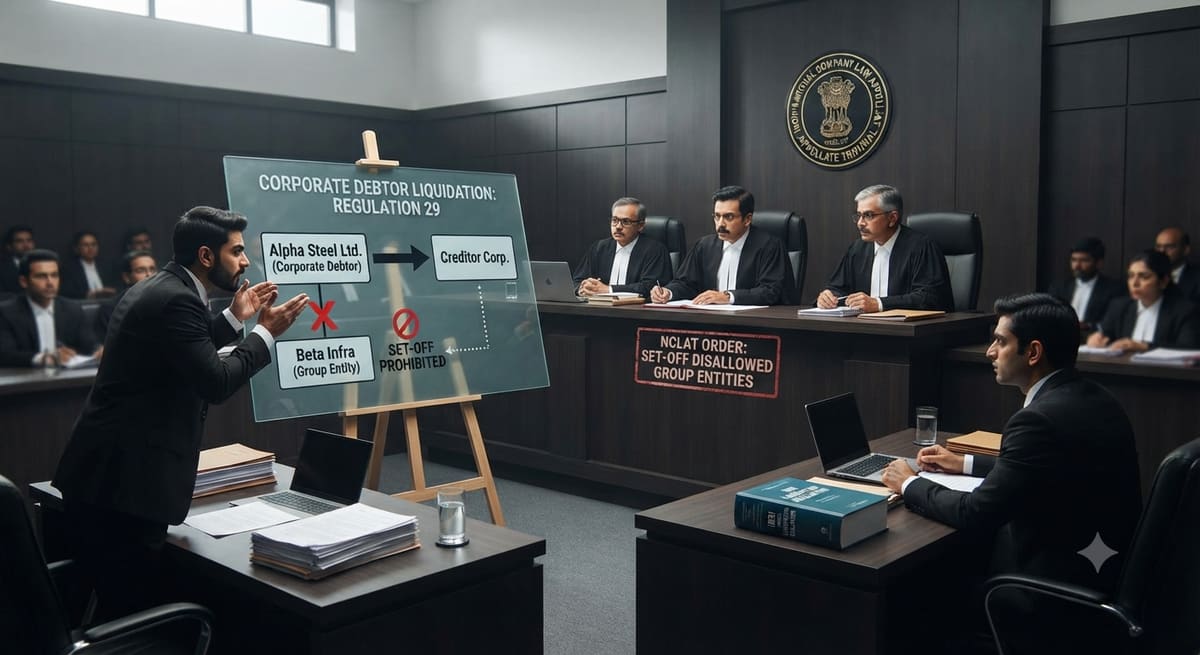
The Supreme Court has clarified a critical boundary under the Insolvency and Bankruptcy Code: while claims not included in an approved resolution plan are extinguished, the right to assert a set-off as a defensive plea in pending arbitration is preserved. This nuanced holding balances the clean slate principle with equitable procedural fairness.
Background & Facts
The Dispute
The dispute arose from a contract for the manufacture, procurement, and installation of grid-connected rooftop solar PV power plants across West Bengal. The respondent, West Bengal Power Development Corporation Ltd., a public sector undertaking, floated an e-tender on 15.02.2017. The appellant, Ujaas Energy Ltd., an MSME, won the bid and received a Letter of Award dated 12.05.2017.
Key Facts
- The contract performance became contentious, leading to arbitration proceedings initiated by the appellant’s Resolution Professional on 31.12.2021.
- The appellant was admitted into Corporate Insolvency Resolution Process (CIRP) under the Insolvency and Bankruptcy Code, 2016, on 17.09.2020.
- The appellant filed its Statement of Claim on 17.01.2023.
- The respondent filed its Statement of Defence and Counterclaim on 18.04.2023 and 12.05.2023 respectively.
- The counterclaim was never submitted to the Resolution Professional during the CIRP.
- The National Company Law Tribunal, Indore, approved the resolution plan on 13.10.2023.
- Paragraph 12.4.1 of the resolution plan explicitly extinguished all claims not included therein, including counterclaims in pending arbitration.
- The Arbitral Tribunal rejected the appellant’s objection to jurisdiction under Section 14 of the IBC on 22.12.2023.
- On 10.01.2024, the appellant applied under Section 31(6) of the Arbitration and Conciliation Act, 1996, seeking dismissal of the counterclaim.
- The Tribunal granted the application on 30.04.2024, issuing an interim award rejecting the counterclaim.
Procedural History
- 15.02.2017: E-tender floated by respondent.
- 12.05.2017: Letter of Award issued to appellant.
- 17.09.2020: Appellant admitted into CIRP under IBC.
- 31.12.2021: Arbitration invoked by Resolution Professional.
- 17.01.2023: Statement of Claim filed by appellant.
- 18.04.2023: Statement of Defence filed by respondent.
- 12.05.2023: Counterclaim filed by respondent.
- 22.12.2023: Tribunal rejects appellant’s jurisdictional objection under Section 14 IBC.
- 13.10.2023: NCLT approves resolution plan.
- 10.01.2024: Appellant files Section 31(6) application to dismiss counterclaim.
- 30.04.2024: Tribunal issues interim award dismissing counterclaim.
- 21.08.2024: Single Judge of Calcutta High Court dismisses Section 34 challenge to interim award.
- 02.09.2024: Division Bench of Calcutta High Court sets aside Single Judge’s order, directs Tribunal to continue proceedings.
- 20.03.2026: Supreme Court delivers judgment.
Relief Sought
The appellant sought dismissal of the respondent’s counterclaim on grounds of extinguishment under Section 31(1) IBC. The respondent sought to maintain its counterclaim as an independent claim, and alternatively, to assert a set-off defence against the appellant’s claim.
The Legal Issue
The central question was whether a claim extinguished under Section 31(1) of the Insolvency and Bankruptcy Code due to non-inclusion in the approved resolution plan may still be raised as a set-off defence in pending arbitration proceedings.
Arguments Presented
For the Appellant
The appellant, through senior counsel Abhijit Sinha, argued that Section 31(1) of the IBC creates a clean slate upon approval of the resolution plan. All claims not expressly included in the plan are extinguished, including counterclaims not filed with the Resolution Professional. The respondent’s failure to submit its claim during CIRP barred any subsequent assertion, even as a defence. The Tribunal and Single Judge correctly applied this principle. Allowing a counterclaim, even as a defence, would undermine the finality and predictability of the resolution process.
For the Respondent
Senior counsel Jishnu Choudhury initially defended the Division Bench’s reasoning but later shifted ground. He conceded that the respondent could not pursue its counterclaim affirmatively. However, he urged that the respondent be permitted to raise a plea of set-off as a defence to offset any award in favour of the appellant. He emphasized that the resolution plan’s language barred only affirmative claims for payment or settlement, not defensive use of set-off. He cited the equitable need to prevent unjust enrichment of the appellant despite its contractual defaults.
The Court's Analysis
The Court reaffirmed the binding nature of Section 31(1) of the IBC, citing Ghanashyam Mishra & Sons (P) Ltd. v. Edelweiss Asset Reconstruction Co. Ltd. to hold that claims not included in the resolution plan stand extinguished. The respondent’s counterclaim, not submitted to the Resolution Professional, could not be pursued as an independent claim.
However, the Court turned to the precise wording of Paragraph 12.4.1 of the resolution plan, which states:
"Other than the payments/settlements under this Resolution Plan, no other payments or settlements (of any kind) will have to be made to any other Person in respect of the claims of any Person or Governmental Authority against the Company... all such claims against the Company including counter claims under any pending arbitration proceedings... shall stand irrevocably and unconditionally abated, discharged, settled and extinguished in perpetuity."
The Court observed that this clause targets affirmative claims for payment or settlement, not defensive assertions. The term "set-off" is not mentioned, nor is its use as a defence impliedly prohibited. The Court applied the maxim expressio unius est exclusio alterius - the express mention of one thing implies exclusion of others. Since the plan does not expressly bar set-off as a defence, it cannot be inferred.
The Court further noted that the respondent had raised the counterclaim before the Tribunal prior to approval of the resolution plan, and the Resolution Professional was aware of it. The failure to include it in the plan was not due to lack of notice but likely strategic omission. To deny even a defensive set-off would result in the appellant benefiting from its own default without accounting for the respondent’s legitimate dues.
The Court distinguished Bharti Airtel Ltd. v. Aircel Ltd. as dealing with set-off during CIRP, whereas this case concerns set-off post-approval under the specific terms of the resolution plan.
The Verdict
The appeal was partly allowed. The Supreme Court held that while the respondent cannot pursue its counterclaim as an independent claim, it may raise the plea of set-off as a defence in the pending arbitration. The respondent shall not receive any affirmative relief or surplus payment. If the amount due to the respondent exceeds the appellant’s claim, the excess shall not be recoverable. If the appellant’s claim remains after set-off, it shall be payable. If the appellant withdraws its arbitration claim, the set-off defence shall also lapse. Parties shall bear their own costs.
What This Means For Similar Cases
Set-off Is Not Automatically Barred by Resolution Plan
- Practitioners may now argue that a creditor’s failure to file a claim during CIRP does not preclude raising set-off as a defence in arbitration or litigation post-approval.
- The key is whether the resolution plan expressly prohibits defensive use - silence on set-off favours its allowance.
Resolution Plan Language Is Decisive
- Drafters of resolution plans must now explicitly bar set-off if intended, using clear language such as "no defence, set-off, or counterclaim shall be permitted."
- Ambiguous clauses like "all claims extinguished" will be narrowly construed to exclude defensive mechanisms.
Strategic Timing of Claims Matters
- Creditors must still file claims during CIRP to preserve affirmative rights.
- However, if a counterclaim is raised before plan approval, even if not filed with the Resolution Professional, it may still serve as a defensive tool - creating a tactical incentive to initiate proceedings early.