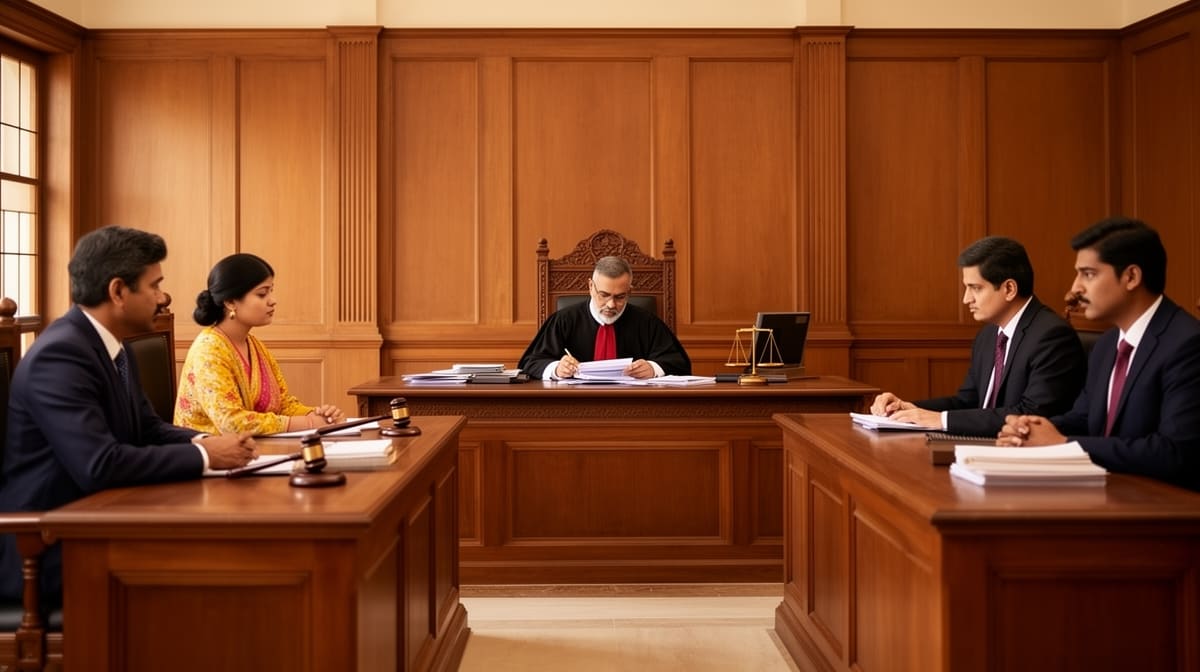
The Supreme Court has affirmed that sustained marital discord, coupled with documented conduct amounting to cruelty and desertion, justifies the grant of divorce under the Hindu Marriage Act, 1955. While upholding the lower courts’ factual findings, the Court also recognized the need for ongoing financial support to the wife, modifying the maintenance award to ensure substantive justice.
Background & Facts
The Dispute
The appellant, Mamta Devi, and the respondent, Sanjay Kumar, were married on 24.02.2002 in Bokaro, Jharkhand, in accordance with Hindu rites and customs. Two children were born from the marriage: a son in 2003 and a daughter in 2005. The couple initially resided with the respondent’s parents in a joint family setup. Disputes emerged over time, particularly concerning dowry demands and domestic conduct. By approximately 2007, the parties began living separately from the joint family, though they continued to reside together in a separate household.
Key Facts
- The appellant alleged sustained cruelty, including harassment over dowry, forced psychiatric evaluation to discredit her mental health, and eventual expulsion from the matrimonial home.
- The respondent countered that the appellant persistently demanded separate residence, used abusive language toward his parents, engaged in conflicts with landlords, and exhibited hostile conduct toward the children.
- A complaint dated 03.02.2017 was filed by the respondent’s mother alleging torture and harassment by the appellant. In response, the appellant submitted an undertaking promising to maintain cordial relations with her husband and in-laws and to avoid future complaints.
- The District Welfare Committee, upon investigation, recommended that the children reside with their paternal grandfather.
- The appellant made no application for restitution of conjugal rights nor sought custody of the children despite living separately.
- The appellant stated in court proceedings that she did not wish the children to live with her.
Procedural History
- 24.02.2002: Marriage solemnized in Bokaro, Jharkhand.
- 2003, 2005: Birth of son and daughter respectively.
- 2007: Parties began living separately from joint family.
- 03.02.2017: Complaint filed by mother-in-law; appellant submitted undertaking.
- 2018: Parties began living in complete separation.
- 2018: Respondent filed O.S. (DP) 486/2018 seeking divorce under Sections 13(1)(ia) and 13(1)(ib) of the Hindu Marriage Act, 1955.
- 23.11.2022: Family Court, Bokaro, granted divorce decree to respondent, finding cruelty and desertion.
- 04.10.2023: High Court of Jharkhand dismissed appellant’s First Appeal No. 9/2023, affirming the Family Court’s decree.
- 10.04.2026: Supreme Court heard appeal and delivered judgment.
Relief Sought
The appellant sought reversal of the divorce decree, restoration of marital status, and custody of the children. The respondent sought confirmation of the divorce and no further relief beyond the decree.
The Legal Issue
The central question was whether the findings of cruelty and desertion under Sections 13(1)(ia) and 13(1)(ib) of the Hindu Marriage Act, 1955, were supported by sufficient evidence and whether the Supreme Court could interfere with such factual determinations made by the courts below.
Arguments Presented
For the Appellant
The appellant’s counsel argued that the allegations of cruelty were exaggerated and retaliatory, and that the undertaking given in 2017 demonstrated an intent to reconcile. It was contended that the High Court erred in relying on the child’s testimony and the appellant’s statement about not wanting custody, without considering her emotional distress. It was further submitted that the prolonged separation was due to the respondent’s actions, not her desertion.
For the Respondent
The respondent’s counsel submitted that the appellant’s conduct - verbal abuse, hostility toward in-laws, refusal to cohabit, and withdrawal from parental responsibilities - constituted mental cruelty. The undertaking, they argued, was not a reconciliation but a tactical concession. The testimony of the child and the welfare committee’s recommendation corroborated the breakdown of the marital bond. The respondent emphasized that the appellant had not sought restitution or custody, indicating abandonment.
The Court's Analysis
The Supreme Court emphasized that its jurisdiction in matrimonial appeals under Article 136 is not to re-appreciate evidence but to examine whether the findings of the courts below are perverse or unsupported. The Court noted that both the Family Court and the High Court had meticulously evaluated oral testimony, documentary evidence, and the conduct of both parties over nearly two decades.
"The findings recorded by Courts below are findings of fact based on appreciation of evidence. No perversity has been demonstrated so as to warrant the interference of this Court."
The Court highlighted the appellant’s undertaking dated 03.02.2017 as a significant admission of her conduct, which she did not dispute. The testimony of the son, who expressed unwillingness to live with his mother, and the welfare committee’s directive placing the children with the paternal grandfather, were deemed credible and consistent with the overall narrative of estrangement.
The Court further observed that the parties had been living separately since 2018, a period exceeding seven years, which, under established jurisprudence, strongly indicates irretrievable breakdown of marriage. The absence of any effort by the appellant to restore conjugal rights or seek custody reinforced the conclusion of desertion.
The Court declined to disturb the divorce decree, affirming that the lower courts’ factual findings were well-reasoned and within the bounds of permissible judicial discretion.
The Verdict
The appeal was dismissed in part. The Supreme Court upheld the divorce decree granted by the Family Court and affirmed by the High Court. However, modifying the maintenance award, the Court directed the respondent to pay the appellant a monthly maintenance of Rs.10,000/-, payable from the date of this order. The Family Court’s earlier lump sum of Rs.6,00,000/- was not set aside but deemed insufficient for long-term support. No other relief was granted.
What This Means For Similar Cases
Fact-Finding Courts Are Entitled to Deference
- Practitioners must recognize that appellate courts, including the Supreme Court, will not re-evaluate evidence unless findings are perverse or based on no evidence.
- In matrimonial disputes, sustained conduct over years - documented through undertakings, witness testimony, and welfare reports - carries greater weight than isolated allegations.
- A party’s failure to seek restitution or custody during prolonged separation strengthens a claim of desertion.
Maintenance Must Reflect Long-Term Need
- Lump sum maintenance may be inadequate where the spouse lacks independent income or earning capacity.
- Courts may enhance maintenance to monthly installments to ensure sustained financial security, even after granting divorce.
- The quantum of maintenance must be assessed in light of the duration of marriage, standard of living, and post-divorce economic vulnerability.
Children’s Wishes Carry Weight in Custody Decisions
- The expressed wishes of a child, particularly a teenager, are a relevant factor in custody determinations under the welfare principle.
- Courts may rely on welfare committee recommendations when parental conduct undermines the child’s emotional well-being.
- A parent’s statement that they do not want custody, if credible and unchallenged, can be decisive in custody proceedings.