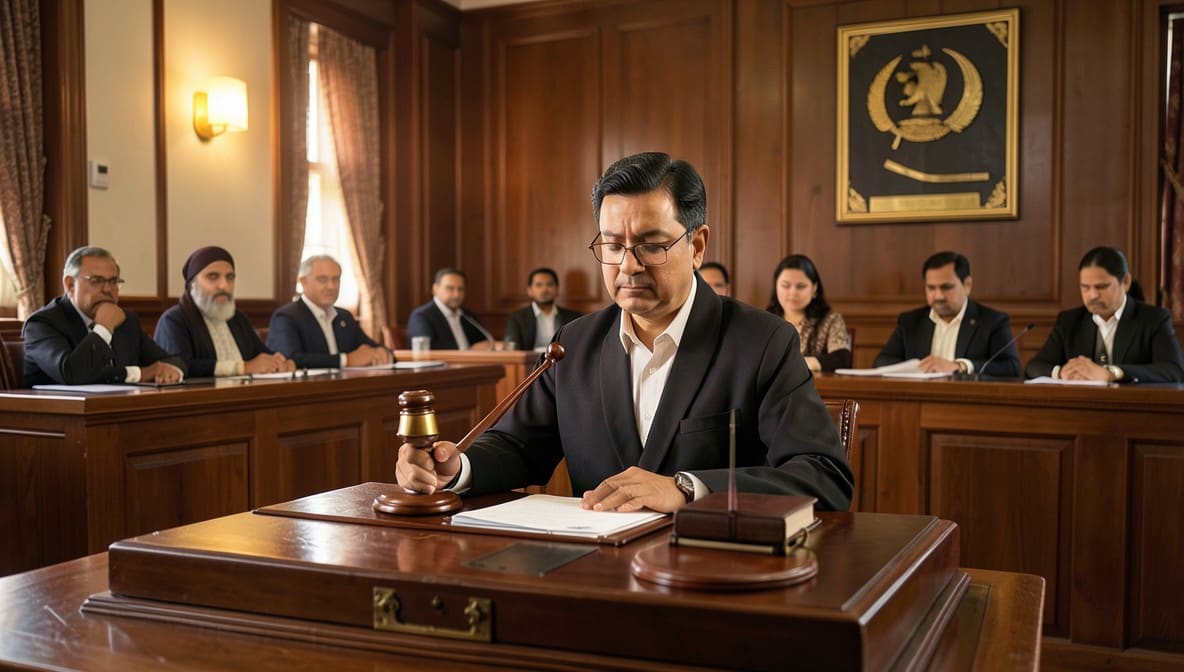
The Allahabad High Court has reinforced the principle that undue delay in deciding bail applications, particularly when a accused appears before the trial court, violates the right to personal liberty under Article 21. In a significant order, the Court directed that any bail application filed within 30 days of appearance must be decided expeditiously, in light of binding precedents from the Supreme Court and this Court.
Background & Facts
The Dispute
The present application under Section 482 of the Code of Criminal Procedure, 1973, was filed by four applicants seeking quashing of a non-bailable warrant (NBW) dated 19.08.2024 and the summoning order dated 17.02.2020, both issued in connection with Crime No. 0084 of 2019 under Sections 452, 325, 323, 504, 506 and 427 IPC at Police Station Bhiti, District Ambedkar Nagar. The applicants, who had not appeared before the trial court despite issuance of summons and NBW, now seek to regularize their position by appearing and filing a bail application.
Key Facts
- Crime No. 0084 of 2019 was registered on an alleged incident of assault and criminal intimidation
- Summoning order dated 17.02.2020 was issued by the Civil Judge (Junior Division)/A.C.J.M., Ambedkar Nagar
- Non-bailable warrant dated 19.08.2024 was issued after non-appearance of applicants
- Applicants were not arrested prior to filing of this application
- No record of prior appearance or representation before the trial court was submitted
Procedural History
- 17.02.2020: Summoning order issued by the trial court
- 19.08.2024: Non-bailable warrant issued due to non-appearance
- 25.06.2026: Application under Section 482 CrPC filed before the Allahabad High Court (Lucknow Bench)
The Parties' Positions
For the Applicants
The applicants, through counsel, submitted that they are willing to appear before the trial court and seek bail. They argued that the NBW should not operate as a bar to their right to apply for bail, and that the trial court must decide any such application expeditiously, in accordance with the Supreme Court’s directions in Satender Kumar Antil v. Central Bureau of Investigation and the Allahabad High Court’s decision in Smt. Bacchi Devi v. State of U.P.
For the Respondent
The Additional Government Advocate opposed the prayer, arguing that the applicants had deliberately avoided appearance and that the NBW was lawfully issued. No specific objection was raised to the request for expeditious disposal of bail, but the state did not consent to any modification of the warrant’s operation.
Relief Sought
The applicants sought quashing of the summoning order and NBW, or alternatively, direction to the trial court to decide any bail application filed within a reasonable time frame. They also requested suspension of the NBW’s operation pending disposal of their bail plea.
The Legal Issue
The central question was whether the High Court, under Section 482 CrPC, can direct the trial court to decide a bail application expeditiously upon the accused’s voluntary appearance, even if a non-bailable warrant has been issued, and whether such direction is consistent with the principles laid down in Satender Kumar Antil and Smt. Bacchi Devi.
Arguments Presented
For the Appellant/Petitioner
Learned counsel relied on Satender Kumar Antil v. Central Bureau of Investigation (2022) 10 SCC 1, where the Supreme Court held that courts must avoid mechanical issuance of arrest or NBW and must prioritize bail as the norm. The Court emphasized that bail applications must be decided within a reasonable time, and undue delay violates Article 21. Counsel also cited Smt. Bacchi Devi v. State of U.P. (decided 12.08.2025), wherein this Court held that when an accused voluntarily appears, the trial court must treat the bail application with urgency and not allow procedural delays to frustrate the right to liberty. The applicants argued that their willingness to appear negates any risk of flight and that the NBW should not be a permanent bar to bail.
For the Respondent/State
The Additional Government Advocate did not dispute the legal principles cited but contended that the applicants had neglected their obligations under the criminal process for over four years. The state argued that the NBW was a legitimate consequence of non-appearance and that the Court should not interfere unless the trial court had acted arbitrarily. However, no substantive objection was raised to the request for expeditious disposal of bail upon appearance.
The Court's Analysis
The Court examined the nature of the NBW and its purpose under Section 70 CrPC. It noted that while an NBW is a coercive measure to ensure appearance, it is not a substitute for adjudication on bail. The Court emphasized that the right to apply for bail is a statutory and constitutional right that cannot be extinguished merely because an NBW has been issued.
"The issuance of a non-bailable warrant does not extinguish the right of the accused to apply for bail. When the accused voluntarily appears before the trial court, the court is duty-bound to decide the bail application expeditiously, in accordance with the law laid down by the Supreme Court and this Court."
The Court held that the principles in Satender Kumar Antil are not confined to cases of arbitrary arrest but extend to situations where an accused seeks to regularize their position after prolonged non-appearance. The Court also relied on Smt. Bacchi Devi, which clarified that delay in deciding bail applications, even in non-bailable offences, amounts to a violation of personal liberty.
The Court rejected the notion that the applicants’ prior non-appearance justified indefinite suspension of their bail rights. It observed that the applicants had not been arrested and were not in custody, and their intention to appear demonstrated good faith. The Court further noted that the trial court had not yet conducted any hearing on the merits of the case, making the NBW’s continued operation disproportionate.
The Verdict
The application was disposed of with the following directions: (1) The applicants shall appear before the trial court and file a bail application within 30 days from 25.06.2026; (2) The trial court shall decide the bail application expeditiously, within 7 days of filing, in accordance with Satender Kumar Antil and Smt. Bacchi Devi; (3) The operation of the non-bailable warrant dated 19.08.2024 shall remain in abeyance until the bail application is decided or until the expiry of the 30-day period, whichever is earlier; (4) If the bail application is not filed within 30 days, the NBW shall stand revived.
What This Means For Similar Cases
Bail Rights Survive NBW Upon Voluntary Appearance
- Practitioners may now argue that an accused’s voluntary appearance before the trial court revives their right to bail, even if an NBW is active
- Courts cannot treat NBW as a permanent bar to bail applications
- Delay in deciding bail after appearance is now a clear ground for High Court intervention under Section 482 CrPC
Procedural Fairness Over Technical Non-Appearance
- Prior non-appearance does not forfeit the right to bail if the accused subsequently seeks to regularize their position
- Trial courts must prioritize bail hearings in such cases, with a presumption in favor of liberty
- The 30-day window established here sets a precedent for reasonable timelines to cure procedural defaults
Judicial Duty to Prevent Delay
- The judgment reinforces that courts at all levels have a constitutional duty to prevent undue delay in bail adjudication
- Failure to decide bail within 7 days of filing may now be challenged before the High Court under Article 226
- This ruling applies equally to offences under IPC, NDPS, POCSO, and other special laws where NBWs are commonly issued