A landmark ruling by the Allahabad High Court has clarified that an ex-parte decree obtained against a deceased defendant is a legal nullity, incapable of conferring any right, title, or interest in property. The Court further held that payment of house tax and mutation entries in municipal records cannot substitute for proven ownership, reinforcing foundational principles of property law in India.
Background & Facts
The Dispute
The plaintiff, Indra Mohan Sachdev, sought a mandatory injunction to compel the Nagar Nigam Ghaziabad to enter his name as owner of property no. 9, Anand Industrial Estate, GT Road, Ghaziabad. He relied on an ex-parte decree dated 31.5.2022 from O.S. No. 1126 of 2019, in which he had been declared owner by adverse possession against Smt. Sushila Mehra.
Procedural History
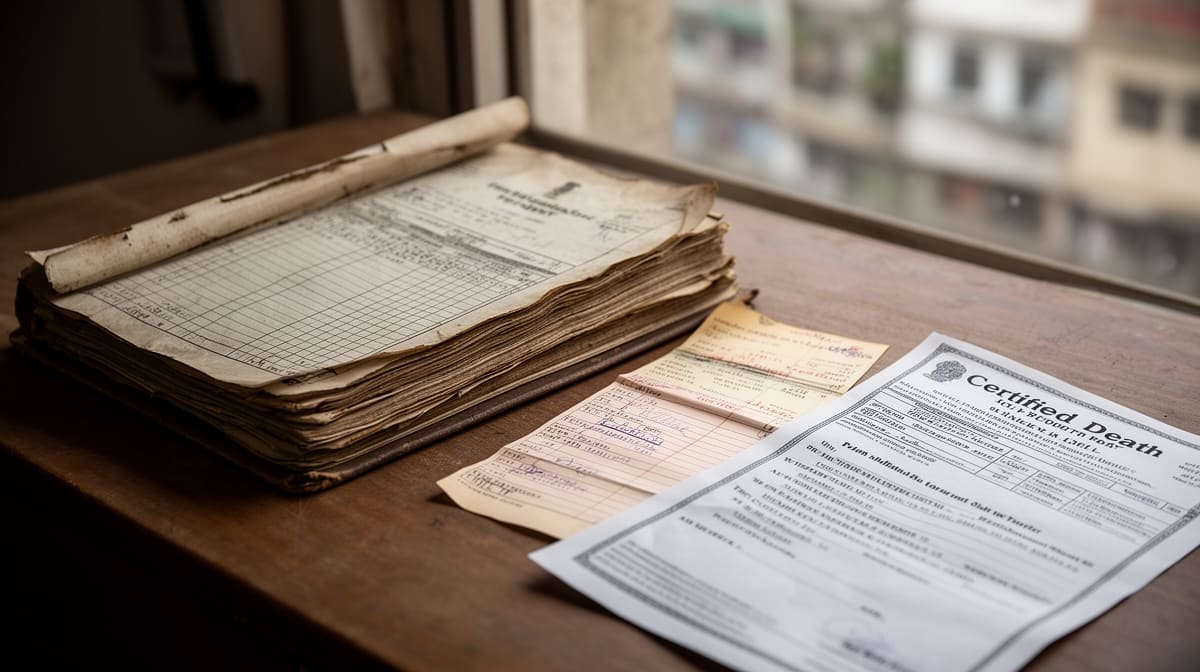
- 1996: Smt. Sushila Mehra died on 2.4.1996; her death was certified by the Municipal Corporation, Hyderabad.
- 1999: Delhi High Court, in O.S. No. 339 of 1992, decreed ownership of the property (recorded as Muraga Khana) in favor of Nandkishore Mehra, Sushila’s husband, after substitution of legal heirs.
- 2019: Plaintiff filed O.S. No. 1126 of 2019 against the deceased Sushila Mehra, claiming adverse possession since 1990.
- 2022: Trial Court granted ex-parte decree in plaintiff’s favor without noticing Sushila Mehra’s death.
- 2023: Legal heir of Sushila Mehra filed O.9 R.13 CPC application to set aside the 2022 decree.
- 2025: Trial Court decreed plaintiff’s suit for mandatory injunction based solely on the 2022 ex-parte decree.
- 2026: First Appeal No. 702 of 2025 filed under Section 96 CPC.
Relief Sought
The plaintiff sought a mandatory injunction directing the Nagar Nigam to record his name as owner of the property. The defendants sought dismissal of the suit on grounds of fraud, nullity of the prior decree, and lack of title.
The Legal Issue
The central question was whether an ex-parte decree obtained against a deceased defendant, who was not substituted by legal heirs, can serve as a valid basis for enforcing rights against third parties, and whether payment of house tax or mutation entries in municipal records can establish ownership.
Arguments Presented
For the Appellant
Shreya Gupta, counsel for the Nagar Nigam, argued that the 2022 decree was a nullity because it was passed against a deceased person, Sushila Mehra, whose death was established by a certified death certificate and confirmed by prior proceedings in the Delhi High Court. She contended that the trial court erred in rejecting admissible documentary evidence and that tax payments cannot confer title. She relied on Vikram Bhalchandra Ghongade v. State of Maharashtra and Ashok Transport Agency v. Awadhesh Kumar to establish that decrees against dead persons are void ab initio.
For the Respondent
Shivam Yadav, counsel for the plaintiff, fairly admitted that Sushila Mehra had died in 1996 and that the 2022 decree was therefore a nullity. He argued that the plaintiff was unaware of her death and committed no fraud, but conceded that the decree could not confer title. His position effectively conceded the legal invalidity of the foundation of the suit.
The Court's Analysis
The Court undertook a rigorous analysis of the nature of ex-parte decrees against deceased parties, drawing extensively from Vikram Bhalchandra Ghongade and Ashok Transport Agency. It held that when a defendant dies before the decree is pronounced, and legal heirs are not brought on record, the decree is a nullity, not merely voidable. The Court emphasized:
"The judgment pronounced in the first appeal on 20.10.2010 was, thus, in favour of the parties who were no more alive. The said adjudication, therefore, amounted to a nullity and the same did not have the force of law."
The Court rejected the trial court’s reasoning that the death certificate was inadmissible merely because it was a copy. It noted that such certificates are routinely filed as certified copies in judicial proceedings, and the fact that substitution had already occurred in the Delhi High Court case confirmed its authenticity. The trial court’s refusal to consider this evidence was deemed perverse and indicative of judicial misconduct.
The Court further held that mutation entries and tax payment receipts are fiscal records only, and do not confer title. Citing P. Kishore Kumar v. Vittal K. Patkar and State of Punjab v. Bhagwantpal Singh, it reiterated that revenue or municipal records are not documents of title and cannot override actual ownership established through legal title or adverse possession.
Crucially, the Court examined the plaintiff’s claim of adverse possession and found it legally untenable. The plaintiff’s father had been a tenant under Sushila Mehra. The Court held that a tenant cannot claim adverse possession against the landlord unless possession is openly hostile and the landlord’s title is denied with clear notice. The plaintiff’s continued payment of rent until 1996 negated any claim of hostile possession.
The Court concluded that the trial court’s reliance on a null decree, combined with its disregard for admissible evidence and misapplication of property law, rendered the judgment unsustainable.
The Verdict
The appellant won. The Court held that an ex-parte decree against a deceased defendant is a nullity and cannot be enforced, and that payment of house tax or mutation entries do not confer title. The impugned decree was set aside, the plaintiff’s suit was dismissed with costs, and the matter was referred to the Chief Justice for administrative action against the trial judge.
What This Means For Similar Cases
Ex-Parte Decrees Against Deceased Parties Are Null and Void
- Practitioners must verify the status of all defendants before seeking ex-parte decrees
- Any attempt to enforce such a decree in execution or collateral proceedings may be resisted as a nullity
- Legal heirs must be substituted under Order XXII Rule 6 CPC before judgment is pronounced
Tax Payments and Mutation Entries Are Not Proof of Title
- Do not rely on tax receipts or municipal records to establish ownership in property suits
- Always plead and prove title through title deeds, inheritance, or adverse possession with clear evidence of hostility and notice
- Mutation entries are only for revenue collection purposes - they create no legal rights
Adverse Possession Requires Hostile Intent and Notice
- Tenants cannot claim adverse possession unless they repudiate the landlord’s title with clear, open, and continuous denial
- Payment of rent, even if discontinued, negates the claim of hostility
- Courts will scrutinize the timeline and nature of possession rigorously - mere long possession is insufficient