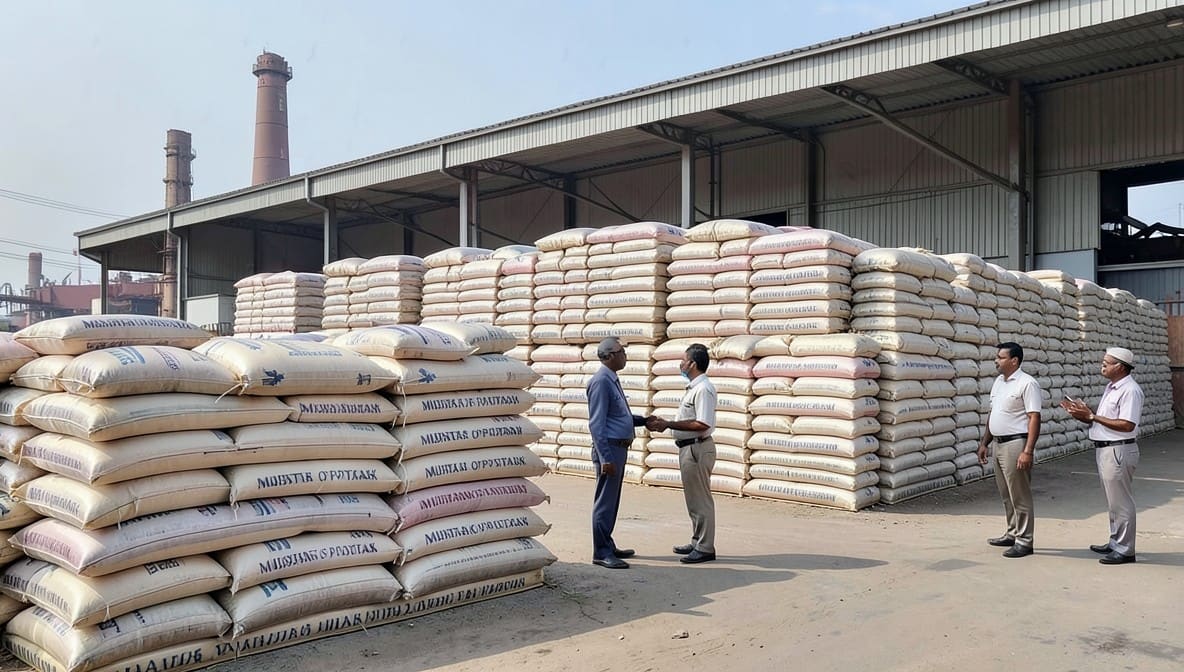
The Allahabad High Court has set aside a conviction under the Essential Commodities Act, 1955, emphasizing that mere possession of excess stock cannot sustain a criminal charge without proof of violation of a specific control order and established mens rea. This ruling reinforces the foundational requirement that economic offences under the Act are not strict liability crimes and demand rigorous evidentiary compliance.
Background & Facts
The Dispute
The appellant, Pitambar Das, was charged and convicted under Sections 3 and 7 of the Essential Commodities Act, 1955, for allegedly storing 12 quintals of excess wheat at the U.P. Food Corporation of India’s Purchasing Centre in Dahar Khakha, Bisauli. The prosecution alleged that this excess stock constituted an illegal contravention of regulatory controls on essential commodities. The appellant, however, was not a licensed dealer but merely the in-charge of the government-owned procurement centre.
Key Facts
- The inspection leading to the case occurred on 30.05.1984 by Sub-Divisional Magistrate S.P. Dasmana (P.W.-1)
- Physical verification revealed 1,263 quintals of wheat against a recorded stock of 1,251 quintals, resulting in an alleged excess of 12 quintals
- The appellant was present during the inspection and was asked to explain the discrepancy
- On 31.05.1984, the appellant submitted a handwritten statement (Ex. Ka-1) and signed a weighing statement (Ex. Ka-2)
- Documents seized included stock registers, bill books, and ledger books (marked Exhibits 1 to 7)
- A written report (Ex. Ka-3) was prepared on 31.05.1984 and signed by S.P. Dasmana
- The case was registered at Police Station Bisauli on 31.05.1984
- Sanction for prosecution was granted on 04.02.1987 (Ex. Ka-13)
- The charge sheet was filed on 15.03.1987 (Ex. Ka-15)
- The trial concluded with conviction on 20.05.1988
- The appellant was sentenced to two years’ rigorous imprisonment and a fine of Rs. 2,000/-
- The appellant was not a licensed dealer under any control order
- No control order under Section 3 of the Act was ever produced or referenced by the prosecution
- The grade of the excess wheat (Grade-1 or Grade-2) was not determined or documented
- The investigating officer admitted he did not verify records with FCI and had no knowledge of wheat grading
Procedural History
- 30.05.1984: Inspection conducted at Purchasing Centre, Bisauli
- 31.05.1984: Written statement, weighing report, and tehrir prepared; FIR registered
- 15.03.1987: Charge sheet filed by Investigating Officer
- 04.02.1987: Sanction for prosecution granted
- 20.05.1988: Special Judge, E.C. Act, Budaun, convicted appellant under Sections 3/7 of the Act
- 10.04.2026: Judgment reserved
- 24.04.2026: Judgment delivered by the Allahabad High Court
The Parties' Positions
Appellant’s Position: The appellant was not a dealer, held no license, and was merely an employee in charge of a government procurement centre. No control order under Section 3 was invoked or proved. The prosecution failed to establish mens rea or any intentional contravention. The evidence was contradictory, incomplete, and lacked verification from FCI records.
State’s Position: The prosecution contended that the excess stock itself constituted an offence under the Act, regardless of licensing status or control order. The presence of excess wheat and the appellant’s failure to explain it were sufficient for conviction.
Relief Sought
The appellant sought acquittal on the grounds that the prosecution failed to prove any violation of a control order under Section 3, failed to establish mens rea, and presented contradictory, uncorroborated evidence. He also sought discharge of his bail bonds and sureties.
The Legal Issue
The central question was whether Section 7 of the Essential Commodities Act, 1955 can be invoked for criminal conviction in the absence of proof that the accused violated a specific control order issued under Section 3, and whether mens rea is an essential ingredient of the offence.
Arguments Presented
For the Appellant
Counsel for the appellant relied on Nathulal v. State of Madhya Pradesh (AIR 1966 SC 43) to argue that mens rea is a necessary ingredient in criminal offences unless the statute explicitly excludes it. He contended that the Essential Commodities Act does not create absolute liability; the prosecution must prove intentional contravention of a valid control order. He emphasized that the appellant was not a licensed dealer and had no authority to determine stock limits. The prosecution failed to produce any control order, failed to establish the grade or legality of the excess wheat, and presented inconsistent testimonies from witnesses. He further cited Shambhu Dayal v. State of West Bengal (1990) to argue that Section 7(1)(b) mandates forfeiture only upon proven contravention of a control order, which was entirely absent.
For the Respondent
The learned Additional Government Advocate submitted that the presence of excess wheat, coupled with the appellant’s failure to explain it, was sufficient to infer guilt. He argued that the Act’s objective of preventing hoarding justified a broad interpretation and that technical lapses in documentation should not defeat public interest. He did not produce or reference any specific control order, nor did he address the absence of mens rea or the appellant’s non-dealer status.
The Court's Analysis
The Court undertook a meticulous review of the prosecution’s case and found it fundamentally defective. The judgment emphasized that Section 3 of the Essential Commodities Act is merely an enabling provision that authorizes the government to issue control orders. It does not, by itself, create a criminal offence. Only a contravention of a specific order made under Section 3 can attract penal consequences under Section 7.
"The prosecution has neither referred to any control order nor provided details of any alleged violation thereof by the appellant/accused."
The Court noted that the prosecution failed to establish even a prima facie case of violation of any control order. The appellant’s role as in-charge of a government procurement centre did not impose upon him the legal obligations of a licensed dealer. The absence of any licensing requirement or control order applicable to him rendered the entire prosecution baseless.
The Court further held that the prosecution’s evidence was riddled with contradictions. P.W.-1 admitted he did not examine pages 40 and 41 of the stock register, where Grade-2 wheat entries were recorded. P.W.-2, the Supply Inspector, admitted he did not sign any document on the day of inspection and could not identify the grade of the excess wheat. The Investigating Officer admitted he did not verify records with FCI and had no knowledge of wheat grading. These lapses undermined the credibility of the entire investigation.
The Court also examined the requirement of mens rea. Citing Nathulal, it held that economic offences under the Act are not strict liability crimes. The prosecution must prove that the accused acted with knowledge or intent to contravene a lawful order. The appellant’s position as a government employee, acting in good faith and without any license or authority to determine stock limits, negated any inference of dishonest intent.
"In absence of the violation of any control order or any violation of provisions of Section 3 of the Act, no penalty could be imposed upon the appellant under Section 7 of the Act."
The Court concluded that the prosecution had not discharged its burden of proving guilt beyond reasonable doubt. The conviction was based on speculation, not evidence.
The Verdict
The appellant succeeded. The High Court set aside the conviction and sentence dated 20.05.1988. The appellant is acquitted of all charges under Sections 3 and 7 of the Essential Commodities Act, 1955. His bail bonds and sureties are discharged. No fine is to be paid, and no forfeiture of property is ordered.
What This Means For Similar Cases
Control Order Violation Is Non-Negotiable
- Practitioners must insist that prosecution produce the exact control order allegedly violated
- Mere possession of excess stock without reference to a specific order is insufficient for conviction
- Defence counsel should immediately challenge the absence of a control order in the charge sheet or during trial
Mens Rea Remains Essential in Economic Offences
- The burden lies on the prosecution to prove intentional contravention, not mere presence of excess goods
- Employees acting in good faith under government authority cannot be presumed to have criminal intent
- Defence arguments based on Nathulal and Shambhu Dayal must be raised at the earliest opportunity
Prosecution Lapses Invalidate Convictions
- Contradictory testimonies, unverified records, and failure to involve relevant authorities (e.g., FCI) render cases unsustainable
- Investigating officers must document grade, source, and legal status of seized commodities
- Courts will not overlook procedural failures when public interest in food security is at stake