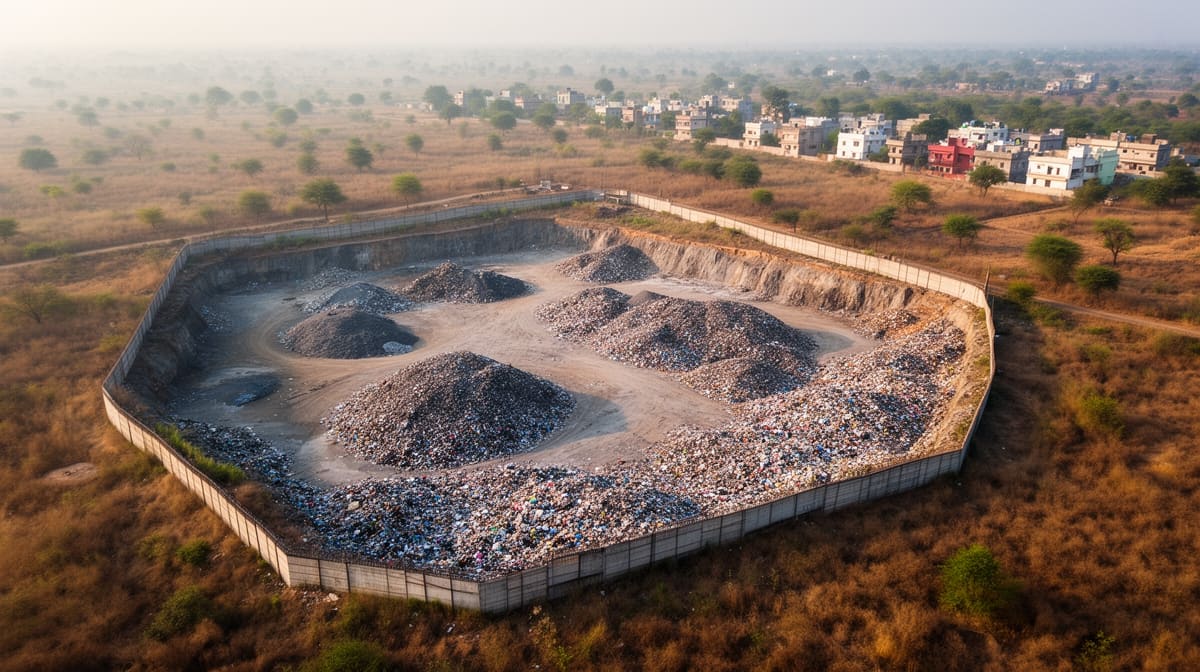
The National Green Tribunal’s dismissal of an environmental application following complete remediation underscores a critical procedural principle: when violators voluntarily and fully restore environmental conditions, the tribunal may permit withdrawal without adjudicating on liability. This outcome reinforces the importance of remedial action over punitive proceedings in environmental governance.
Background & Facts
The Dispute
Mamta Sharma, a resident of village Arrana in Aligarh, filed an original application under Section 18(1) of the National Green Tribunal Act, 2010, alleging severe environmental degradation due to unregulated discharge of sewage and solid waste into Gata No. 38 - a locally significant land parcel historically used for mining Pili Mitti. The applicant claimed that the Gram Panchayat and other authorities had failed to enforce basic sanitation norms, leading to waterlogging, foul odour, and public health hazards.
Procedural History
- 2023: Original Application No. 745/2023 filed before the National Green Tribunal, Principal Bench, New Delhi.
- 2024: Two interim applications (I.A. No. 431/2024 and I.A. No. 503/2024) were filed seeking urgent intervention.
- 2025: Arguments concluded on October 15, 2025, with judgment reserved.
- 2026: Matter re-listed after new evidence emerged regarding remedial action taken by district authorities.
Relief Sought
The applicant sought directions to:
- Halt discharge of wastewater into Gata No. 38
- Restore the gata to its original condition
- Impose penalties for non-compliance
- Ensure long-term monitoring of drainage and waste systems
Remediation Achieved
In an affidavit dated February 6, 2026, the applicant confirmed that district authorities had fully addressed all grievances:
- A new drainage system with proper gradient was constructed to channel sewage toward NH-334D
- All accumulated sewage and solid waste were completely evacuated from Gata No. 38
- The area is now free of pollutants and has been restored for its original use: mining of Pili Mitti
- No residual contamination remains
The Legal Issue
The central question was whether an environmental application under the National Green Tribunal Act, 2010 may be withdrawn when the alleged violations have been fully remediated by the respondents, without the tribunal needing to issue a binding order on liability or compliance.
Arguments Presented
For the Applicant
The applicant submitted that the environmental harm had been completely reversed through proactive remediation by district authorities. She argued that continuing the proceeding would serve no purpose, as the substantive grievance no longer existed. She relied on the principle of mootness in environmental jurisprudence, citing that courts and tribunals should not adjudicate on issues that have been rendered academic by subsequent events.
For the Respondents
The respondents, including the Gram Panchayat and UPPCB, did not contest the applicant’s claims. Their counsel acknowledged the remediation and expressed no objection to withdrawal. They emphasized that the actions taken were voluntary, timely, and fully compliant with environmental norms, thereby negating any need for adjudication.
The Court's Analysis
The Tribunal examined the factual record and found that the applicant’s affidavit provided clear, specific, and verifiable evidence of complete restoration. The Tribunal noted that the National Green Tribunal Act, 2010 empowers the Tribunal to grant relief based on the current state of the environment, not merely to punish past violations. The Court observed that the purpose of environmental adjudication is remedial, not merely retributive.
"The Tribunal’s mandate under Section 14 is to provide relief to the environment and affected persons. Where the environment has been restored and the harm eliminated, the object of the proceeding is achieved."
The Tribunal further held that permitting withdrawal under such circumstances encourages voluntary compliance and avoids unnecessary litigation. It emphasized that the Tribunal retains jurisdiction to entertain future applications if violations recur, thereby balancing finality with vigilance.
The Verdict
The applicant prevailed. The National Green Tribunal dismissed the original application as withdrawn with liberty to file a fresh application if violations recur. The parties were directed to bear their own costs, and all pending interim applications were disposed of.
What This Means For Similar Cases
Voluntary Compliance Can Preclude Adjudication
- Practitioners should document and submit evidence of remediation as early as possible in NGT proceedings
- If respondents fully restore environmental conditions before final order, withdrawal becomes a viable and strategic option
- Tribunals are likely to accept withdrawal where harm is demonstrably reversed, avoiding protracted litigation
Remediation Must Be Complete and Verifiable
- General assurances are insufficient; affidavits must specify:
- Actions taken
- Methods used
- Current status of the site
- Absence of residual pollution
- Photographic evidence, third-party certifications, or government inspection reports strengthen the case for withdrawal
Liberty to File Again Preserves Future Accountability
- The Tribunal’s grant of liberty to file a fresh application ensures that respondents cannot claim immunity from future violations
- This creates a deterrent effect while respecting the principle of finality in resolved matters
- Practitioners should explicitly plead this condition in withdrawal applications to preserve legal recourse