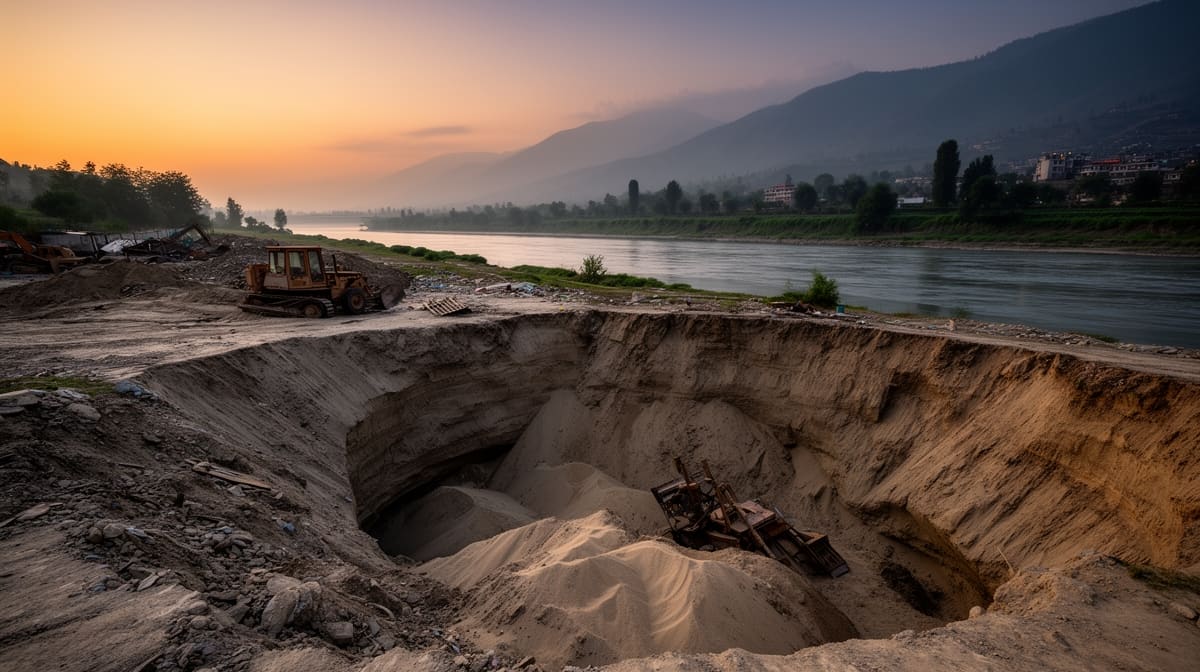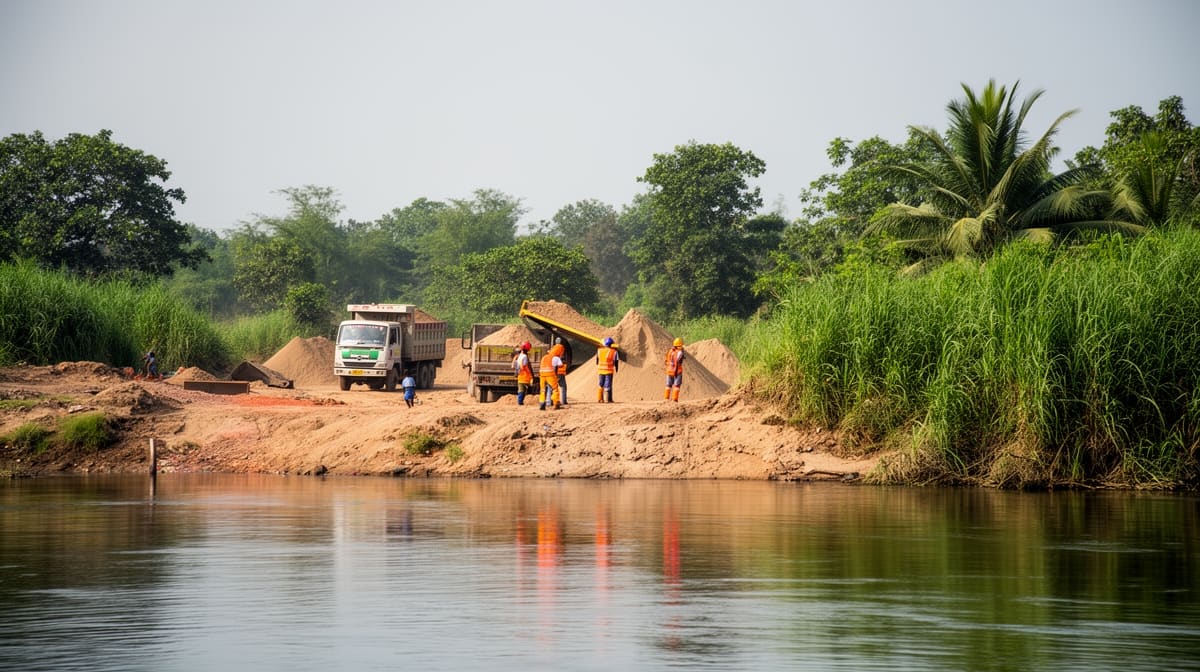
The Calcutta High Court has clarified that once a revised mining plan is approved by competent authorities and environmental clearance is granted by the State Level Expert Appraisal Committee, any subsequent attempt to question the validity of production estimates based on outdated or erroneous data constitutes an abuse of power. This judgment reinforces the primacy of statutory environmental clearances over preliminary administrative records in sand mining operations.
Background & Facts
The Dispute
The petitioner, Krishna Som, operates a sand mining business under the name "New Kalimata Sand Supply" and was the highest bidder in a 2017 e-auction for a five-year lease to extract sand from the Damodar River. She submitted an initial mining plan proposing an annual production capacity of 66,000 cubic meters, which was approved by the Chief Mining Officer on 01.02.2018. The District Level Environment Impact Assessment Authority (DEIAA) granted environmental clearance on 24.04.2018, but erroneously recorded the annual capacity as 3,99,600 cubic feet (approximately 11,316 cubic meters), a figure significantly lower than the approved plan.
Procedural History
- 2017: Petitioner won e-auction for sand block lease
- 2018: Initial mining plan approved; DEIAA clearance issued with erroneous volume
- 2025: Revised mining plan submitted with year-wise production: 63,800 cu.m (Year 1), 49,445 cu.m (Years 2 - 5)
- 09.01.2025: Revised mining plan approved by Chief Mining Officer
- 18.12.2025: State Level Environment Impact Assessment Authority (SEIAA) granted environmental clearance based on revised plan
- 29.01.2026: 4th respondent issued notice directing field verification citing "abrupt increase" in mineable reserve
Relief Sought
The petitioner sought a writ of mandamus to set aside the impugned letter dated 29.01.2026, which directed field verification on the ground of unexplained increase in reserve. She also sought directions for issuance of pending e-challans consistent with the SEIAA clearance.
The Legal Issue
The central question was whether the issuance of a field inspection notice by the mineral development corporation, based on an outdated and erroneous DEIAA estimate, could override a duly approved revised mining plan and subsequent environmental clearance granted by SEIAA under the EIA Notification, 2006.
Arguments Presented
For the Petitioner
Mr. Kallol Basu argued that the revised mining plan, approved by the Chief Mining Officer on 09.01.2025, was legally valid and formed the basis for SEIAA’s environmental clearance on 18.12.2025. He emphasized that the DEIAA’s initial figure of 3,99,600 cubic feet was a clerical error, later corrected by the 6th respondent’s own letter dated 19.03.2025, which acknowledged the correct volume as 23,30,770 cubic feet per annum. He contended that the 4th respondent’s notice was issued without any factual or legal basis and violated the principle of legitimate expectation.
For the Respondent
Mr. Sanjay Saha and Mr. Chandi Charan De contended that the sudden disparity between the DEIAA and SEIAA figures triggered a duty under the West Bengal Sand Mining Policy 2021 to verify whether the increase was justified to prevent ecological harm. They argued that the corporation had a statutory obligation to monitor mining activities and that the notice was merely a precautionary step, not a final adverse order.
The Court's Analysis
The Court conducted a meticulous review of the sequence of approvals and clearances. It noted that the DEIAA’s initial figure was demonstrably incorrect and had been internally corrected by the 6th respondent months before the impugned notice. The Court emphasized that SEIAA’s clearance, granted after detailed scrutiny by the State Level Expert Appraisal Committee, was the final and binding environmental authorization under the EIA Notification, 2006.
"It is not the case of WBMDTCL that the mining volume as per the approved mining plan of 01.02.2018 or the lease deed registered on 18.05.2022 is 3,99,600 cubic feet per annum and not 66,000 cubic meter per annum."
The Court further observed that the revised plan showed a reduction in annual output from 66,000 cu.m to 63,800 cu.m in Year 1, followed by further reductions - contrary to the claim of "abrupt increase." The respondent failed to produce any material to substantiate its allegation of unexplained reserve growth. The Court held that the West Bengal Sand Mining Policy 2021, while imposing monitoring duties, does not empower authorities to initiate intrusive inspections without prima facie evidence of non-compliance or ecological risk. The absence of any allegation of actual environmental harm or violation of clearance conditions rendered the inspection notice arbitrary and disproportionate.
The Verdict
The petitioner succeeded. The Court set aside the impugned letter dated 29.01.2026, holding that the field inspection notice was legally unsustainable. It further directed the authorities to issue pending e-challans strictly in accordance with the SEIAA environmental clearance dated 18.12.2025.
What This Means For Similar Cases
Environmental Clearance Is Final and Binding
- Practitioners must treat SEIAA or MoEFCC clearances as the definitive regulatory benchmark, superseding earlier provisional or erroneous estimates
- Any administrative action contradicting a valid environmental clearance must be challenged on grounds of arbitrariness and lack of statutory basis
No Inspection Without Grounded Suspicion
- Authorities cannot initiate technical verifications based on statistical discrepancies alone
- A prima facie showing of non-compliance, ecological risk, or violation of clearance conditions is mandatory before invoking monitoring powers
- Blanket suspicion based on data mismatches is insufficient under the rule of law
Correction of Administrative Errors Is Not Grounds for Punitive Action
- Clerical errors in initial approvals must be corrected through administrative amendment, not punitive or investigatory measures
- Petitioners are entitled to rely on approvals granted by competent authorities without fear of retroactive scrutiny
- This judgment reinforces the doctrine of legitimate expectation in environmental licensing