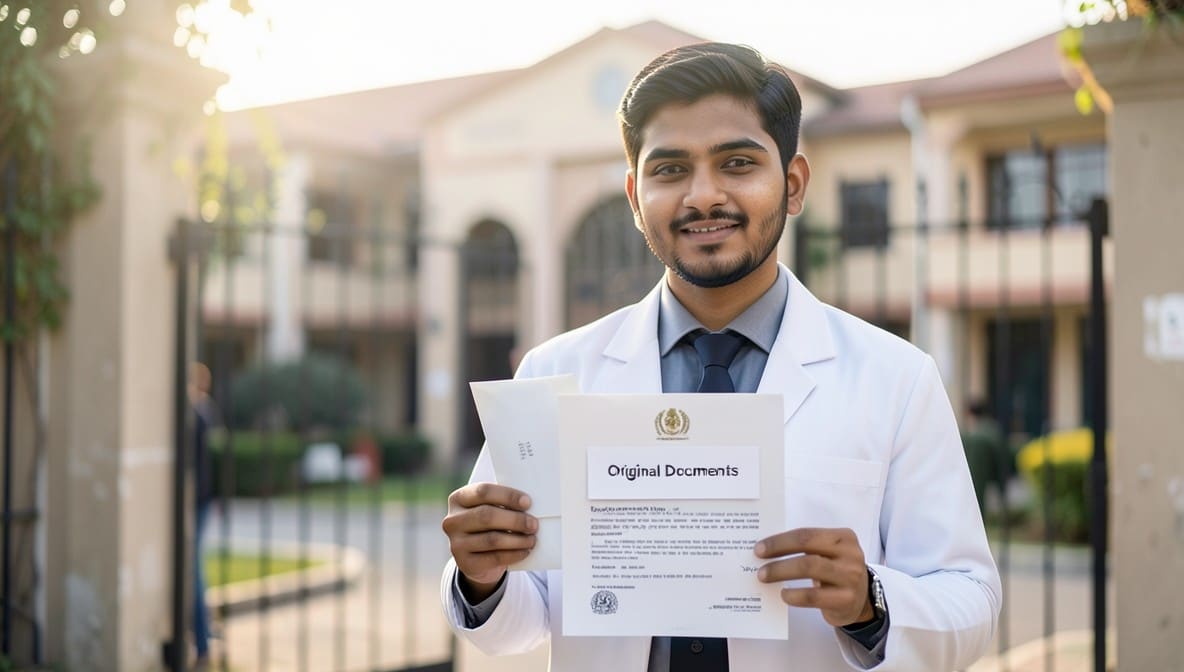
In a significant ruling on student rights, the Madras High Court balanced the enforceability of educational bonds against the humanitarian need to return original certificates to a student who discontinued his dental course due to severe mental health struggles. The judgment distinguishes between financial penalties and the fundamental right to pursue alternative education, offering relief to students in similar distressing circumstances.
Background & Facts
The Dispute
The petitioner, M. Meena Vignesh, secured admission to JKKN Dental College and Hospital in Namakkal District for the academic year 2023-2024 after qualifying in the NEET examination. Shortly after admission, he attempted suicide twice - once in August 2024 and again later in the academic year - due to academic pressure and mental health challenges. The petitioner incurred over Rs. 6,00,000 in medical expenses and subsequently discontinued his dental course to enroll in a B.Tech program at another institution.
When the petitioner sought the return of his original certificates from the dental college to complete his new admission, the college refused, citing Clause 6 of the bond agreement executed at the time of admission. This clause mandated a penalty of Rs. 10,00,000 for discontinuing the course, recoverable as arrears of land revenue.
Procedural History
The petitioner approached the Madras High Court under Article 226 of the Constitution of India, seeking:
- A declaration that Clause 6 of the bond agreement was null and void.
- The return of his original certificates without payment of the penalty.
The respondents, including the State of Tamil Nadu, Directorate of Medical Education, Tamil Nadu Dr. MGR Medical University, and JKKN Dental College and Hospital, opposed the petition, relying on a Division Bench judgment of the Madras High Court in Director of Medical Education v. M. Aarthy, which held that certificates could only be returned upon payment of the bond amount.
Relief Sought
The petitioner argued that his circumstances - severe mental health struggles, financial hardship, and the need to pursue alternative education - warranted an exception to the bond clause. He relied on the Supreme Court’s judgment in Association of Medical Super Speciality Aspirants and Residents v. Union of India and a subsequent Division Bench ruling in Dr. Nirmal M. v. The State of Tamil Nadu, which ordered the return of certificates in similar cases.
The Legal Issue
The central question before the Court was whether a student who discontinues a medical course due to extreme mental health challenges and financial hardship is entitled to the return of their original certificates without paying the penalty stipulated in the bond agreement.
Arguments Presented
For the Petitioner
The petitioner’s counsel argued:
- The bond clause, while legally valid, should not be enforced in cases of extreme hardship, particularly where the student’s mental health and financial circumstances prevent continuation of the course.
- The Supreme Court’s judgment in Association of Medical Super Speciality Aspirants and Residents v. Union of India established that humanitarian considerations must prevail in such cases.
- The Division Bench ruling in Dr. Nirmal M. v. The State of Tamil Nadu supported the return of certificates without penalty, as there was no express clause in the prospectus allowing the college to retain them.
- The University Grants Commission (Grievance Redressal) Regulations, 2018 classify the withholding of documents as a grievance, reinforcing the petitioner’s right to their return.
For the Respondents
The respondents’ counsel contended:
- The bond agreement was valid and enforceable, as upheld by the Supreme Court and the Division Bench in Director of Medical Education v. M. Aarthy.
- The penalty clause (Clause 6) was a contractual obligation, and the college was entitled to recover Rs. 10,00,000 as arrears of land revenue if the petitioner failed to pay.
- The return of certificates was conditional upon payment of the penalty, and no exception should be made for the petitioner’s circumstances.
The Court's Analysis
The Court undertook a nuanced analysis, balancing the contractual obligations under the bond agreement with the humanitarian and educational rights of the petitioner. Key aspects of the reasoning included:
-
Validity of the Bond Clause: The Court acknowledged that Clause 6 of the bond agreement was legally valid and enforceable, as established in Director of Medical Education v. M. Aarthy. The penalty amount could be recovered as arrears of land revenue if the petitioner failed to pay.
-
Distinction Between Penalty and Certificate Release: While the Court upheld the enforceability of the penalty clause, it distinguished between the financial penalty and the return of original certificates. The Court observed that the petitioner’s case involved extreme circumstances, including severe mental health struggles and financial hardship, which warranted a departure from the general rule.
-
Precedent Application: The Court relied on the Division Bench judgment in Dr. Nirmal M. v. The State of Tamil Nadu, which ordered the return of certificates without payment of the bond amount. Unlike cases involving medical bond service (where prospectus clauses expressly allowed retention of certificates), the petitioner’s case did not involve such a provision. The Court emphasized that the petitioner’s circumstances were exceptional and required compassionate consideration.
-
Educational and Humanitarian Principles: The Court invoked Tamil literary wisdom, quoting the adage that "education is a wealth that cannot be destroyed" and should come to the petitioner’s rescue. It noted that the University Grants Commission (Grievance Redressal) Regulations, 2018 included the withholding of documents as a grievance, reinforcing the petitioner’s right to their return.
"This is an extreme case of the petitioner being unwell, and the facts are stated supra. Under the conditions, the petitioner must be helped, encouraged and aided to use his learning/education, for there can be no damage to the same ('கேடில் விழுச் செல்வம்') and that it should come to his rescue always ('கல்வி ஒருவற்குச் செல்வம் அது சேரும்')."
The Court concluded that while the financial penalty under the bond agreement remained enforceable, the return of certificates was a separate issue that required humanitarian intervention.
The Verdict
The Madras High Court disposed of the writ petition with the following directions:
- The prayer to declare Clause 6 of the bond agreement as null and void was rejected. The college authorities remain entitled to recover the penalty amount as arrears of land revenue.
- The original certificates of the petitioner must be returned within one week from the date of receipt of the web copy of the order, without waiting for a certified copy.
- No order as to costs was passed.
What This Means For Similar Cases
Humanitarian Exceptions to Bond Clauses
This judgment establishes that educational bonds, while enforceable, are not absolute. Courts may carve out exceptions for students facing extreme hardship, such as mental health struggles or financial distress. Practitioners should:
- Argue for compassionate grounds when seeking the return of certificates, particularly where the student’s circumstances prevent continuation of the course.
- Highlight the absence of express clauses in the prospectus allowing retention of certificates, as seen in Dr. Nirmal M. v. The State of Tamil Nadu.
Financial Penalties vs. Certificate Release
The Court drew a critical distinction between financial penalties and the return of original certificates. While the penalty clause remained enforceable, the release of certificates was treated as a separate issue. Key takeaways include:
- Bond clauses mandating penalties for discontinuation remain valid and enforceable.
- Certificate release may be ordered independently, especially in cases involving mental health challenges or financial hardship.
- Practitioners must separately argue for the return of certificates, even if the penalty clause is upheld.
UGC Regulations as a Tool for Student Rights
The Court’s reliance on the University Grants Commission (Grievance Redressal) Regulations, 2018 underscores the importance of these regulations in protecting student rights. The regulations classify the withholding of documents as a grievance, providing a legal basis for students to seek redress. Practitioners should:
- Cite Regulation 2(f) of the UGC Regulations to argue against the withholding of certificates.
- Use the regulations to challenge arbitrary retention of documents by educational institutions.
This judgment serves as a precedent for students seeking relief from bond clauses in exceptional circumstances, while also reinforcing the enforceability of financial penalties where no humanitarian grounds exist.