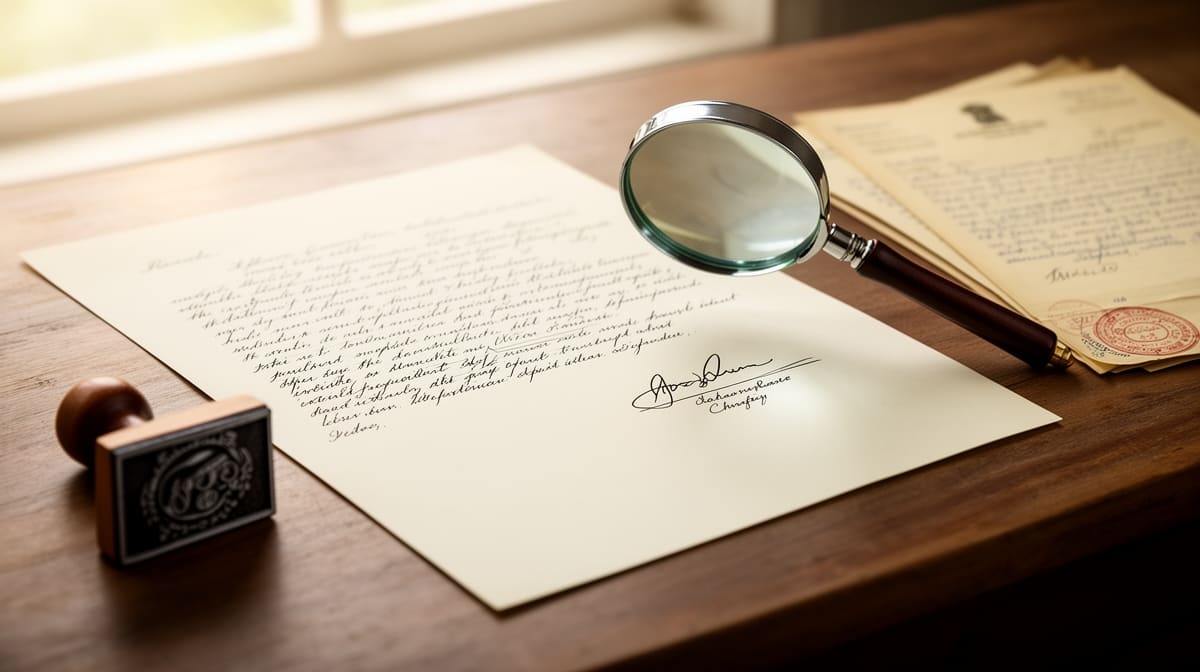
The Supreme Court has set aside the dismissal of a court attender for alleged forgery, emphasizing that grave charges of document fabrication demand rigorous evidentiary scrutiny and expert verification. The judgment reinforces that loss of livelihood demands fair play, and conclusory findings without scientific validation cannot sustain punitive action.
Background & Facts
The Dispute
The appellant, K. Rajaiah, was employed as an attender in the Court of Additional Senior Civil Judge, Karimnagar since 1998. In August 2017, he was absent from duty for five days (03.08.2017 to 07.08.2017) due to illness. He telephoned the office to inform of his absence and later submitted a medical certificate issued by Dr. Bommaraveni Swamy Mudiraj, certifying hospital admission. He also applied for casual leave for the period.
Procedural History
- 03.08.2017 to 07.08.2017: Appellant absent due to fever and vomiting; informed office by phone
- 22.08.2017: Appellant submitted medical certificate (Ex. P-7) and explanation; salary was deducted
- 26.10.2017: After a two-month gap triggered by another minor absence, the Presiding Officer summoned Dr. Bommaraveni to verify the certificate
- 28.10.2017: Dr. Bommaraveni stated the certificate was not issued by him and may have been fabricated using his old letterhead
- 03.03.2018: Formal charges framed under APCS (CC&A) Rules, 1991
- 13.11.2018: Appellant dismissed from service after disciplinary inquiry
- 08.01.2021: Appellate authority upheld dismissal
- 12.02.2024: High Court dismissed writ petition challenging dismissal
Relief Sought
The appellant sought reinstatement with full back wages and consequential benefits, arguing that the charge of forgery was not proved and that the inquiry violated principles of natural justice.
The Legal Issue
The central question was whether a disciplinary authority may conclusively hold that a medical certificate is forged based solely on the denial of the issuing doctor, without verifying the disputed handwriting against authenticated samples or referring the matter to a handwriting expert.
Arguments Presented
For the Appellant
Mr. Pratap Narayan Sanghi, Senior Advocate, argued that the doctor admitted the appellant consulted him and received medication, and that the letterhead and rubber stamp on the certificate were genuine. He contended that the doctor’s denial of issuing the certificate was insufficient to prove forgery, especially since the signature on the certificate (Ex. P-7) and the doctor’s acknowledged signature on the notice (Ex. P-9) were broadly similar. He relied on Sawai Singh v. State of Rajasthan and V.M. Saudagar to assert that expert verification is mandatory in forgery cases.
For the Respondent
Ms. Sindoora VNL, counsel for the State, argued that the Inquiry Officer was entitled to rely on the doctor’s testimony, which categorically denied issuing the certificate. She contended that judicial review does not permit reappreciation of evidence and that the findings were consistent with the record. She further argued that Rule 9(x) proviso mandates dismissal for forgery, making the penalty proportionate.
The Court's Analysis
The Court examined the evidence with particular attention to the nature of the charge - forgery - and the consequences - loss of livelihood. It noted that the medical certificate (Ex. P-7) was fully handwritten, bore the doctor’s rubber stamp, and used his letterhead. Crucially, Dr. Bommaraveni admitted the appellant had consulted him and received tablets, though he could not recall the date. He also admitted the letterhead was his, and the rubber stamp was his.
The Court observed that the doctor’s signature on Ex. P-7, Ex. P-9 (his statement), and the acknowledgment on the notice (Ex. P-8) were not identical but broadly similar. No handwriting expert was consulted. The Court held that in cases involving forgery, where the consequences are severe, the principle of fair play demands more than a verbal denial.
"In a departmental enquiry entailing consequences like loss of job which nowadays means loss of livelihood, there must be fair play in action; in respect of an order involving adverse or penal consequences against an employee, there must be investigations to the charges consistent with the requirement of the situation in accordance with the principles of natural justice."
The Court cited Sawai Singh v. State of Rajasthan and V.M. Saudagar to underscore that when a charge of forgery hinges on handwriting, and the evidence is inconclusive, the inquiry authority must refer the matter to a handwriting expert. Failure to do so renders the finding perverse and unsupported by evidence.
The Court also noted the inexplicable delay in initiating proceedings, the absence of any record of unauthorized absence in October 2017, and the fact that the doctor’s initial statement was recorded behind the appellant’s back - all factors undermining the fairness of the inquiry.
The Verdict
The appellant won. The Supreme Court held that the charge of forgery was not proved due to the failure to verify handwriting through expert analysis, violating principles of natural justice. The dismissal order was set aside, and the appellant was reinstated with full back wages and consequential benefits.
What This Means For Similar Cases
Handwriting Verification Is Mandatory in Forgery Cases
- Practitioners must insist on referral to a handwriting expert whenever a document’s authenticity is contested in disciplinary proceedings
- A witness’s denial alone, even if credible, cannot substitute for scientific verification when forgery is alleged
- Failure to obtain expert opinion renders findings perverse and liable to be set aside
Natural Justice Requires Proportionate Inquiry Procedures
- Disciplinary authorities must adopt procedures proportionate to the gravity of the charge
- Loss of livelihood triggers heightened obligations under Article 14 and Article 21
- Delayed or retaliatory inquiries, especially those triggered by minor subsequent infractions, raise procedural unfairness concerns
Presumption of Innocence Applies in Service Matters
-
The burden of proving forgery lies squarely on the department
-
Ambiguity in evidence must benefit the employee
-
Past minor penalties cannot be used to justify dismissal for unproven charges
-
Always request handwriting comparison if disputed documents are central to the charge
-
File objections to inquiry proceedings if expert analysis is not ordered in forgery cases
-
Argue that Sawai Singh and V.M. Saudagar bind all disciplinary authorities, including judicial departments