The Jharkhand High Court has reaffirmed a foundational principle of administrative law: that documentary evidence in departmental proceedings cannot sustain a finding of guilt without corroboration through oral testimony. This judgment delivers a decisive blow to procedural shortcuts adopted by disciplinary authorities, particularly in banking institutions, where reliance on unproven documents has become routine. The ruling restores the centrality of natural justice in service law.
Background & Facts
The Dispute
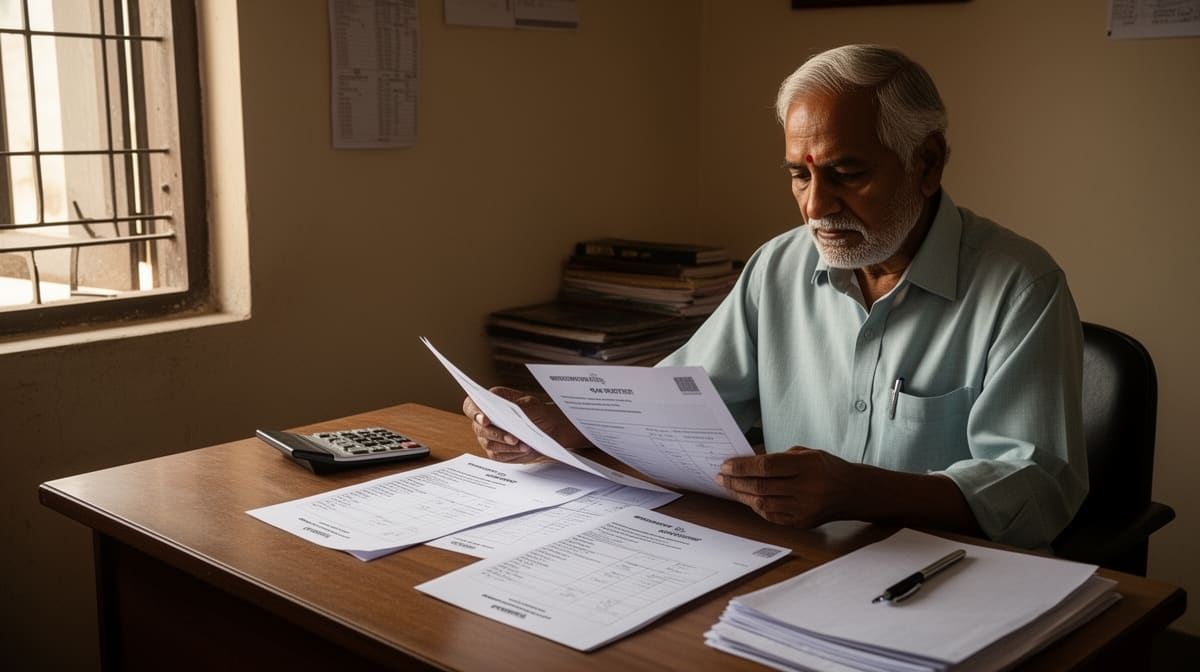
The petitioner, Samir Kumar Pandey, a 21-year veteran of the State Bank of India, was subjected to a departmental inquiry for alleged gross negligence in loan sanctioning and recovery, resulting in a non-performing asset (NPA) loss of Rs. 83.82 Lakhs. The disciplinary authority concluded that he had failed to exercise due diligence as Branch Manager at Tundoo Branch between 01.10.2014 and 27.10.2016. Based solely on documentary records, he was charged, found guilty, and punished with dismissal.
Key Facts
- The petitioner was appointed as Clerk-cum-Cashier-cum-Typist on 15.09.1997
- Promoted to Assistant Manager in 2003 and Deputy Manager in 2007
- Served as Branch Manager at Tundoo Branch from 01.10.2014 to 27.10.2016
- Charge Memo dated 21.08.2018 alleged failure in loan sanctioning and recovery, leading to Rs. 83.82 Lakhs in NPA
- All evidence relied upon by the inquiry officer was documentary: loan files, internal audit reports, NPA records, and correspondence
- No witness was examined to authenticate, explain, or verify the contents of any document
- The petitioner was not given an opportunity to cross-examine any person who could attest to the documents
Procedural History
- 21.08.2018: Charge Memo issued by Disciplinary Authority
- 15.04.2019: Disciplinary Authority imposed punishment of dismissal (Memo No. VIG/GEN/SK/19, Annexure-8)
- 21.09.2019 / 23.09.2019: Appellate Authority (Chief General Manager) affirmed dismissal (Memo No. HR/A&R/1969, Annexure-9)
- 20.05.2020 / 23.07.2020: Reviewing Committee modified punishment to "Removal from Service" (Memo No. A&R/SS/51, Annexure-10)
- 27.04.2026: Hearing before Jharkhand High Court
- 04.05.2026: Judgment pronounced
Relief Sought
The petitioner sought quashing of all three orders (dismissal, affirmation, and modification) and reinstatement with full back wages, continuity of service, and all consequential benefits.
The Legal Issue
The central question was whether departmental proceedings imposing major punishment may rely exclusively on unproven documentary evidence, or whether oral testimony is mandatory to establish the authenticity and content of such documents under the principles of natural justice.
Arguments Presented
For the Petitioner
The petitioner’s counsel argued that the inquiry officer acted as a prosecutor rather than an impartial adjudicator by accepting unverified documents as conclusive proof. He cited Roop Singh Negi v. Punjab National Bank, State of Uttar Pradesh v. Saroj Kumar Sinha, and Satyendra Singh v. State of Uttar Pradesh to establish that documents do not prove themselves. He emphasized that the absence of any oral witness rendered the entire proceeding a nullity, violating Article 311(2) of the Constitution and the rules of natural justice.
For the Respondent
The counsel for the State Bank of India conceded that no oral witness had been examined but contended that the documentary evidence was voluminous and self-explanatory. He argued that the petitioner had ample opportunity to rebut the documents but failed to do so, and therefore, the inquiry was valid. He did not dispute the legal position cited by the petitioner but sought to distinguish the facts.
The Court's Analysis
The Court undertook a comprehensive review of the Supreme Court’s jurisprudence on departmental inquiries. It noted that while the Indian Evidence Act, 1872, does not strictly apply to departmental proceedings, its foundational principles - particularly regarding the admissibility and proof of documents - are indispensable to ensure fairness.
"A document does not prove itself. In the enquiry, therefore, the contents of the relied-on documents have to be proved by examining a witness having knowledge of the contents of such document and who can depose as regards its authenticity."
The Court emphasized that the inquiry officer’s role is not to act as an advocate for the department but as an independent adjudicator. Even in ex parte proceedings, the burden remains on the department to prove its case through legally admissible evidence. The absence of any witness to testify to the authenticity, origin, or accuracy of the documents meant that the charges were not established on any legally valid basis.
The Court further observed that the State Bank of India had ignored repeated warnings from the Supreme Court in Saroj Kumar Sinha and Ram Prakash Singh, where similar procedural lapses had been condemned. The fact that the punishment was modified from dismissal to removal did not cure the fundamental defect - the entire proceeding was vitiated from inception.
The Court rejected the notion that the petitioner’s silence or non-appearance could validate the use of unproven documents. Natural justice requires the authority to actively ensure that evidence is properly adduced, not merely to wait for the delinquent to respond.
The Verdict
The petitioner succeeded. The Jharkhand High Court quashed all three impugned orders dated 15.04.2019, 21.09.2019/23.09.2019, and 20.05.2020/23.07.2020. The Court directed the State Bank of India to reinstate the petitioner forthwith with all consequential benefits, including full back wages from the date of removal. The Bank was permitted to initiate fresh proceedings if it so desired, provided they complied with the mandate of oral evidence and natural justice.
What This Means For Similar Cases
Oral Evidence Is Non-Negotiable in Major Punishment Cases
- Practitioners must insist that any departmental inquiry involving dismissal, removal, or major penalty must record oral testimony for every document relied upon
- Merely producing loan files, audit reports, or internal memos without a witness to authenticate them renders the proceeding void
- The burden of proving the document’s contents lies with the department, not the employee
Courts Will Not Tolerate Repeated Procedural Lapses
- The judgment explicitly criticizes the Bank for repeating errors condemned in prior Supreme Court rulings
- Authorities cannot claim ignorance of settled law; repeated violations invite outright quashing
- Even if the punishment is reduced on review, the procedural illegality remains fatal
Document-Based Disciplinary Actions Are Now High-Risk
- Banks, PSUs, and government departments must train inquiry officers on evidentiary standards
- Legal departments must ensure that witnesses are identified, summoned, and examined before any charge sheet is finalized
- Any future inquiry relying on unproven documents is vulnerable to immediate quashing under Roop Singh Negi and its progeny