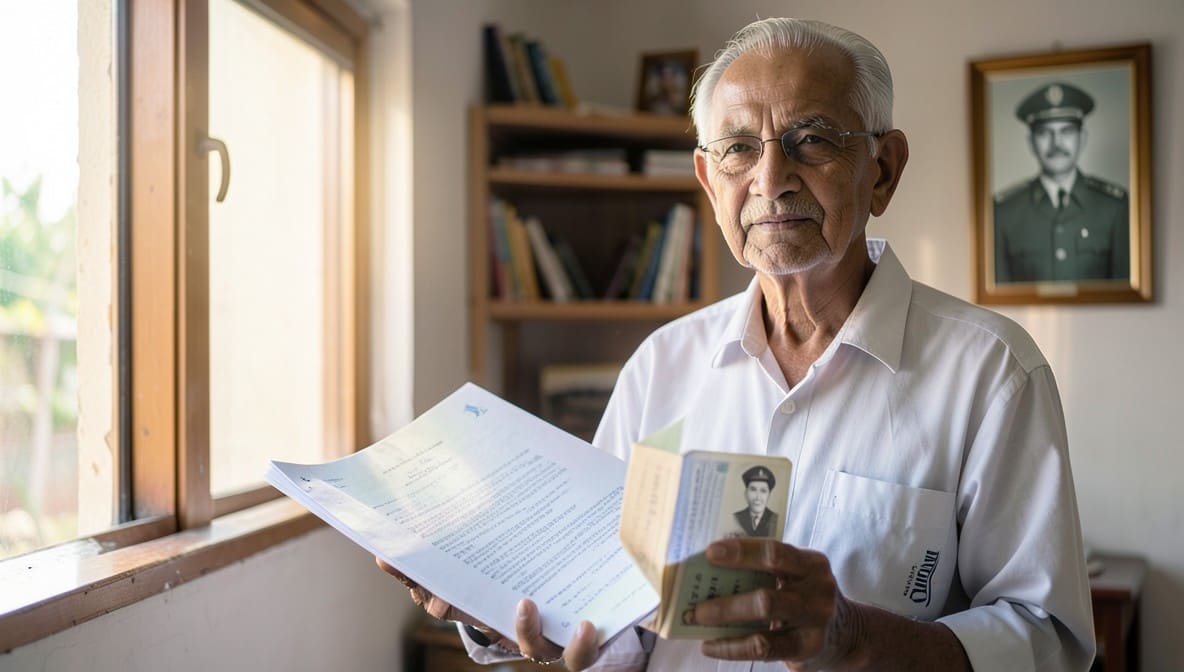
The Kerala High Court has clarified that the denial of disability pension to a retired soldier based solely on the location of disease onset - namely, a peace station - is legally unsustainable. In a significant ruling, the Court emphasized that the burden of proving non-attributability rests primarily with the Department when claims are filed within 15 years of discharge, and that medical opinions lacking reasoned justification cannot stand.
Background & Facts
The Dispute
The writ petitioner, Ex. Hon. Sub. Maj. Chandrasekhar, served in the Indian Army from 26.04.1991 until his discharge on 10.04.2019. He was medically discharged due to Apical Hypertrophic Cardiomyopathy, classified as a 20% permanent disability. Despite this, the Release Medical Board concluded that the condition was neither attributable to nor aggravated by military service. The petitioner challenged this denial of disability pension before the Armed Forces Tribunal, which upheld the Board’s finding. He then filed this writ petition before the Kerala High Court.
Key Facts
- The petitioner was enrolled in the Indian Army on 26.04.1991 with no prior medical history of cardiac conditions.
- A Medical Board examination on 11.12.2017 diagnosed him with Apical Hypertrophic Cardiomyopathy (ICD Code I-42.2) and assessed a 20% permanent disability.
- The Release Medical Board, in its opinion dated 11.12.2017, stated the disability was "Not connected with service" with the reason: "Not related to service conditions, diagnosed during evaluation of ECG abnormality detected during PME."
- The petitioner was discharged on 10.04.2019 on medical grounds in Low Medical Category S1H1A1P2(P)E1.
- He filed his Original Application (O.A. No. 211 of 2024) before the Armed Forces Tribunal on 02.09.2024, well within 15 years of discharge.
- The Tribunal, on 17.02.2025, dismissed the claim, relying on the Medical Board’s conclusion that the disease onset occurred in a peace station.
- No record exists indicating the petitioner suffered from this condition prior to enlistment.
- The petitioner had no prior treatment history or family history of the condition.
Procedural History
- 26.04.1991: Enlistment in Indian Army
- 11.12.2017: Medical Board diagnosis of Apical Hypertrophic Cardiomyopathy (20% disability)
- 10.04.2019: Discharge from service on medical grounds
- 02.09.2024: Original Application filed before Armed Forces Tribunal, Kochi
- 17.02.2025: Tribunal dismissed claim, accepting Medical Board’s opinion without reasoned analysis
- 28.03.2025: Writ Petition (C) No. 30411/2025 filed before Kerala High Court
- 05.06.2026: Final hearing concluded
- 09.06.2026: Judgment delivered
Relief Sought
The petitioner sought: (1) quashing of the Tribunal’s order dated 17.02.2025; (2) grant of disability pension with effect from date of discharge; (3) payment of arrears with interest; and (4) issuance of a corrected Pension Payment Order (PPO).
The Legal Issue
The central question was whether the denial of disability pension based on the disease’s onset in a peace station, without reasoned medical justification, violates Regulation 423 of the Regulations for Medical Services of the Armed Forces, 1983, and whether the onus of proof under Rule 7 of the Entitlement Rules for Casualty Pensionary Awards, 2008, shifts to the Department for claims filed within 15 years of discharge.
Arguments Presented
For the Petitioner
The petitioner’s counsel argued that: (1) Regulation 423(a) explicitly states that the location of disease onset - whether in a field area or peace station - is immaterial; (2) the Medical Board’s opinion dated 11.12.2017 provided no substantive reasoning to support its conclusion of non-attributability; (3) the absence of any pre-enlistment medical record triggers the statutory presumption under Regulation 423(c) that the disease arose during service; (4) the Tribunal failed to consider the beneficial nature of pension rules and the Supreme Court’s directive in Union of India v. Col. Balbir Singh; and (5) Rule 7 of the 2008 Rules places the primary burden on the Department for claims filed within 15 years, as held in Bhaskaran and affirmed by the Supreme Court in Sarma Rao and Hemraj Singh Chauhan.
For the Respondent
The Central Government Counsel contended that: (1) the Medical Board’s opinion was final and binding under Regulation 423(d); (2) the disease was a lifestyle disorder and its onset in a peace station negated any causal link to service; (3) the Tribunal was justified in relying on the Board’s conclusion; and (4) the petitioner had not discharged any burden of proof, even though the claim was filed within 15 years.
The Court's Analysis
The Court undertook a detailed analysis of Regulation 423 of the Regulations, 1983, particularly sub-clause (a), which states: "It is immaterial whether the cause giving rise to the disability or death occurred in an area declared to be a Field Service/Active service area or under normal peace conditions. It is, however, essential to establish whether the disability or death bore a causal connection with the service conditions."
"A mere statement that a disease is a lifestyle disorder cannot be a sufficient reason to deny the grant of Disability Pension, unless the Medical Board has duly examined and recorded particulars relevant to the individual concerned."
The Court emphasized that the Medical Board’s opinion dated 11.12.2017 provided no reasoning beyond a boilerplate phrase. It did not address whether service conditions - such as prolonged stress, irregular hours, psychological strain, or physical demands - contributed to the onset of the disease. The Court held that such a conclusion, devoid of reasoning, is legally unsustainable, citing Rajumon T.M. v. Union of India.
The Court further relied on Regulation 423(c), which presumes that a disease not noted at the time of enlistment arose during service, unless proven otherwise. No evidence was presented to show the disease was pre-existing or hereditary. The absence of any such record triggered the statutory presumption in favor of the petitioner.
The Court also interpreted Rule 7 of the Entitlement Rules, 2008, in light of State of A.P. v. V. Sarma Rao and Union of India v. Bhaskaran. The word "ordinarily" does not mean "exclusively"; it permits exceptions. For claims filed within 15 years of discharge, the burden remains primarily on the Department to disprove attributability. The petitioner’s claim, filed in September 2024 - five years after discharge - fell squarely within this category.
The Court rejected the argument that the petitioner should be sent for a Resurvey Medical Board, noting that the 20% permanent disability had already been certified and no request for review had been made by the petitioner. The Court cited Commander Rakesh Pande v. Union of India to affirm that re-assessment cannot be ordered suo motu.
Finally, the Court invoked the principle of beneficial interpretation from Maniben Maganbhai Bhariya, holding that social security legislation must be construed liberally in favor of the beneficiary.
The Verdict
The writ petition was allowed. The Tribunal’s order dated 17.02.2025 was set aside. The respondents are directed to issue a corrigendum PPO granting disability pension to the petitioner with effect from 10.04.2019, at any rate within three months from the date of receipt of this judgment. Unpaid arrears shall carry interest at 7% per annum from the date of discharge until payment.
What This Means For Similar Cases
Peace Station Does Not Bar Disability Pension
- Practitioners must now argue that location of disease onset - whether in peace station, field area, or cantonment - is legally irrelevant under Regulation 423(a).
- Any denial based solely on "peace station" or "lifestyle disease" without medical reasoning is vulnerable to challenge.
- Medical Boards must record specific, case-specific reasons linking service conditions to disease onset or aggravation.
Burden of Proof Shifts to Department Within 15 Years
- For claims filed within 15 years of discharge, the Department bears the primary burden to disprove attributability.
- Claimants are not required to prove causation; the onus is on the State to rebut the statutory presumption under Regulation 423(c).
- The phrase "ordinarily" in Rule 7 does not eliminate the Department’s responsibility - it merely creates an exception for belated claims after 15 years.
Medical Opinions Must Be Reasoned and Justified
- Unreasoned medical opinions, even from statutory boards, are not conclusive.
- Courts will examine whether the opinion addresses: (a) service conditions, (b) pre-enlistment status, (c) contributory factors, and (d) differential diagnosis.
- Failure to provide reasons renders the opinion liable to be set aside under Rajumon T.M. and Maniben Maganbhai Bhariya.