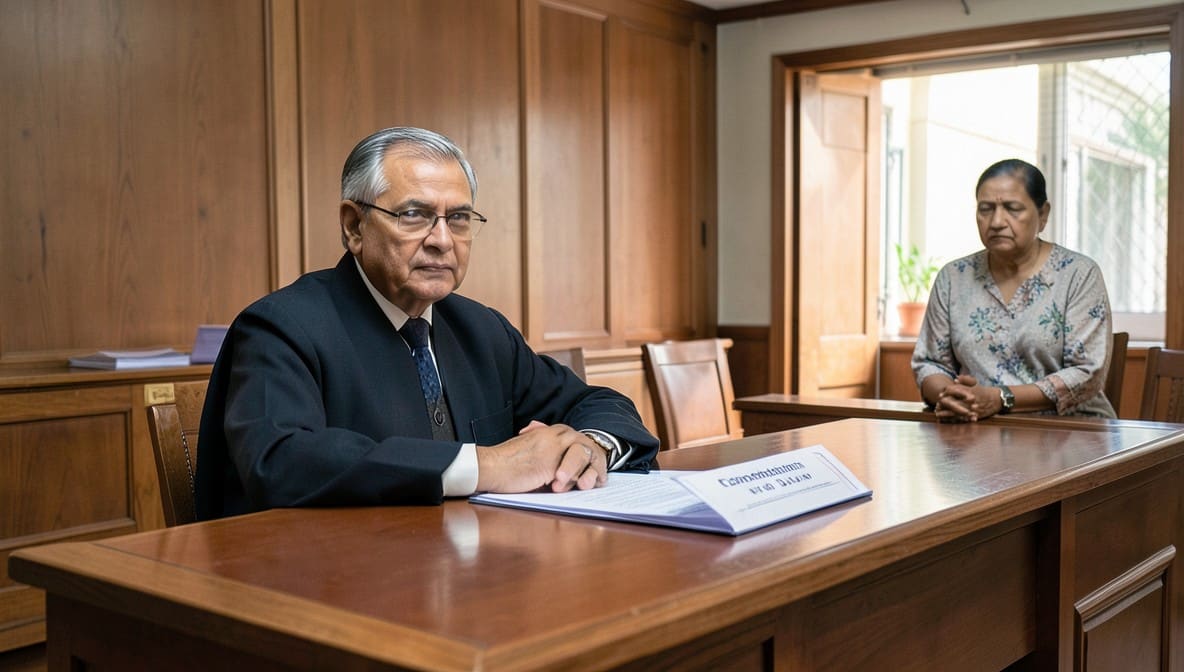
The Chhattisgarh High Court has reaffirmed that delays in filing arbitration appeals under Section 37 of the Arbitration and Conciliation Act, 1996, cannot be condoned on vague administrative explanations alone. This judgment underscores the judiciary’s commitment to the statutory mandate of expeditious dispute resolution in arbitration matters, setting a clear boundary for what constitutes 'sufficient cause' under Section 5 of the Limitation Act.
Background & Facts
The Dispute
The dispute arose from land acquisition proceedings under the National Highways Act, 1956, for the widening of National Highway No. 200. The Competent Authority for Land Acquisition (CALA) passed an award on 16.04.2018 determining compensation. The private respondent, Kalachand Patel, challenged the award under Section 3G(5) seeking enhancement. The Arbitrator, instead of determining enhanced compensation, remanded the matter to CALA for a revised award on 21.02.2023.
Procedural History
- 16.04.2018: CALA passed original compensation award
- 21.02.2023: Arbitrator remanded matter to CALA under Section 3G(5)
- 27.09.2024: District Court dismissed appellant’s Section 34 application challenging the arbitral award
- 05.12.2024: Appellant obtained certified copy of the impugned order
- 29.03.2025: Arbitration appeal filed under Section 37
- 02.08.2025: Application for condonation of 218-day delay filed
Relief Sought
The appellant sought condonation of delay under Section 5 of the Limitation Act to file its appeal under Section 37 of the Arbitration and Conciliation Act, 1996, arguing that administrative delays - including officer superannuation, vacancy, and winter vacation - justified the delay.
The Legal Issue
The central question was whether administrative delays, such as officer turnover and procedural bottlenecks within a government department, constitute sufficient cause under Section 5 of the Limitation Act to condone a delay of 218 days in filing an arbitration appeal under Section 37.
Arguments Presented
For the Appellant
The appellant contended that the delay was not deliberate or mala fide, but resulted from legitimate administrative processes: seeking legal opinion, awaiting approval from superior authorities, and delays caused by the superannuation of the Executive Engineer and subsequent vacancy. It relied on the principle that courts should exercise discretion generously in favor of adjudication on merits, especially where public interest is involved.
For the Respondent
The respondents argued that the explanation was generic and lacked specificity. They cited Government of Maharashtra (Water Resources Department) v. Borse Brothers Engineers and Contractors Pvt. Ltd. to assert that delays beyond the statutory 90-day period under Section 37 must be condoned only as an exception, not as a rule. They emphasized that government departments are expected to manage internal procedures efficiently and cannot use bureaucratic inertia as a shield against limitation.
The Court's Analysis
The Court examined the nature of the delay and the quality of the explanation offered. It noted that the certified copy of the impugned order was obtained on 05.12.2024, yet the appeal was filed only on 29.03.2025 - well beyond the 90-day limitation period. The Court rejected the claim that officer superannuation and vacancy justified such an extended delay, observing that government departments have established protocols for continuity of work.
"Also, it must be remembered that merely because sufficient cause has been made out in the facts of a given case, there is no right in the appellant to have delay condoned."
The Court relied heavily on the Supreme Court’s ruling in Borse Brothers Engineers and Contractors Pvt. Ltd., which clarified that Section 5 does not confer a right to condonation - it is a discretionary power exercised only after establishing sufficient cause. The Court emphasized that the object of the Arbitration and Conciliation Act is speedy resolution, and delays beyond 90 days must be treated as exceptional. The appellant’s explanation was deemed “woefully short” and failed to demonstrate due diligence or any external impediment beyond routine administrative workflow.
The Court further noted that its own prior judgment in Sumitra Bai v. Executive Engineer, PWD had already settled this issue, reinforcing that internal bureaucratic delays cannot override statutory limitation periods.
The Verdict
The appellant’s application for condonation of delay was rejected. Consequently, the arbitration appeal was dismissed. The Court held that administrative delays within government departments do not constitute sufficient cause under Section 5 of the Limitation Act to condone a delay of 218 days in filing an appeal under Section 37 of the Arbitration and Conciliation Act.
What This Means For Similar Cases
Condonation Is Not a Right, But a Discretion
- Practitioners must demonstrate concrete, exceptional circumstances - not routine bureaucratic delays - to justify condonation
- Internal departmental procedures, including officer transitions, are not valid excuses under Section 5
- Courts will not entertain delays exceeding statutory limits unless the party proves unavoidable external impediments
Statutory Deadlines Are Absolute in Arbitration
- The 90-day limitation under Section 37 is mandatory and must be strictly adhered to
- Delay beyond this period triggers a higher threshold for condonation, per Borse Brothers
- Government entities must establish internal mechanisms to ensure timely filing, as they are held to the same standard as private litigants
Documentary Proof Must Precede Legal Action
- Obtaining a certified copy is not the end of the timeline - it is the starting point
- Legal opinion and internal approvals must be initiated immediately upon receipt of the order
- Any delay in initiating the appeal process after obtaining the certified copy will be viewed as negligence, not administrative hardship