The Madras High Court’s directive to dispose of a pending SARFAESI application within three months underscores a critical judicial commitment to timely resolution in financial recovery proceedings. This order reinforces that procedural delays in debt recovery mechanisms cannot be tolerated, especially when cases have lingered for years without substantive adjudication.
Background & Facts
The Dispute
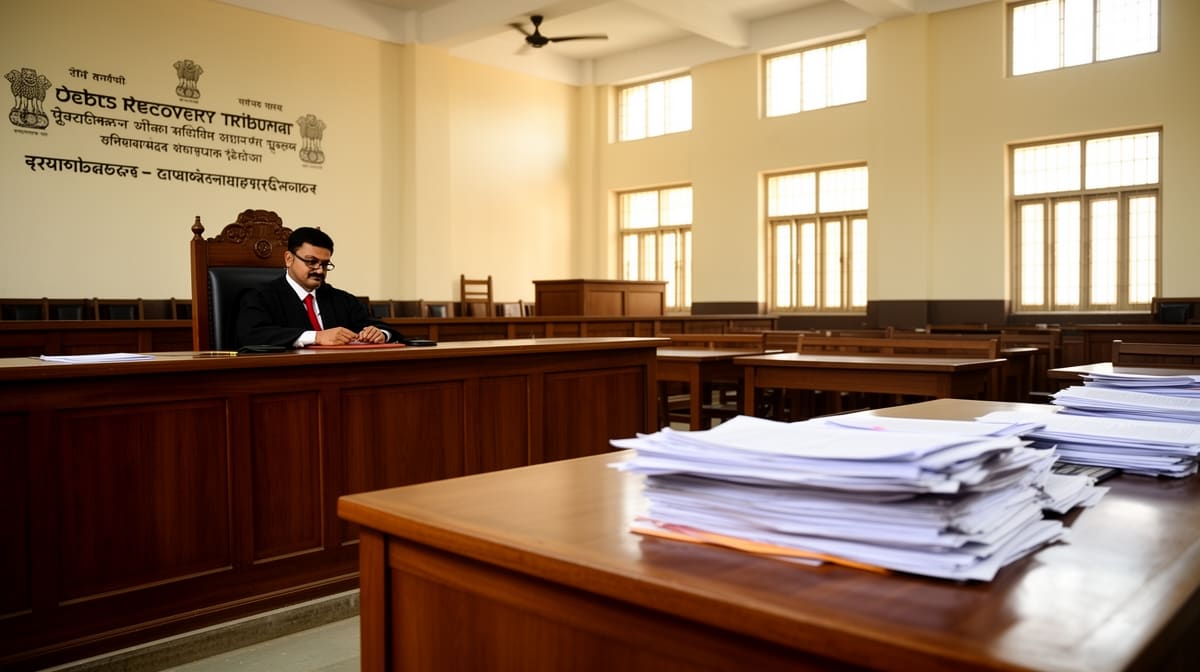
The petitioner, A. Lokanayaki, sought relief against the Authorized Officer of Canara Bank and eight other respondents concerning a pending Securitisation and Reconstruction of Financial Assets and Enforcement of Security Interest (SARFAESI) application filed in 2021. The application, numbered S.A. No. 288 of 2021, was filed by the bank to enforce its security interest over immovable property pledged as collateral for a defaulted loan.
Procedural History
- 2021: SARFAESI application filed before the Debts Recovery Tribunal, Coimbatore
- 2021 - 2026: Application remained pending for over five years without final orders
- 2026: Petitioner filed Writ Petition No. 3302 of 2026 under Article 226 of the Constitution, seeking mandamus to compel disposal
- 24 February 2026: Hearing conducted before Justices R. Suresh Kumar and Shamim Ahmed
Relief Sought
The petitioner sought a writ of mandamus directing the Debts Recovery Tribunal to dispose of the SARFAESI application expeditiously, preferably within a fixed time frame set by the High Court.
The Legal Issue
The central question was whether the High Court, under its writ jurisdiction under Article 226, can intervene to impose a time-bound deadline on the Debts Recovery Tribunal to decide a pending SARFAESI application that has remained unresolved for an unreasonably long period.
Arguments Presented
For the Petitioner
Mr. V. Sathish, counsel for the petitioner, argued that the prolonged pendency of the SARFAESI application - over five years - constituted a violation of the petitioner’s right to timely justice under Article 21. He emphasized that the matter was at the disposal stage and that undue delay undermined the very purpose of the SARFAESI Act, which is to ensure swift recovery. He cited M/s. M. S. R. & Co. v. Union of India to support the proposition that courts must intervene when quasi-judicial bodies fail to act within a reasonable time.
For the Respondent
Mr. R. Sreedhar, Standing Counsel for Canara Bank, did not oppose the prayer. He acknowledged the delay and confirmed that the matter was indeed at the final stage of hearing. He submitted that the bank had no objection to the Court fixing a timeline for disposal, thereby implicitly conceding the unreasonableness of the delay.
The Court's Analysis
The Court examined the legislative intent behind the SARFAESI Act, 2002, which was enacted to provide a time-bound mechanism for banks and financial institutions to recover dues without prolonged litigation. The Court noted that while the Debts Recovery Tribunal is an expert forum, its duty to adjudicate matters expeditiously is not optional but mandatory.
"The purpose of the SARFAESI Act would be rendered illusory if applications remain pending for years without any adjudication, particularly when they are at the final stage of hearing."
The Court held that the High Court’s writ jurisdiction under Article 226 is not confined to correcting legal errors alone but extends to ensuring that statutory bodies discharge their duties without undue delay. The Court distinguished this from interference in merits, clarifying that it was not directing the outcome but compelling the process. The three-month deadline was deemed reasonable given the age of the case and its proximity to conclusion.
The Verdict
The petitioner succeeded. The Madras High Court held that the Debts Recovery Tribunal must dispose of pending SARFAESI applications within a reasonable time, and directed the Tribunal to decide S.A. No. 288 of 2021 within three months of receiving a copy of the order. No costs were awarded.
What This Means For Similar Cases
Timely Adjudication Is a Legal Obligation
- Practitioners may now invoke Article 226 to seek time-bound disposal of pending SARFAESI applications that exceed two years without substantive progress
- The three-month benchmark set here may be applied as a reference point in future petitions
- Courts will likely view prolonged inaction by DRTs as a breach of statutory duty under the SARFAESI Act
Writ Jurisdiction Is a Viable Remedy Against Procedural Delay
- Writ petitions are not restricted to illegal orders - they can compel performance of statutory duties
- Banks and borrowers alike may use this precedent to push for faster resolution
- The Court’s refusal to award costs signals that such petitions are treated as procedural safeguards, not adversarial contests
No Merits Interference, Only Process Enforcement
- The Court explicitly avoided commenting on the merits of the case
- This reinforces that writs under Article 226 are not appeals but tools to enforce procedural compliance
- Practitioners must frame such petitions narrowly: focus on delay, not outcome