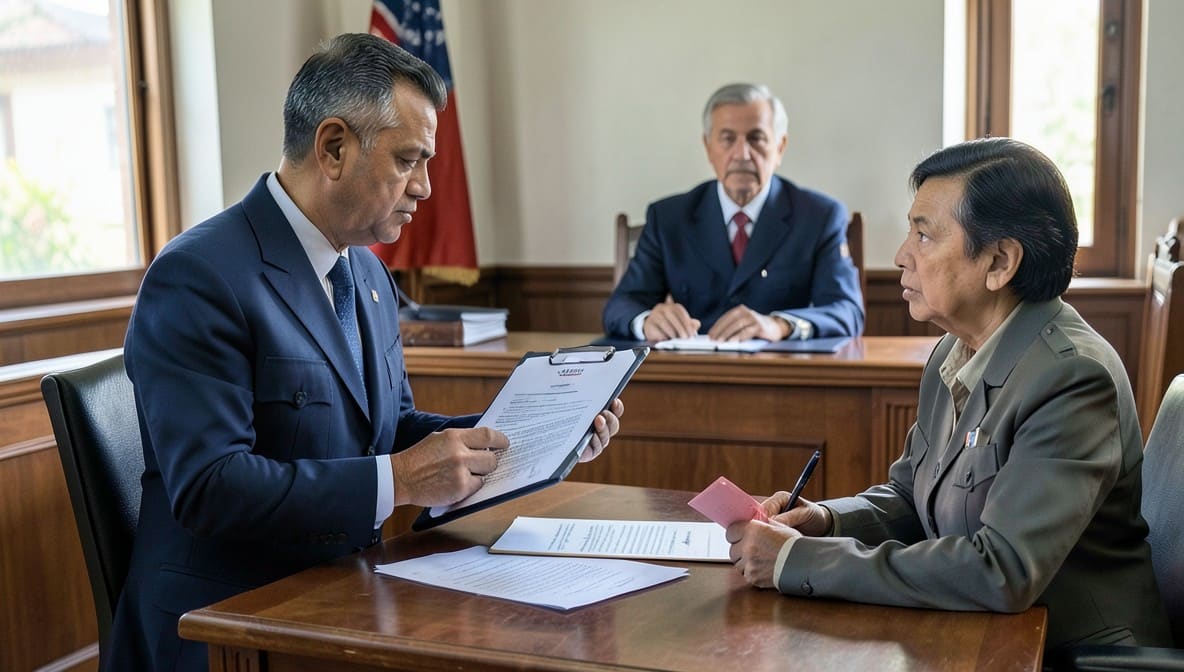
The Gauhati High Court has reaffirmed that a remand for denovo trial is not a procedural formality but a substantive right to a fair hearing. When an appellate court sets aside a conviction due to procedural defects, the trial court must conduct a fresh trial with full opportunity to both parties - failure to do so renders the subsequent judgment legally unsustainable.
Background & Facts
The Dispute
The appellant, Sh. H. Lalhmingmawia, was originally convicted under Section 6 of the Protection of Children from Sexual Offences (POCSO) Act, 2012, and sentenced to 15 years rigorous imprisonment with a fine of Rs. 5,000/- by the Fast Track Special Court (Rape & POCSO Act, 2012), Champhai, in Criminal Trial No. 496 of 2015. The conviction was based on allegations of sexual assault against a minor girl.
Key Facts
- The victim’s alleged assault occurred in 2014.
- The trial commenced in 2015.
- The original judgment and order was passed on 11.08.2021.
- The appellant filed Criminal Appeal No. 18 of 2021 before the Gauhati High Court.
- On 22.02.2024, the High Court set aside the conviction, holding that:
- The charge under Section 6 of the POCSO Act was not framed.
- The statement of the appellant under Section 313 Cr.P.C. was recorded without the Trial Judge’s signature, violating mandatory procedure.
- The High Court directed a denovo trial from the stage of framing of charges.
- On 21.11.2024, the Trial Court framed fresh charges under Section 6 of the POCSO Act and Section 376(2)(i)(k) IPC.
- On the same day, the appellant was examined under Section 313 Cr.P.C.
- The prosecution and defense both declined to adduce fresh evidence or cross-examine witnesses.
- A birth certificate of the victim, not produced earlier, was submitted by the prosecution.
- The appellant, during his Section 313 examination, stated he wished to examine one additional defense witness, providing name and address.
- The Trial Court, without recording any finding on guilt or allowing the proposed witness to be examined, imposed the same sentence of 15 years rigorous imprisonment and Rs. 5,000/- fine on 16.04.2025.
- The impugned judgment copied verbatim paragraphs 1 to 12 from the earlier, set-aside judgment.
Procedural History
- 2014: Alleged offense occurred.
- 2015: Criminal Trial No. 496 of 2015 commenced.
- 11.08.2021: Trial Court convicted appellant and sentenced him to 15 years RI + Rs. 5,000 fine.
- 2021: Appellant filed Criminal Appeal No. 18 of 2021 before Gauhati High Court.
- 22.02.2024: High Court set aside conviction, directed denovo trial from stage of framing of charge.
- 21.11.2024: Trial Court framed fresh charges under POCSO Section 6 and IPC Section 376(2)(i)(k); examined appellant under Section 313 Cr.P.C. on same day.
- 16.04.2025: Trial Court passed impugned judgment sentencing appellant to same punishment without conviction record.
- 23.01.2025: Criminal Appeal No. 23/2025 filed under Section 415 BNSS.
- 13.05.2026: Judgment pronounced by Division Bench of Gauhati High Court.
The Parties' Positions
For the Appellant
- Argued that the Trial Court treated the remand as a review, not a denovo trial.
- Contended that the right to cross-examine witnesses and adduce new evidence was denied.
- Highlighted that the proposed defense witness was ignored despite being named during Section 313 examination.
- Asserted that no formal conviction was recorded before sentencing, violating Section 235(2) Cr.P.C.
- Submitted that the judgment was a verbatim copy of the earlier, invalid order.
For the Respondent
- Argued that no substantial prejudice occurred as no fresh evidence was sought.
- Relied on Section 511 BNSS to contend that technical irregularities should not vitiate the outcome.
- Maintained that the sentence was justified based on the earlier evidence.
Relief Sought
The appellant sought:
- Setting aside of the impugned judgment and order dated 16.04.2025.
- Acquittal on grounds of grave procedural injustice.
- Alternatively, remand for a proper denovo trial with full opportunity to present defense.
The Legal Issue
The central question was whether a trial court, upon remand for a denovo trial, is obligated to provide the accused with a full opportunity to cross-examine witnesses, adduce new evidence, and present a defense - including the right to call proposed witnesses - before imposing sentence, and whether sentencing without a formal conviction violates the principles of natural justice and statutory procedure.
Arguments Presented
For the Appellant
The appellant’s counsel relied on State of Haryana v. Bhajan Lal and K. S. Puttaswamy v. Union of India to argue that a denovo trial is not a mere formality but a substantive right to a fair trial. He emphasized that Section 313 Cr.P.C. is not a substitute for trial; it is a pre-sentencing inquiry that must follow proper framing of charges and opportunity to defend. He cited State of U.P. v. Krishna Gopal to assert that sentencing without conviction is a nullity. He further argued that the failure to record the appellant’s request to examine a defense witness rendered the trial fundamentally flawed.
For the Respondent
The Additional Public Prosecutor contended that Section 511 of the Bharatiya Nagarik Suraksha Sanhita, 2023, bars reversal of orders for mere technical defects unless a failure of justice is shown. She argued that the evidence remained unchanged, the victim’s birth certificate was merely corroborative, and the sentence was proportionate. She maintained that the Trial Court’s action was efficient and not prejudicial.
The Court's Analysis
The Court observed that the remand order dated 22.02.2024 was unequivocal: a denovo trial was to be conducted from the stage of framing of charges. This was not a direction to merely correct a technical defect but to restart the trial with full procedural safeguards. The Court noted that the Trial Court’s conduct betrayed a fundamental misunderstanding of its mandate.
"The Trial Court appears to have taken up the matter as if it was dealing with an appeal or review and not conducting a denovo trial as directed by this Court."
The Court emphasized that the mere production of a birth certificate - a document not previously filed - required the Trial Court to afford the defense an opportunity to cross-examine on its authenticity and relevance. The failure to do so was a denial of the right to a fair hearing under Article 21 of the Constitution.
The Court further held that the appellant’s request to examine a defense witness, made during Section 313 examination, was a clear indication of his intent to adduce further evidence. The Trial Court’s silence on this point, coupled with its failure to record any finding of guilt, rendered the sentencing process legally invalid.
"The recitation of paragraph Nos. 1 to 12 of the impugned judgment is the same as the earlier order and in fact, a copy paste of the earlier Judgment & Order dated 09.08.2021."
The Court concluded that the Trial Court had not discharged its duty to independently evaluate the evidence. The sentencing without conviction violated Section 235(2) Cr.P.C., which mandates a separate hearing on sentence after conviction. The Court held that the Trial Court’s actions were not merely irregular but amounted to a failure of justice.
The Verdict
The appeal was allowed. The impugned judgment and order dated 16.04.2025 was set aside. The matter was remanded for denovo trial from the stage of framing of charges to be conducted by the Additional District & Sessions Judge, Champhai, who is designated to try POCSO cases. The Fast Track Special Court was directed to transmit the Trial Court Record forthwith. The Additional District & Sessions Judge was directed to conclude the trial expeditiously. The Legal Aid Counsel for respondent No. 2 was granted remuneration as fixed for such appointments.
What This Means For Similar Cases
Denovo Trial Requires Full Procedural Compliance
- Practitioners must insist that trial courts treat remands for denovo trials as complete restarts - not reviews or corrections.
- Any prior evidence may be relied upon, but only if both parties are given opportunity to cross-examine, adduce new evidence, or challenge authenticity.
- Failure to allow defense witnesses named during Section 313 examination constitutes a violation of natural justice.
Sentencing Without Conviction Is a Nullity
- A court cannot impose sentence unless a formal conviction under a specific provision is recorded.
- Section 235(2) Cr.P.C. mandates a separate hearing on sentence after conviction; bypassing this renders the sentence void.
- Copy-pasting prior judgments without independent reasoning invalidates the entire proceeding.
Technical Irregularities Can Amount to Failure of Justice
- Section 511 BNSS does not shield orders where the trial process is fundamentally compromised.
- Courts must examine whether procedural lapses have deprived the accused of a fair trial, not merely whether they are "technical."
- Remand orders are binding; deviation invites reversal.