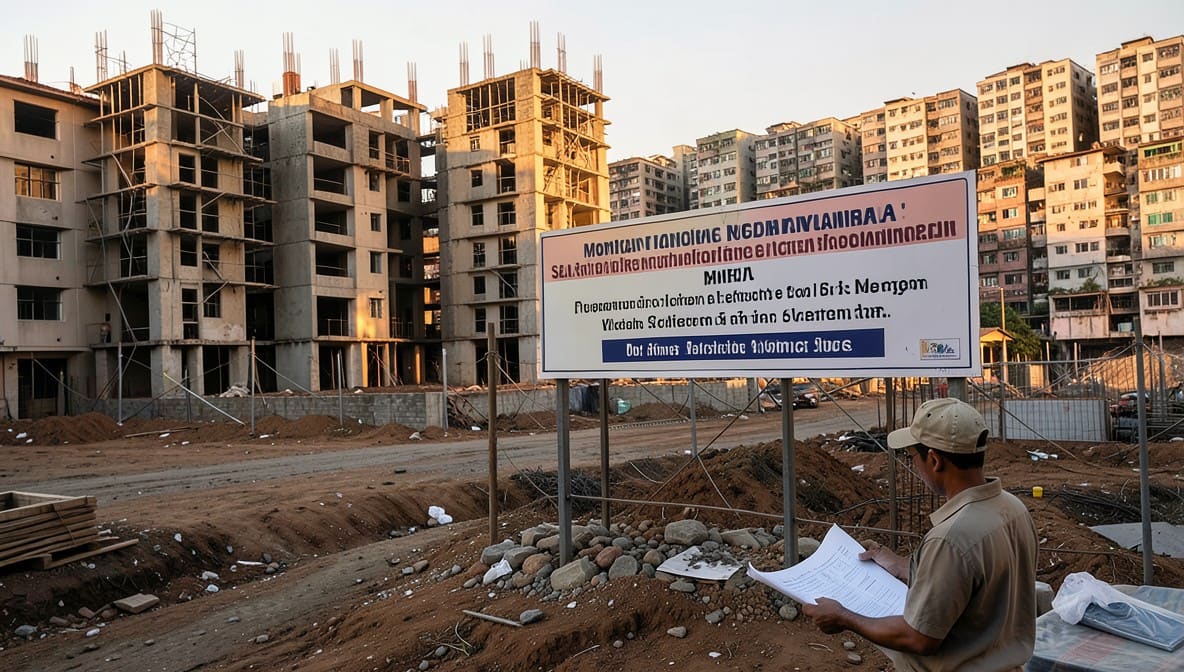
The Bombay High Court has reaffirmed that administrative authorities cannot evade their statutory obligations by issuing non-speaking orders, even in complex urban development matters. The judgment underscores the constitutional imperative of reasoned decision-making under Article 14 and the statutory framework of the Development Control and Promotion Regulations, 2034.
Background & Facts
The Dispute
The petitioners, Chandani Agar Social Co-operative Housing Society Ltd. (Proposed) and M/s. Super Construction Co., sought a No Objection Certificate (NOC) from the Additional Collector, Mumbai, for the implementation of a Slum Rehabilitation (SR) scheme on government-owned land bearing City Survey Nos. 94(pt), 97(pt), 102(pt), 103(pt), and 1/104(pt) in Wadala (E), Mumbai. The land is designated for slum rehabilitation under the Slum Rehabilitation Authority (SRA) framework. The petitioner housing society, representing slum dwellers, had appointed the developer to execute the SR project. Despite prior approvals and directions from the SRA, the NOC remained pending due to procedural objections raised by the Collector.
Key Facts
- The land is owned by the State Government and declared as a slum area under applicable law
- The SRA had issued a bar chart-based implementation schedule on 06.05.2025, directing the developer to complete the SR scheme
- Regulation 33(10)(2.8) of the Development Control and Promotion Regulations, 2034 (DCPR, 2034) mandates that if a land-owning authority does not respond to an NOC request within 60 days, the NOC shall be deemed granted
- The SRA submitted a formal request for NOC on 08.10.2025
- The Additional Collector’s office received the request but returned it on 19.11.2025, citing improper addressing (not directed to the Collector’s office, but to the Additional Collector’s office)
- A fresh proposal was resubmitted by the SRA on 20.11.2025, correctly addressed to the Collector
- The impugned order dated 01.12.2025 rejected the request with the sole observation: "it is rejected for the time being and final decision will be taken later on."
- The petitioners relied on Lakadawala Housing Pvt. Ltd. & others v. State of Maharashtra (Writ Petition(L) No. 27629/2024, order dated 08.01.2025), where a similar unreasoned order was set aside
Procedural History
- 08.10.2025: SRA requests NOC from Additional Collector
- 19.11.2025: Collector returns request on technical ground of misaddressing
- 20.11.2025: SRA resubmits proposal correctly addressed to Collector
- 01.12.2025: Collector issues impugned order rejecting NOC without reasons
- 22.06.2026: Writ Petition (L) No. 5211 of 2026 filed before Bombay High Court
Relief Sought
The petitioners sought quashing of the order dated 01.12.2025 and a direction to the Collector to grant the NOC under the deemed provision of Regulation 33(10)(2.8) of DCPR, 2034, or alternatively, to decide the application within a stipulated time.
The Legal Issue
The central question was whether an administrative order rejecting an NOC application under Regulation 33(10)(2.8) of the DCPR, 2034, which merely states "rejected for the time being" without any reasoning, constitutes a lawful exercise of power or violates the principles of natural justice and reasoned decision-making.
Arguments Presented
For the Petitioner
The petitioners contended that the Collector’s order dated 01.12.2025 was a non-speaking order, devoid of any legal or factual basis, rendering it arbitrary and violative of Article 14 of the Constitution. They relied on Lakadawala Housing Pvt. Ltd. to establish that unreasoned orders in matters involving statutory deemed provisions are per se invalid. They emphasized that the SRA had complied with all procedural requirements, and the 60-day period under Regulation 33(10)(2.8) had lapsed without any substantive response, thereby triggering the deemed grant of NOC. The failure to apply the deemed provision amounted to a denial of statutory right.
For the Respondent
The State and SRA did not contest the legal principle of reasoned orders but argued that the technical misaddressing of the initial application justified the delay. However, they did not offer any substantive justification for the rejection of the resubmitted application dated 20.11.2025, nor did they dispute that the 60-day period under DCPR had expired.
The Court's Analysis
The Court examined the nature of the Collector’s order and found it to be a classic example of arbitrary administrative action. The order contained no reference to any statutory provision, no assessment of the application’s merits, no consideration of the lapse of the 60-day period under Regulation 33(10)(2.8), and no explanation for why the request was being deferred indefinitely.
"The learned Collector simply cannot say 'it is rejected for the time being and final decision will be taken later on.' This cannot be said to be proper exercise of the power."
The Court held that administrative discretion, even when exercised by statutory authorities, must be exercised within the bounds of reason and transparency. The doctrine of audi alteram partem and the requirement of reasoned orders are not mere procedural formalities but substantive constitutional safeguards. The Court distinguished the present case from situations involving genuine administrative delays due to pending clarifications, noting that here, the application had been resubmitted correctly and no further information was sought.
The Court further noted that Regulation 33(10)(2.8) of DCPR, 2034 was enacted precisely to prevent indefinite delays in urban development projects. By refusing to apply the deemed provision without reasons, the Collector effectively nullified a statutory right granted to applicants. The Court emphasized that the power to refuse an NOC must be exercised with clear, documented grounds, especially when the statutory timeline has expired.
The Verdict
The petition succeeded. The Court set aside the order dated 01.12.2025 passed by the Collector. The Collector is directed to decide the proposal submitted by the SRA dated 20.11.2025 for grant of NOC within 30 days from the communication of this order. The petition is disposed of.
What This Means For Similar Cases
Reasoned Orders Are Non-Negotiable Under Statutory Frameworks
- Practitioners must challenge any administrative refusal of statutory benefits (e.g., NOCs, permissions, clearances) that lacks reasoning, even if the underlying application appears procedurally flawed
- The lapse of a statutory timeline (e.g., 60 days under DCPR) triggers a deemed right; refusal thereafter requires explicit, documented justification
- Courts will not uphold "pending decision" or "reconsideration" as valid dispositions when statutory deadlines have expired
Deemed Provisions Are Substantive Rights, Not Technicalities
-
Statutory deemed provisions are not procedural loopholes but legislative tools to prevent bureaucratic inertia
-
Authorities cannot evade deemed grant by raising technical objections after the deadline has passed
-
Where a statute provides for deemed approval, the burden shifts to the authority to demonstrate why the statutory condition for deemed grant does not apply
-
Always verify whether statutory timelines for NOC, building permission, or environmental clearance have lapsed before filing writ petitions
-
In cases involving DCPR, RERA, or municipal bylaws with deemed provisions, plead the lapse of time as a substantive right, not merely a procedural ground
-
Cite Lakadawala Housing and this judgment to support arguments against non-speaking orders in urban development matters