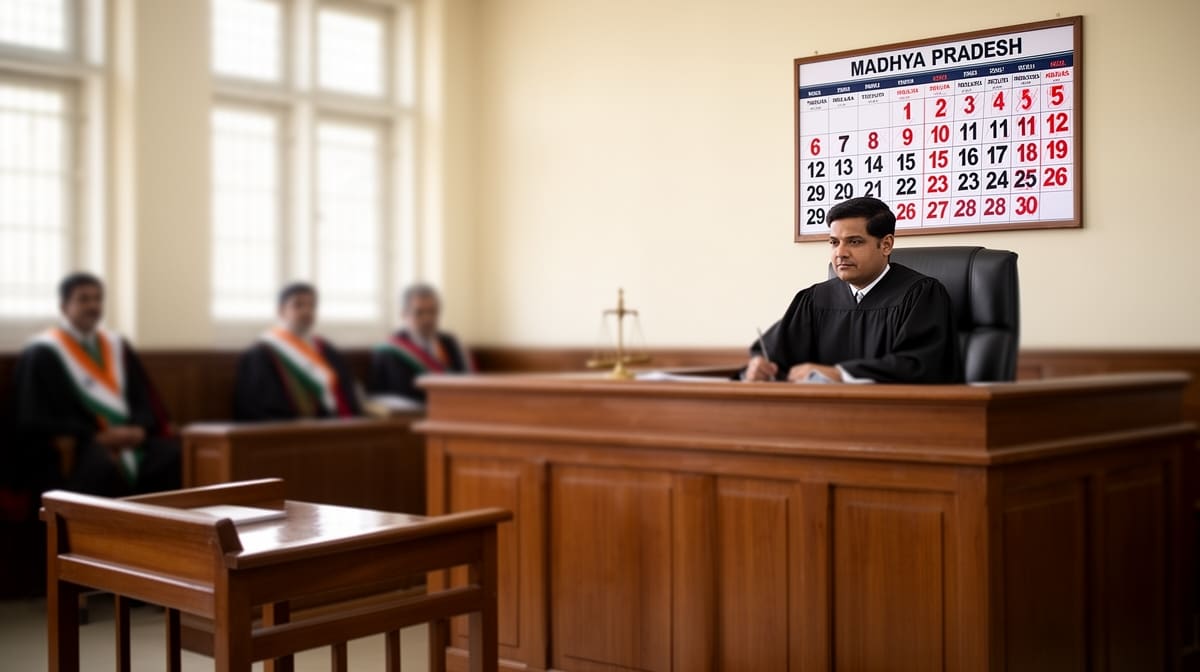
The Madhya Pradesh High Court has reinforced the constitutional imperative of timely justice by directing a trial court to conclude proceedings on an unregistered private complaint within two months. This order underscores the judiciary’s duty to prevent indefinite delays at the preliminary stage, where procedural inaction can effectively deny access to justice.
Background & Facts
The Dispute
The petitioner, Smt. Ramo Patel, filed a private criminal complaint before the Judicial Magistrate First Class, Gwalior, on 02.08.2016, alleging an offence under the Indian Penal Code. Despite the filing of the complaint, the trial court has not proceeded to register the complaint or issue process, and the matter has remained pending for nearly a decade without any substantive progress.
Key Facts
- The private complaint was filed on 02.08.2016 under Section 200 of the Cr.P.C.
- The complaint remains unregistered as of the date of the petition
- The Magistrate has repeatedly adjourned proceedings for recording of statements under Sections 200 and 202 of the Cr.P.C. (now Section 223 of the BNSS)
- No order has been passed on whether to take cognizance, dismiss, or register the complaint
- The petitioner has not been granted any interim relief or status update despite multiple follow-ups
Procedural History
- 02.08.2016: Private complaint filed before Judicial Magistrate First Class, Gwalior
- 2016 - 2026: Repeated adjournments for recording of statements under Sections 200 and 202 Cr.P.C.
- No order issued on registration or dismissal of complaint during this period
- 2026: Petition filed under Section 482 Cr.P.C. before the High Court of Madhya Pradesh at Gwalior
Relief Sought
The petitioner sought a direction to the trial court to conclude the preliminary proceedings and decide whether to register or dismiss the complaint within a specified time frame, citing undue delay and violation of the right to speedy justice.
The Legal Issue
The central question was whether the High Court, under Section 482 of the Cr.P.C., can intervene to direct a trial court to conclude preliminary proceedings on a private complaint within a reasonable time when there is unjustified and prolonged inaction.
Arguments Presented
For the Petitioner
Learned counsel for the petitioner relied on the Supreme Court’s repeated directives in Lalita Kumari v. Government of U.P. and Siddharam Satlingappa Mhetre v. State of Maharashtra that preliminary inquiry stages must not be allowed to drag on indefinitely. He emphasized that Section 200 and 202 Cr.P.C. contemplate expeditious examination of complainants and inquiry into the truth of allegations, not perpetual delay. He argued that the failure to act for nearly ten years amounted to a denial of justice and violated Article 21 of the Constitution.
For the Respondent/State
The Government Advocate conceded that while the trial court must follow due procedure, indefinite pendency of a complaint at the preliminary stage is impermissible. He acknowledged that the delay was unreasonable and did not contest the petitioner’s prayer for a time-bound direction, provided it did not prejudice the court’s discretion to decide on registration or dismissal.
The Court's Analysis
The Court observed that the right to a speedy trial is an integral component of Article 21 and applies even at the preliminary stage of a private complaint. The Court noted that while the Magistrate has the discretion to examine the complaint under Sections 200 and 202 Cr.P.C., this discretion cannot be exercised in a manner that results in indefinite delay.
"The law does not contemplate a complaint remaining in a state of suspended animation for nearly a decade without any decision on registration or dismissal. Such inaction defeats the very purpose of the criminal justice system."
The Court distinguished between legitimate procedural requirements and unjustified delay. It held that the Magistrate’s failure to act for nearly ten years, despite the absence of any complex factual or legal issues requiring extended inquiry, constituted a clear abuse of process. The Court further relied on the Supreme Court’s guidelines in State of Haryana v. Bhagwan Das and K. Veeraswami v. Union of India, which emphasize that judicial delay, even at the preliminary stage, is a violation of fundamental rights.
The Court declined to express any opinion on the merits of the complaint or the likelihood of its success, but stressed that the procedural machinery must function within reasonable timeframes.
The Verdict
The petition was allowed. The High Court directed the Judicial Magistrate First Class, Gwalior, to conclude the proceedings on the private complaint filed on 02.08.2016, including recording of statements under Sections 200 and 202 Cr.P.C., and to pass an order on registration or dismissal of the complaint, within two months from the date of receipt of a certified copy of this order. The direction is binding and non-extendable.
What This Means For Similar Cases
Judicial Inaction at Preliminary Stage Is Not Tolerated
- Practitioners may now invoke Section 482 Cr.P.C. to seek time-bound directions when private complaints remain pending for more than two years without any substantive progress
- Courts must record reasons for any adjournment beyond 30 days at the preliminary stage
- Delay beyond 18 months without a reasoned order may constitute grounds for a writ petition under Article 226
Procedural Compliance Must Be Time-Bound
- The two-month deadline set here establishes a new benchmark for preliminary inquiry timelines in private complaints
- Trial courts must now treat the period between filing and registration as a critical phase subject to judicial oversight
- Advocates should file applications under Section 309 Cr.P.C. for early hearing if no progress is made within 60 days of filing
Right to Speedy Justice Applies Even Before Cognizance
- The judgment confirms that Article 21 protections extend to the pre-cognizance stage of criminal proceedings
- This principle now applies equally to private complaints and police-initiated investigations
- Delay in deciding whether to take cognizance is no longer a mere procedural lapse - it is a constitutional violation