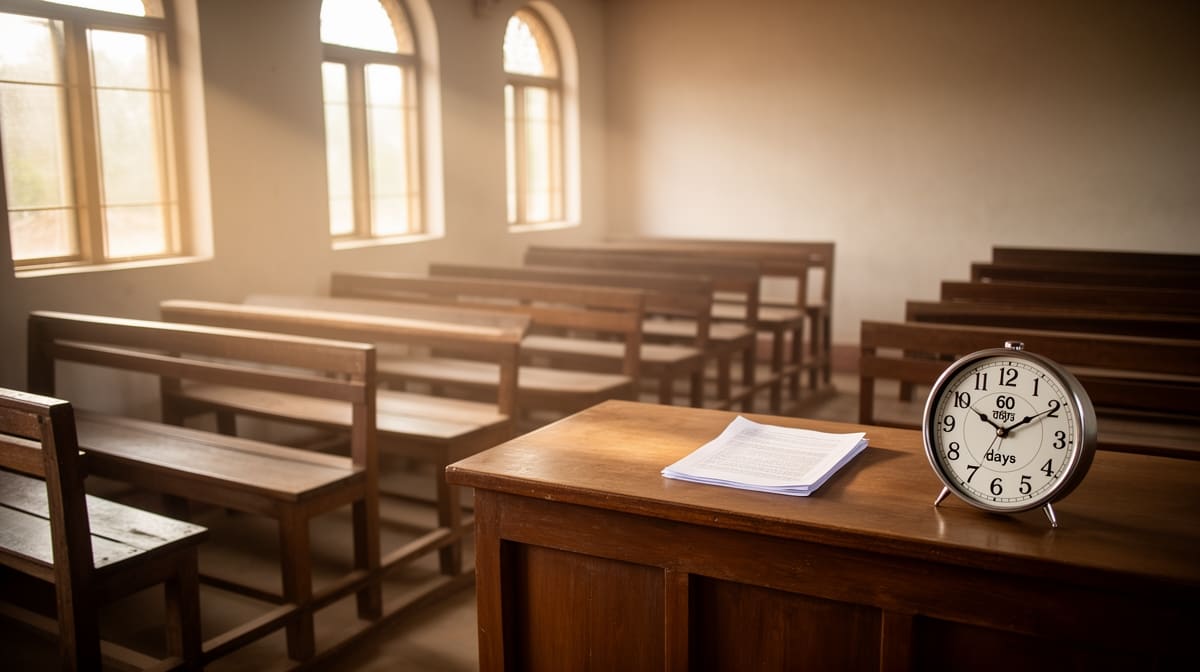
The Allahabad High Court has reaffirmed the constitutional imperative of protecting personal liberty by granting bail under Section 437(6) of the CrPC when trial proceedings are unduly delayed. This judgment provides critical clarity for accused persons in non-bailable offences where the prosecution fails to conclude evidence within the statutory 60-day window, reinforcing the legislative intent behind the provision.
Background & Facts
The Dispute
The applicant, Deepak Saini, is accused in Crime No. 157 of 2024 under Sections 420, 406, 467, 468, and 471 of the IPC at Police Station Echoda Kamboh, District Sambhal. The case arises from an allegation that the applicant received Rs. 5,60,000 via RTGS from the informant on the pretext of securing university admission for the informant’s son in Germany. The prosecution claims the amount was fraudulently obtained, but no evidence has been adduced to substantiate the applicant’s direct involvement or benefit.
Key Facts
- The First Information Report (FIR) was registered on 21.11.2024.
- The applicant was arrested on 07.11.2024 and has remained in custody since then.
- The charge sheet was filed on 31.01.2025.
- The Magistrate took cognizance of the charge sheet on 12.02.2025.
- Charges were formally framed on 28.05.2025.
- The trial was scheduled to commence with prosecution evidence after framing of charges.
- As of the date of the bail order, no prosecution witness has testified.
- The applicant has three prior criminal cases, all of which were explained in Paragraph 17 of the bail application.
Procedural History
- 21.11.2024: FIR registered.
- 07.11.2024: Applicant taken into custody.
- 31.01.2025: Charge sheet submitted.
- 12.02.2025: Magistrate took cognizance.
- 28.05.2025: Charges framed.
- Post-28.05.2025: First date fixed for taking evidence.
- 29.04.2026: Bail application heard and decided by the High Court.
Relief Sought
The applicant sought release on bail under Section 437(6) CrPC (now Section 480(6) BNSS) on the ground that the trial had not concluded within 60 days from the first date fixed for taking evidence, despite his continuous custody since 07.11.2024.
The Legal Issue
The central question was whether an accused person, who has been in continuous custody since arrest and whose trial has not concluded within 60 days from the first date fixed for taking evidence, is automatically entitled to bail under Section 437(6) CrPC, even in cases involving serious non-bailable offences, provided there is no risk of evidence tampering or absconding.
Arguments Presented
For the Appellant/Petitioner
Learned counsel for the applicant argued that the statutory conditions under Section 437(6) CrPC were fully satisfied: the case was triable by a Magistrate, the trial had not concluded within 60 days of the first date fixed for evidence, and the applicant had been in continuous custody since 07.11.2024. Counsel emphasized that the prosecution had not examined a single witness despite charges being framed over three months prior. Counsel relied on the Supreme Court’s recent decision in Subhelal @ Sushil Sahu v. State of Chhattisgarh to argue for a liberal interpretation of the provision, stressing that the absence of any fault on the accused’s part, the documentary nature of evidence, and the substantial period of incarceration warranted immediate release.
For the Respondent/State
The Government Advocate did not dispute the factual matrix or the applicability of Section 437(6) CrPC. He conceded that the statutory conditions were met and did not advance any specific grounds to deny bail under the provision, effectively abandoning opposition to the bail plea on statutory grounds.
The Court's Analysis
The Court undertook a detailed examination of Section 437(6) CrPC, noting its insertion was intended to prevent prolonged pre-trial detention in cases where the prosecution fails to make timely progress. The Court observed that the provision operates as a statutory right, not a discretionary privilege, once the conditions are satisfied.
"This Court is of a considered view that applications under Section 437 (6) have to be given a liberal approach and it would be a sound and judicious exercise of discretion in favour of the accused by the Court concerned more particularly where there is no chance of tampering of evidence e.g. where the case depends on documentary evidence which is already collected; where there is no fault on part of the accused in causing of delay; where there are no chances of any abscondence by the accused; where there is little scope for conclusion of trial in near future; where the period for which accused has been in jail is substantial in comparison to the sentence prescribed for the offence for which he is tried."
The Court noted that the case primarily rested on documentary evidence - bank records and communication trails - all of which were already collected and in the possession of the prosecution. There was no allegation of witness intimidation or risk of evidence destruction by the applicant. The applicant had been in custody for over five months, far exceeding the 60-day threshold. The Court further held that the normal bail parameters applicable to regular bail applications - such as gravity of offence or criminal antecedents - must yield to the statutory mandate of Section 437(6), especially where the accused is not responsible for delay.
The Court distinguished this from applications for regular bail, emphasizing that Section 437(6) is a safeguard against arbitrary detention, not a tool for evaluating the merits of the case. The absence of any positive factor indicating prejudice to the prosecution or culpability of the accused in delay rendered the applicant entitled to release.
The Verdict
The bail application was allowed. The applicant, Deepak Saini, is directed to be released on bail upon executing a personal bond of Rs. 50,000 and two reliable sureties each in the like amount, subject to the following conditions: (1) He shall not tamper with evidence; (2) He shall not commit any further offence; (3) He shall not intimidate or pressure prosecution witnesses; (4) He shall appear before the trial court on every date fixed, unless exempted by the court. In the event of breach, the trial court may cancel bail. The order was passed on 29.04.2026.
What This Means For Similar Cases
Bail Is a Statutory Right Under CrPC 437(6)
- Practitioners must file applications under Section 437(6) immediately upon expiry of 60 days from the first date fixed for evidence, regardless of offence severity.
- The burden shifts to the prosecution to record written reasons for denying bail - silence or non-opposition is insufficient to defeat the claim.
Documentary Evidence Cases Are Strong Candidates for Bail
- Where the case hinges on bank records, emails, or digital trails already in possession of the prosecution, courts must presume no risk of evidence tampering.
- Such cases are ideal for invoking Section 437(6), as the Supreme Court has explicitly recognized the absence of tampering risk as a decisive factor.
Custody Duration Trumps Gravity of Offence
- Even in cases involving offences punishable by up to seven years (e.g., forgery under Section 467 IPC), prolonged custody beyond 60 days without trial progress mandates release.
- Criminal antecedents do not override the statutory right unless they directly indicate risk of absconding or witness tampering.
Delay Must Be Attributable to Prosecution
- Courts will examine whether the delay stems from prosecution’s failure to examine witnesses, adjournments sought by the state, or court backlogs - not from the accused’s conduct.
- Accused who have not sought adjournments or caused procedural delays are entitled to automatic relief under this provision.