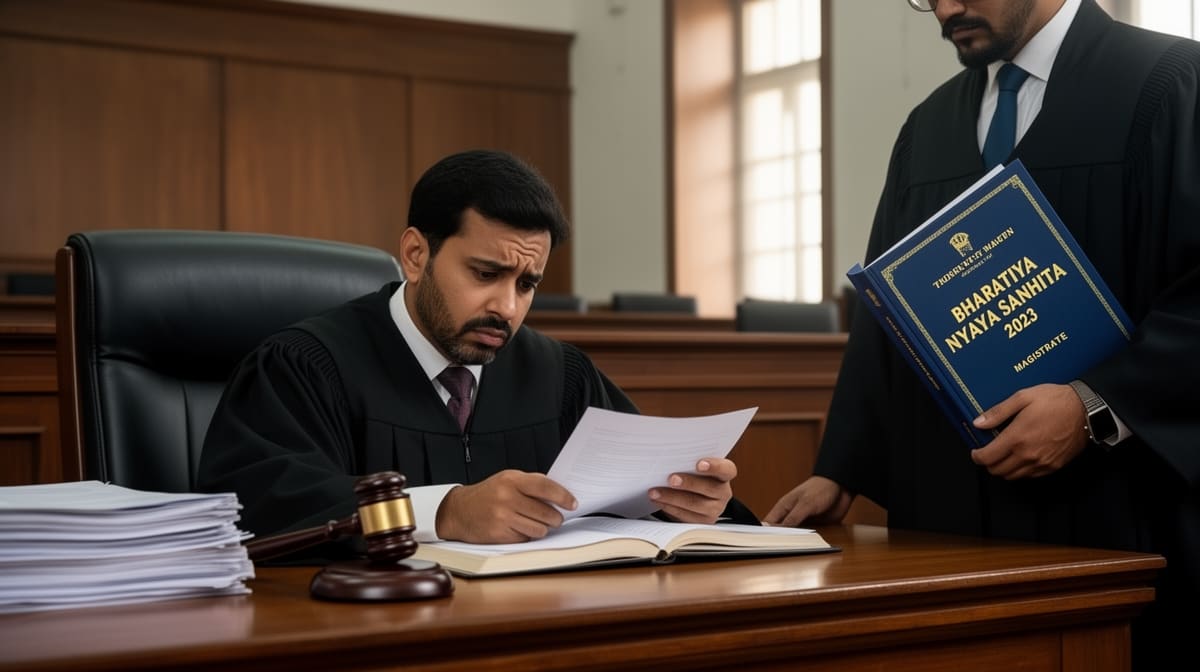
The Bombay High Court has reaffirmed that the right to be heard is not a formality but a constitutional imperative in criminal proceedings. In quashing an order summoning a prosecution witness under Section 311 of the CrPC without affording the accused an opportunity to respond, the Court underscored that procedural fairness cannot be sacrificed even in the name of expediency.
Background & Facts
The Dispute
The petitioner, Rakesh Kumar, son of Omprakash Sharma, is the accused in Special CBI Case No. 2/2016, pending before the Special Court, CBI, Nagpur. The case involves allegations of corruption and misconduct under the Prevention of Corruption Act. The prosecution had closed its evidence, and the trial was proceeding toward arguments. At this stage, the Central Bureau of Investigation (CBI) filed an application under Section 311 of the Code of Criminal Procedure seeking to summon G. A. Suriya Kumar, Inspector of Police, CBI, ACB Branch, Chennai, as a prosecution witness.
Key Facts
- The CBI application was filed on or about 31.01.2026
- The Special Court passed an order on 02.02.2026 (Exh. 410) allowing the application with the cryptic direction: "issue witness summons as prayed"
- The petitioner was neither present in court nor served with notice of the application
- No opportunity was given to the petitioner to oppose the summoning of the witness
- The prosecution had already closed its evidence, and the trial was beyond the stage of recording witness testimony
- The witness sought to be summoned, G. A. Suriya Kumar, was not previously listed in the charge sheet or the list of prosecution witnesses
Procedural History
- 02.02.2026: Special Court, CBI Nagpur, passed impugned order allowing CBI’s application under Section 311 CrPC without hearing the accused
- 15.02.2026: Petitioner became aware of the order through his counsel
- 20.02.2026: Petitioner filed the present Criminal Writ Petition No. 192/2026 before the Bombay High Court, Nagpur Bench
- 04.05.2026: Hearing concluded before Justice M. M. Nerlikar
The Parties' Positions
Petitioner: Argued that the order was passed ex parte, in violation of the principles of natural justice. He contended that summoning a new witness after closure of evidence, without notice or hearing, prejudices his right to cross-examine and defend himself. He emphasized that Section 311 cannot override the fundamental right to a fair hearing.
Respondent (CBI): Contended that Section 311 CrPC grants the court plenary power to summon any person as a witness at any stage of trial, even after evidence is closed, for the purpose of arriving at a just decision. It argued that no prejudice was caused as the witness’s testimony would be subject to cross-examination.
Relief Sought
The petitioner sought quashing of the order dated 02.02.2026, setting aside the summons issued to G. A. Suriya Kumar, and directing the Trial Court to afford him an opportunity to be heard before any further action is taken under Section 311 CrPC.
The Legal Issue
The central question was whether a criminal court may invoke Section 311 of the CrPC to summon a witness after closure of evidence without providing the accused an opportunity to be heard, and whether such an ex parte order violates the principles of natural justice.
Arguments Presented
For the Petitioner
The petitioner’s counsel relied on State of U.P. v. Krishna Gopal and Rajendra Prasad v. State of U.P. to argue that while Section 311 grants wide powers, they are not unfettered. The right to be heard is an essential component of fair trial under Article 21 of the Constitution. Summoning a new witness after evidence is closed, without notice or opportunity to oppose, amounts to a denial of procedural fairness. The order was cryptic, lacked reasoning, and was passed without any record of the accused’s presence or submission.
For the Respondent
The respondent’s counsel contended that Section 311 CrPC is a discretionary power exercisable at any stage to ensure justice. Citing S. R. Batra v. Union of India, he argued that the court’s duty to seek truth overrides procedural technicalities. He submitted that the witness’s testimony was not intended to fill a lacuna but to clarify a material fact, and that the accused would still have full opportunity to cross-examine.
The Court's Analysis
The Court examined the nature of the order passed by the Trial Court and found it to be procedurally defective. The order contained no reasons, no indication that the petitioner was heard, and no reference to any material justifying the summoning of a witness after evidence closure.
"Prima facie, it appears to me that unless an opportunity is given to the petitioner, the order could not have been passed. Further, the order is cryptic as no reasons are given for allowing the application."
The Court emphasized that Section 311 CrPC is not a tool to bypass the adversarial process. Even though the power is broad, it must be exercised in a manner consistent with natural justice. The absence of any record of notice, hearing, or reasoning rendered the order arbitrary and violative of the accused’s right to a fair trial.
The Court distinguished the respondent’s reliance on cases where summoning was done during trial with notice and opportunity. Here, the accused was completely excluded from the process. The Court held that the power to summon a witness cannot be exercised in a manner that renders the trial unfair.
The Verdict
The petition succeeded. The impugned order dated 02.02.2026 passed in Special CBI Case No. 2/2016 is quashed and set aside. The petitioner is granted an opportunity to file his say within eight days. The Trial Court shall then pass a brief reasoned order after considering the petitioner’s submission. If the petitioner fails to file his say within the stipulated time, the Trial Court may proceed further. No costs are awarded.
What This Means For Similar Cases
Procedural Fairness Trumps Procedural Convenience
- Practitioners must now insist on notice and hearing before any application under Section 311 CrPC is decided, especially after evidence closure
- Courts cannot rely on the broad language of Section 311 to bypass the right to be heard
- Any order under Section 311 passed without recording reasons or affording opportunity is liable to be quashed
Post-Evidence Summoning Requires Strict Scrutiny
- Summoning a witness after closure of evidence is not per se illegal, but it triggers heightened scrutiny
- The prosecution must demonstrate a compelling reason why the witness could not have been examined earlier
- The accused’s right to cross-examine and prepare a defense must be preserved
- Courts must record reasons for allowing such applications, even if brief
Cryptic Orders Are Legally Unsustainable
- Orders that merely state "application allowed" without reasoning are vulnerable to challenge
- The absence of reasoning raises a presumption of arbitrariness
- Advocates should routinely move for reasoned orders in all applications under Section 311 CrPC