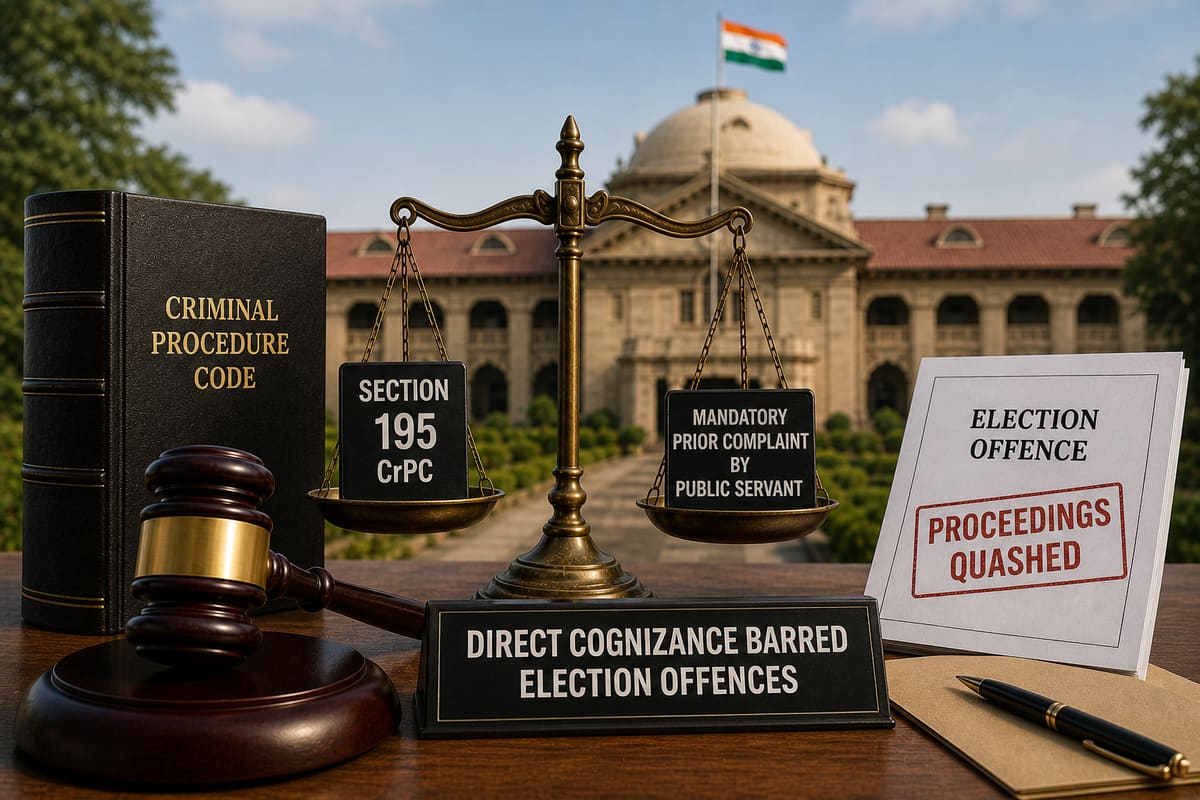
The Telangana High Court has delivered a significant ruling clarifying the threshold for prosecuting electoral bribery under the Indian Penal Code, emphasizing that mere possession of cash and voter lists does not constitute an offence without proof of intent to influence electoral conduct.
Background & Facts
The Dispute
The criminal proceedings arose from allegations that two faculty members of Geethanjali Engineering College and the brother of a college chairman - accused Nos. 1, 2, and 4 - were involved in distributing Rs. 1,90,000 along with voter lists and pamphlets for the Chevella Lok Sabha constituency. The complainant, an Assistant Sub-Inspector of Police, claimed the money and materials were seized from a two-wheeler during a check at Vishal Mark Check Post. The accused were charged under Section 171-B (bribery), Section 171-E (punishment for bribery), Section 188 (disobedience to public order), and Section 109 (punishment for abetment) of the IPC.
Procedural History
- 11 May 2024: Complaint filed by Respondent No. 2 alleging illegal distribution of money and voter lists.
- Crime No. 333 of 2024: Registered by Saifabad Police Station.
- Investigation: Statements recorded under Section 161 Cr.P.C. from complainant and two constables; no voter or independent witness examined.
- Charge Sheet Filed: Accused Nos. 1, 2, and 4 were arrayed; accused No. 3 (college chairman) was dropped.
- C.C. No. 7169 of 2024: Taken on file by IV Additional Chief Metropolitan Magistrate, Hyderabad.
- Crl. P. Nos. 152 & 5696 of 2025: Petitions filed under Section 528 BNSS to quash proceedings.
Relief Sought
The petitioners sought quashing of the criminal proceedings on grounds that the complaint and evidence failed to establish the essential ingredients of the alleged offences, particularly the element of gratification offered to voters with intent to influence electoral choice.
The Legal Issue
The central question was whether the allegations, even if accepted at face value, establish the essential ingredients of bribery under Section 171-B IPC and disobedience to a public order under Section 188 IPC, or whether the proceedings constitute an abuse of process due to absence of prima facie evidence.
Arguments Presented
For the Petitioner
Learned counsel argued that:
- The complaint and witness statements do not allege that any voter received money or was induced to vote.
- There is no evidence linking the cash or voter lists to any specific voter or electoral act.
- Section 171-B IPC requires proof that gratification was given to induce or reward electoral conduct; mere possession is insufficient.
- Section 188 IPC requires a lawful order promulgated by a public servant, which was neither pleaded nor proved.
- The Investigating Officer failed to follow mandatory procedures under Section 155(2) Cr.P.C. and Section 195(1)(a) Cr.P.C., which require prior sanction for prosecution in cases involving disobedience to public orders.
- Relied on N.T. Rama Rao v. State of A.P., Bhajan Lal v. State of Haryana, and Kesineni Srinivasa Rao v. State of A.P. to support the absence of prima facie case.
For the Respondent
The Public Prosecutor contended that:
- The seizure of large cash amounts and voter lists from individuals connected to a contesting candidate raises serious suspicion.
- The presence of campaign materials and money in proximity to a candidate’s associates supports an inference of electoral malpractice.
- The trial court is the appropriate forum to evaluate credibility of witnesses and determine guilt.
- Quashing at this stage would undermine the investigative process.
The Court's Analysis
The Court undertook a rigorous statutory and precedential analysis to determine whether the allegations met the threshold for initiating criminal proceedings.
"To attract an offence under Section 171-B of IPC, the requirement is that he should be a person, who give or at least offers to give any gratification as a reward for exercising the electoral right or for having exercised such a right."
The Court emphasized that gratification under Section 171-B IPC must be shown to have been offered to a voter with the intent to influence their vote. The complainant’s statement and those of the two constables did not allege that any voter received money, was approached, or was promised anything. The cash was found in the vehicle of the accused, not in the hands of any elector. The Court cited Kesineni Srinivasa Rao to affirm that gratification must please or satisfy the recipient - here, no recipient was identified.
Regarding Section 188 IPC, the Court held that the offence requires a lawful order promulgated by a public servant, which was neither pleaded nor produced. The Court relied on N.T. Rama Rao, which held that only a Superintendent or Assistant Superintendent of Police can issue such orders under the Police Act, 1861, and that complaints under Section 188 require prior sanction under Section 195(1)(a) Cr.P.C. - a condition entirely ignored.
On abetment under Section 107 IPC, the Court noted that instigation, conspiracy, or intentional aid must be proven. No such acts were alleged against the petitioners. The mere association with the accused candidate or possession of materials does not constitute abetment.
The Court further applied the sixth guideline in Bhajan Lal, which permits quashing where there is an express legal bar to prosecution or where the complaint lacks essential ingredients. The absence of any voter testimony, lack of sanction under Section 195(1)(a), and failure to establish the core elements of the offences rendered the proceedings unsustainable.
The Verdict
The petitioners won. The Court held that the proceedings under Section 171-B IPC, Section 188 IPC, and Section 109 IPC lacked prima facie evidence of the essential ingredients and were therefore an abuse of process. The Court quashed C.C. No. 7169 of 2024 against accused Nos. 1, 2, and 4.
What This Means For Similar Cases
Gratuities Must Be Linked to Voters, Not Just Found in Possession
- Practitioners must now insist on direct evidence linking cash or gifts to specific voters with intent to influence votes.
- Mere possession of voter lists or campaign funds by candidates or associates is insufficient to invoke Section 171-B IPC.
- Prosecutors must identify the recipient of the gratification and prove the causal link to electoral conduct.
Sanction Under Section 195(1)(a) Cr.P.C. Is Mandatory for Section 188 IPC
- Any prosecution under Section 188 IPC for disobedience to public order requires prior sanction from the competent authority.
- Failure to obtain such sanction renders the charge sheet void ab initio.
- Defence counsel should raise this as a jurisdictional defect at the earliest opportunity.
Abetment Cannot Be Inferred from Association Alone
- Section 107 IPC requires active instigation, conspiracy, or intentional aid - not passive association.
- Prosecutors cannot rely on guilt by proximity; specific acts of abetment must be pleaded and proved.
- Courts must apply the triple test under Section 107 strictly: instigation, conspiracy, or intentional aid.