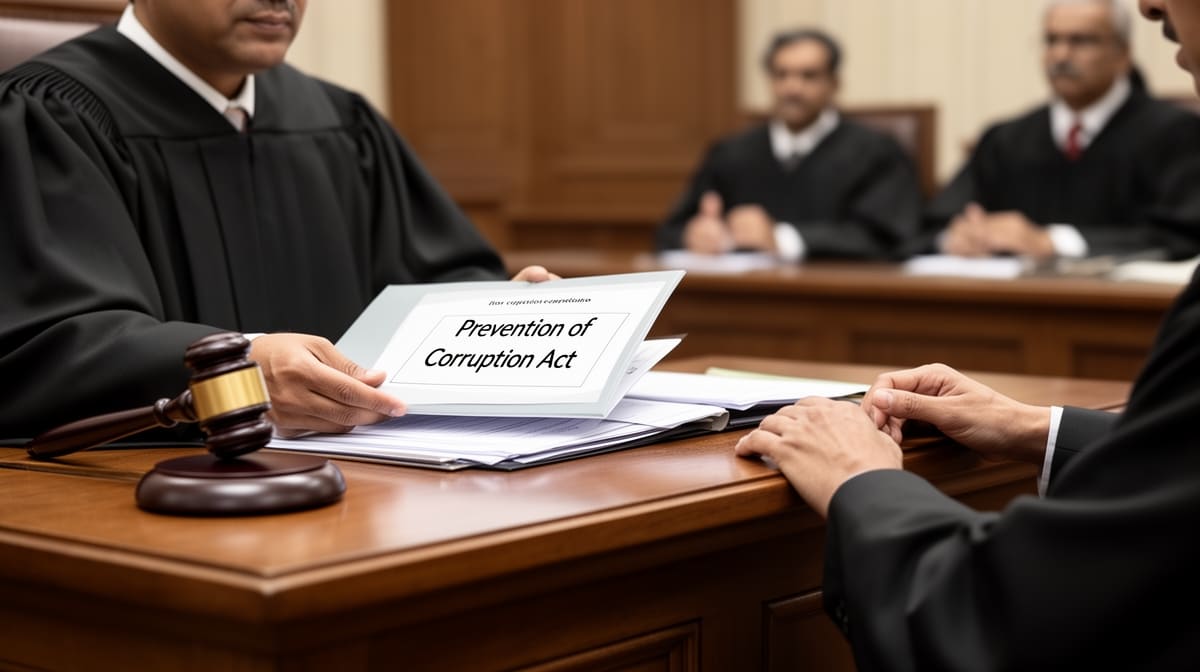
The Bombay High Court has declined to grant leave to appeal against an acquittal in a corruption case under the Prevention of Corruption Act, 1988, emphasizing that the prosecution failed to establish a direct demand or acceptance of bribe. The judgment underscores the necessity of concrete evidence to prove criminal intent and highlights the legal infirmities in obtaining sanction for prosecution of public servants.
Background & Facts
The Dispute
The State of Maharashtra sought leave to appeal against the acquittal of two accused persons in Special (ACB) Case No. 9 of 2017, filed under Sections 2(c), 7, 12, 13(1)(d) read with Section 13(2) of the Prevention of Corruption Act, 1988. The case arose from an alleged bribe demand by a government official and its acceptance by a private individual during the renewal of a school bus permit.
Key Facts
- The complainant, Athar Khan (PW2), was a RTO agent acting on behalf of Saifuddin Abbas for renewal of school bus permits.
- On 18.01.2016, 21 permit renewal applications were submitted to the RTO Office, Aurangabad.
- The complainant alleged that accused no.1, Sudhir Jaybhaye, an Assistant Road Transport Officer (government servant), demanded Rs. 10,000/- for processing the permit, later reduced to Rs. 7,000/-.
- The complainant claimed that accused no.1 directed him to pay the amount to accused no.2, Upendra @ Bapu Jayprakash Rai (a private person), who allegedly accepted the money.
- The Anti-Corruption Bureau (ACB) conducted a trap on 21.01.2016, using a shadow panch (PW3, Amit) and a voice recorder.
- The complainant’s statement to police did not include key details later introduced in court, including the alleged instruction to pay accused no.2.
- The term "G-form" was used by accused no.1 during conversation; the complainant claimed it was a code word for money, but no independent evidence corroborated this.
- The shadow panch’s testimony contained material inconsistencies with the complainant’s version, including the sequence of events and the timing of the payment.
- The payment of Rs. 7,000/- was made to accused no.2 before any explicit demand was made by accused no.1.
- Accused no.2 was shown to have prepared a receipt for Rs. 9,500/- for permit-related fees, which included Rs. 1,035/- as government charges.
Procedural History
- 18.01.2016: Alleged bribe demand and initial contact with accused no.1.
- 21.01.2016: ACB trap executed at RTO Office, Aurangabad.
- 22.01.2016: Charge sheet filed by Kranti Chowk Police Station.
- 05.02.2016: Sanction for prosecution sought from the Department of Law and Judiciary.
- 15.03.2016: PW1 Prakash Sable, Deputy Secretary, submitted a report recommending rejection of sanction, citing lack of evidence against accused no.1.
- 20.04.2016: Law and Judiciary Department overruled PW1’s opinion and granted sanction.
- 07.07.2016: Special (ACB) Case No. 9 of 2017 commenced before the Additional Sessions Judge.
- 27.02.2025: Trial Court acquitted both accused persons.
- 15.03.2025: State filed Application for Leave to Appeal No. 155 of 2025 before the Bombay High Court.
- 27.03.2026: Judgment reserved.
- 01.04.2026: Judgment pronounced.
The Parties' Positions
For the State (Applicant)
- Argued that the trial court misappreciated evidence by ignoring the context of "G-form" as a code word for bribe.
- Contended that the trap was properly planned and executed, and the payment to accused no.2 was made pursuant to accused no.1’s instruction.
- Asserted that the sanction was valid despite PW1’s initial recommendation against it, as the Law and Judiciary Department applied independent scrutiny.
- Claimed that the acquittal was based on erroneous appreciation of circumstantial evidence.
For the Respondents (Accused)
- Argued that no direct demand for bribe was made by accused no.1; the term "G-form" was never established as a code word.
- Emphasized that accused no.2 was a private person with no knowledge of any bribe and was merely handling permit-related payments.
- Highlighted that the complainant was a habitual complainant and his testimony was inconsistent and self-serving.
- Pointed out that PW1, the sanctioning authority, had explicitly stated there was no evidence of demand or acceptance against accused no.1.
- Stressed that the sanction was legally invalid as it was granted contrary to the opinion of the competent officer.
Relief Sought
The State sought leave to appeal the acquittal order to challenge the trial court’s findings on evidence appreciation and sanction validity, with a view to securing a conviction under the Prevention of Corruption Act, 1988.
The Legal Issue
The central question was whether the prosecution successfully proved a demand and acceptance of bribe under Section 7 and 13(1)(d) of the Prevention of Corruption Act, 1988, and whether the sanction for prosecution was legally valid when granted contrary to the opinion of the competent authority.
Arguments Presented
For the Appellant/Petitioner
The State contended that the trial court erred in dismissing the case on the basis of alleged inconsistencies in the complainant’s testimony. It argued that the use of the term "G-form" in context, coupled with the payment to accused no.2 immediately after the conversation with accused no.1, constituted a clear circumstantial chain proving bribe demand and acceptance. The State relied on State of Maharashtra v. M. P. Bhojwani to argue that indirect demands are sufficient under the Act. It further asserted that the sanction, though initially opposed by PW1, was validly granted by the Law and Judiciary Department after review, and that the trial court’s reliance on PW1’s opinion was misplaced.
For the Respondent/State
The accused argued that the prosecution failed to establish any direct or indirect demand by accused no.1. The term "G-form" was never defined as a bribe code in any official document or by any independent witness. Accused no.2 was shown to be handling legitimate permit fees, and there was no evidence he acted as an agent for accused no.1. The defense relied on CBI v. S. R. Singh to argue that mere suspicion or circumstantial proximity cannot substitute for proof of criminal intent. They further emphasized that under Section 19 of the Prevention of Corruption Act, sanction must be granted after due application of mind, and where the competent officer recommends rejection, subsequent approval without fresh scrutiny is legally defective.
The Court's Analysis
The Court undertook a meticulous review of the evidence presented by the prosecution, particularly the testimonies of PW2 (complainant) and PW3 (shadow panch). It noted that the complainant’s version of events was inconsistent with his initial police statement, particularly regarding the instruction to pay accused no.2. The Court observed that the complainant himself admitted that he had never seen accused no.1 accept any money, and that the payment was made to accused no.2 without any prior communication or acknowledgment from accused no.1.
"There is no direct demand by accused no.1, nor any evidence that accused no.2 accepted the amount on his behalf. The term 'G-form' remains uncorroborated and is merely an assertion by the complainant."
The Court further noted that the shadow panch’s testimony contained material contradictions: he stated that the complainant paid accused no.2 before any demand was made, and that accused no.2 prepared a receipt for legitimate fees. The Court held that the payment of Rs. 7,000/- was made in the context of a routine permit renewal process, and the amount corresponded closely to the official fees listed on the receipt.
Regarding sanction, the Court examined the report of PW1 Prakash Sable, who, after reviewing the file, concluded there was no evidence of demand or acceptance against accused no.1. The Court held that the Law and Judiciary Department’s subsequent grant of sanction, without independently reassessing the evidence or addressing PW1’s objections, amounted to a mechanical exercise. The Court cited State of U.P. v. Krishna Kumar to affirm that sanction under Section 19 must be a conscious application of mind, not a rubber-stamp approval.
The Court concluded that the prosecution’s case was built on speculation, unsupported assertions, and procedural irregularities. The trial court’s acquittal was not only justified but inevitable given the evidentiary vacuum.
The Verdict
The State’s application for leave to appeal was dismissed. The High Court upheld the acquittal of both accused persons, holding that the prosecution failed to prove a demand or acceptance of bribe under the Prevention of Corruption Act, 1988, and that the sanction for prosecution was invalid due to lack of due application of mind. No further proceedings shall be initiated against the accused in relation to this case.
What This Means For Similar Cases
Sanction Must Reflect Independent Application of Mind
- Prosecutors must ensure that sanction under Section 19 of the Prevention of Corruption Act is not granted mechanically after a dissenting opinion.
- If the competent officer recommends rejection, the sanctioning authority must record reasons for overruling it; mere administrative approval is insufficient.
- Courts will scrutinize the sanction process rigorously, especially where the investigating agency’s own officer finds no prima facie case.
Circumstantial Evidence Alone Is Insufficient for Bribe Prosecution
- Alleged code words like "G-form" require independent corroboration; unverified assertions by complainants are not enough.
- Payment to a third party does not automatically imply agency or acceptance on behalf of a public servant.
- The burden remains on the prosecution to prove a direct nexus between the demand, the payment, and the public servant’s intent.
Habitual Complainants Require Extra Scrutiny
- Courts must treat complainants with a history of filing corruption complaints with heightened skepticism.
- Inconsistencies between police statements and court testimony must be addressed explicitly in the judgment.
- The absence of independent witnesses or documentary support weakens the prosecution’s case significantly.