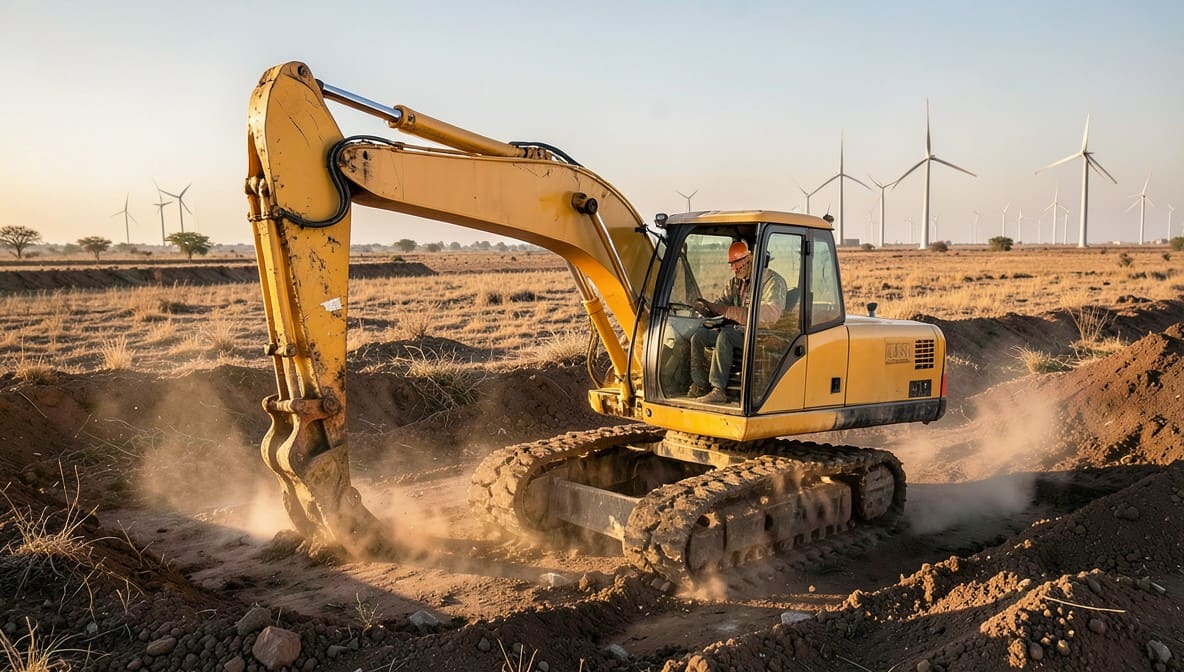
The Rajasthan State Consumer Disputes Redressal Commission has clarified that the purchase of heavy machinery for livelihood-based commercial activity does not automatically exclude the buyer from the definition of a 'consumer' under the Consumer Protection Act, 1986. While the Commission rejected claims of inherent manufacturing defects, it emphasized that repeated service failures warrant equitable relief, reinforcing the Act’s protective intent even in commercial contexts.
Background & Facts
The Dispute
The complainant, M/s Shree Earthmovers, proprietor Janak Kumari, purchased a Hydraulic Excavator Model Tata Hitachi ZX210 LCH with Cubik GP-Bucket on 23.01.2013 for Rs. 52,00,000 from M/s Oriental Earth Movers Pvt. Ltd., the authorized dealer. The machine was used for earthmoving contracts and excavation work to earn a livelihood. Within months, the machine developed recurring mechanical issues, particularly in the engine, including excessive oil consumption, overheating, and intermittent breakdowns. Despite multiple service visits by the Appellant’s technicians, the problems persisted. The complainant issued a legal notice on 01.07.2013, following which the Appellant, Tata Hitachi Construction Equipment Co. Limited, extended the warranty from 5000 hours to 7000 hours or 24 months, whichever came first. However, within 400 hours of this extension, the engine again malfunctioned.
Key Facts
- Purchase invoice dated 23.01.2013 for Rs. 52,00,000
- Machine operated for over 6500 - 7000 hours before complaint
- Warranty extended by Appellant on 27.09.2013 to 7000 hours or 24 months
- Defects reappeared after 400 hours of post-extension operation
- Service reports submitted by complainant showed repeated visits by service engineers
- Appellant’s technical reports cited dust ingress through damaged hose pipe, overheating, and wear due to inadequate maintenance
- Complainant did not produce service records for the period between 2000 - 6500 hours
- Appellant alleged forged entries in service logs
- Complainant claimed the machine was used for small-scale contracting, not large-scale commercial enterprise
Procedural History
- 23.01.2013: Purchase of excavator
- 01.07.2013: Legal notice issued by complainant
- 27.09.2013: Appellant extended warranty
- 02.01.2015: Consumer Complaint No. CC/17/2015 filed before District Consumer Disputes Redressal Commission (DCDRC), Bikaner
- 29.01.2019: DCDRC allowed complaint, ordered engine replacement or refund of Rs. 19,00,000, plus Rs. 25,000 compensation and Rs. 10,000 litigation expenses
- 03.05.2019: First Appeal No. FA/404/2019 filed before Rajasthan State Commission, Jaipur
- Transferred to Circuit Bench, Bikaner and re-registered as FA/86/2021
- 02.06.2026: Judgment delivered by State Commission
Relief Sought
Complainant sought:
- Replacement of defective engine or refund of Rs. 19,00,000 with 12% interest
- Rs. 74,000 compensation for mental agony and physical distress
- Rs. 25,000 for harassment and litigation expenses
Appellant sought dismissal of complaint on grounds of non-consumer status, lack of manufacturing defect, and alleged negligence in maintenance.
The Legal Issue
The central question was whether a person purchasing a heavy construction machine for livelihood-based business activity qualifies as a 'consumer' under Section 2(1)(d) of the Consumer Protection Act, 1986, despite the commercial use of the goods, and whether repeated mechanical failures constitute a deficiency in service or merely result of poor maintenance.
Arguments Presented
For the Appellant
The Appellant contended that the excavator was purchased for commercial purposes and therefore the complainant was not a 'consumer' under Section 2(1)(d). Relied on Indian Medical Association v. V.P. Shantha to argue that large-scale commercial use excludes consumer protection. Asserted that the machine operated for over 6500 hours without major failure, indicating no manufacturing defect. Cited technical inspection reports showing damage due to dust ingress and lack of scheduled servicing every 500 hours. Alleged that the complainant failed to maintain the machine and submitted forged service records. Argued that the DCDRC’s order of replacement or refund was excessive and not supported by evidence.
For the Respondent
The complainant maintained that the machine was purchased to carry on a small-scale business for earning livelihood, not for resale or large-scale commercial enterprise. Cited V. S. D. C. v. M/s. S. S. Enterprises to argue that use for livelihood-based activity retains consumer status. Submitted service reports and warranty extension letter as proof of recurring defects. Denied allegations of forgery and stated that servicing was done through authorized channels. Argued that repeated breakdowns despite warranty extension established deficiency in service and unfair trade practice.
The Court's Analysis
The Commission examined the scope of Section 2(1)(d) and distinguished between commercial use for profit-making enterprise and commercial use for livelihood. It held that the mere fact that goods are used for business does not exclude the buyer from consumer protection unless the transaction is part of a large-scale commercial enterprise unrelated to personal livelihood. The Commission noted that the complainant operated as a sole proprietor using the machine for excavation contracts, which falls within the protective ambit of the Act.
"Mere use of goods for commercial activity does not automatically exclude a purchaser from the purview of the Consumer Protection Act, unless it is clearly established that the transaction forms part of a large-scale commercial enterprise unconnected with earning a livelihood through self-employment."
Regarding the defect, the Commission reviewed technical reports from the Appellant, which attributed engine failure to dust ingress through a damaged hose pipe, overheating, and wear due to non-compliance with 500-hour servicing schedules. The complainant failed to produce service records for the 2000 - 6500 hour period, weakening her claim of consistent maintenance. The Commission held that mere allegations of oil consumption and repeated repairs, without independent expert evidence, could not establish an inherent manufacturing defect.
However, the Commission acknowledged the machine’s repeated malfunctioning and the Appellant’s own warranty extension as an admission of service concerns. It found that while the DCDRC erred in ordering replacement or refund, the complainant deserved equitable relief given the pattern of complaints and the Appellant’s prior commitment to warranty support.
The Verdict
The appeal was partly allowed. The impugned order dated 29.01.2019 was modified: the directions for replacement of the engine, refund of Rs. 19,00,000, compensation of Rs. 25,000, and litigation expenses of Rs. 10,000 were set aside. Instead, the Appellant and M/s Oriental Earth Movers Pvt. Ltd. were directed to carry out necessary repairs of the machine, if required, free of cost for a period of three months from the date of this order. No costs were awarded. The original record was to be transmitted back to the DCDRC, Bikaner.
What This Means For Similar Cases
Consumer Status Extends to Livelihood-Based Commercial Use
- Practitioners must argue that commercial use alone does not negate consumer status under Section 2(1)(d)
- The key test is whether the purchase is for self-employment or livelihood, not resale or industrial-scale enterprise
- Evidence of small-scale contracting, sole proprietorship, or informal business models supports consumer classification
Burden of Proof for Manufacturing Defects Is High
- Mere repetition of repairs or service visits does not prove manufacturing defect
- Technical reports from authorized service centers carry weight
- Complainants must produce independent expert reports or manufacturer’s admission of defect to succeed
- Absence of maintenance records weakens claims, even if defects are real
Equitable Relief Trumps Absolute Remedies in Absence of Clear Defect
- Courts may deny replacement or refund but grant limited free repairs as a middle path
- Warranty extensions by manufacturers can be used to establish ongoing responsibility
- Compensation and litigation costs require clear proof of mental agony or harassment - not presumed
- Practitioners should seek proportionate remedies: repair, adjustment, or service guarantee rather than full refund unless defect is proven