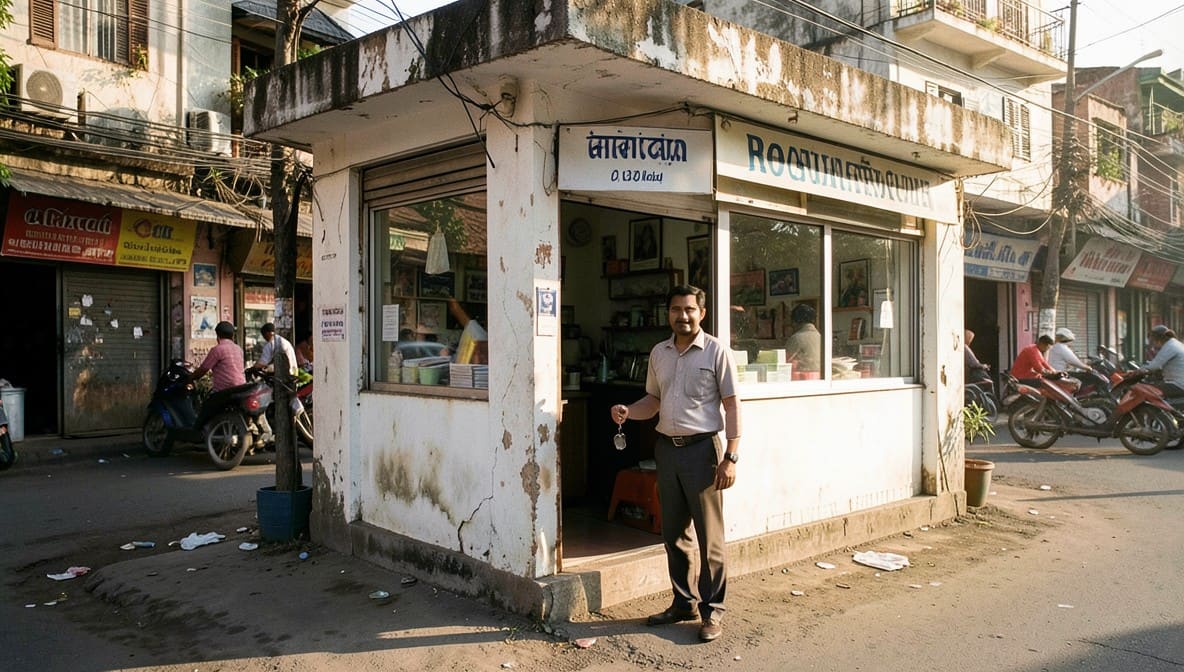
The Delhi State Consumer Disputes Redressal Commission has held that purchasers of commercial shops for self-employment livelihood qualify as consumers under the Consumer Protection Act, 1986, and cannot be denied relief merely because the property was bought for commercial use. The Commission allowed the complaint against Granite Hills Properties Pvt. Ltd., directing refund of Rs. 4,20,750 with interest at 6% per annum from the date of each payment until 28 October 2026, escalating to 9% per annum if not paid by 28 December 2026, along with Rs. 1,00,000 for mental agony and Rs. 50,000 litigation costs.
Background & Facts
The Dispute
The complainants, Mr. S.C. Gupta and Mrs. Sunita Gupta, residents of Safdarjung Enclave, New Delhi, booked two shops bearing Nos. 2430 and 2431 on the 24th floor of the project "Sikka Kapital Grand" developed by Granite Hills Properties Pvt. Ltd. at Plot No. C-01B, Sector 98, Noida Expressway, Noida, Uttar Pradesh. The total consideration for Shop No. 2430 was Rs. 21,35,500 and for Shop No. 2431 was Rs. 21,43,000. The complainants alleged that the payment plan in the tentative application form was blank and no payment plan was agreed upon between the parties. The opposite party persistently demanded payments according to a Construction Linked Payment Plan to which the complainants had never agreed.
Key Facts
- 03.08.2014: Complainants submitted tentative application forms for booking Shop Nos. 2430 and 2431
- Initial payment: Rs. 1,00,000 each towards both shops
- 10.08.2014: Complainants paid additional amounts of Rs. 1,10,000 (Shop 2430) and Rs. 1,10,750 (Shop 2431) via cheques Nos. 036289 and 036290
- 02.01.2015: Complainants returned allotment agreements after making changes, including stipulation that balance payment would be made after delivery of possession
- 11.03.2015 & 31.03.2015: Opposite party issued termination letters cancelling bookings for non-payment under Construction Linked Payment Plan
- 04.04.2015: Complainants replied disputing termination, expressing willingness to pay balance within three days of possession handover
- 11.06.2015: Legal notice issued by complainants
- 29.06.2015: Opposite party replied reiterating termination stance
- Total amount paid by complainants: Rs. 2,10,000 (Shop 2430) and Rs. 2,10,750 (Shop 2431) = Rs. 4,20,750
Procedural History
- 27.03.2017: Complaint filed before Delhi State Consumer Disputes Redressal Commission (Complaint Case No. 591/2017)
- 02.09.2026: Date of hearing
- 28.10.2026: Date of decision and judgment pronouncement
The Parties' Positions
Complainants: Contended they are consumers under the Act; no payment plan was agreed; termination was unjustified; opposite party failed to execute agreements or resolve differences; sought possession or refund with compensation.
Opposite Party: Raised preliminary objections: (1) complainants not consumers as shops booked for commercial/investment purpose; (2) no cause of action disclosed; (3) lack of territorial jurisdiction as project in Noida, Uttar Pradesh. On merits: contended complainants opted for Construction Linked Payment Plan, paid only Rs. 1,00,000 each against required booking amounts, stopped cheque payments, made unilateral agreement changes, and failed to clear dues despite reminders.
Relief Sought
The complainants prayed for: (i) allotment and possession of Shops 2430 and 2431; (ii) compensation of Rs. 5,00,000 for mental agony, harassment, and legal proceedings; (iii) interest @2% per month from date of filing till payment; (iv) costs of the case.
The Legal Issue
The central questions were: (1) Whether purchasers of commercial shops for self-employment livelihood qualify as "consumers" under Section 2(1)(d) of the Consumer Protection Act, 1986, despite the commercial purpose exclusion; (2) Whether the complaint was filed within the limitation period under Section 24A given the termination dates; (3) Whether the Delhi State Commission had territorial jurisdiction under Section 17(2) when the project was situated in Noida; (4) Whether the opposite party's cancellation of bookings constituted deficiency in service under Section 2(1)(g) read with Section 2(1)(o).
Arguments Presented
For the Complainants
Counsel argued that the complainants had paid part consideration and therefore fell within the statutory definition of consumer. Reliance was placed on Rohit Choudhary & Anr. vs. M/s Vipul Ltd. (Civil Appeal No. 5858/2017, decided 06.09.2023) and Lilavati Kirtilal Mehta Medical Trust vs. Unique Shantu Developers & Co. (Civil Appeal No. 12322 of 2016, decided 14.11.2019) where the Supreme Court held that commercial use for livelihood by self-employment does not exclude consumer status. On limitation, counsel submitted that failure to give possession is a continuous wrong constituting recurrent cause of action, citing Mehnga Singh Khera and Ors. Vs. Unitech Ltd. (I (2020) CPJ 93(NC)). On jurisdiction, counsel relied on Rohit Srivastava v. Paramount Villas Pvt. Ltd. (2017 SCC OnLine NCDRC 1198) holding that registered office of opposite party in Delhi confers jurisdiction.
For the Opposite Party
Counsel contended that the complainants were not consumers as the shops were booked for commercial purposes and investment, squarely falling within the exclusion under Section 2(1)(d). It was argued that no cause of action arose in favour of complainants, and the Delhi Commission lacked territorial jurisdiction since the project was in Noida, Uttar Pradesh. On merits, counsel asserted that complainants had opted for the Construction Linked Payment Plan, failed to make stipulated payments, stopped cheques, made unilateral agreement changes, and were rightly terminated after final opportunity to clear dues.
The Court's Analysis
The Commission first addressed the consumer status question. Referring to Section 2(1)(d) of the Consumer Protection Act, 1986, the Commission noted that a person who buys goods for consideration paid or promised or partly paid and partly promised is a consumer, but the definition excludes a person who obtains goods for resale or for any commercial purpose. However, the Commission observed that the National Consumer Disputes Redressal Commission in a series of judgments had held that commercial use depends on facts and circumstances of each case, and if the commercial use is for earning livelihood by means of self-employment, such purchaser continues to be a consumer. The Supreme Court in Rohit Choudhary and Lilavati Kirtilal Mehta Medical Trust had taken a similar view. The Commission found no material on record showing the complainants were engaged in the business of purchasing and selling shops on a regular basis for profit. A mere allegation of commercial purpose could not be ground to reject the complaint.
On limitation under Section 24A, the Commission analysed the provision which bars admission of complaints filed beyond two years from the date cause of action arose, unless sufficient cause is shown. Relying on Mehnga Singh Khera, the Commission held that failure to give possession is a continuous wrong and recurrent cause of action. The period of limitation starts only when the seller virtually refuses to give possession. Here, the opposite party sent cancellation letters on 31.03.2015, and the complaint was filed on 27.03.2017, well within two years.
On territorial jurisdiction under Section 17(2), the Commission noted that a complaint can be instituted where the opposite party actually and voluntarily resides or carries on business or has a branch office. The registered office of the opposite party was at Sikka House, C-60, Preet Vihar, Main Vikas Marg, Delhi-110092, which falls within Delhi territory. Following Rohit Srivastava, the Commission held it had jurisdiction.
On deficiency in service, the Commission examined Section 2(1)(g) defining deficiency as any fault, imperfection, shortcoming or inadequacy in quality, nature and manner of performance required to be maintained by law or contract, and Section 2(1)(o) defining service to include housing construction. The Commission found that the opposite party failed to establish that complainants had agreed to the Construction Linked Payment Plan. No document on record established acceptance of the plan. The complainants' letter dated 01.09.2014 stated they had not received any payment plan. The termination letters dated 31.03.2015 acknowledged the payments of Rs. 1,10,000 and Rs. 1,10,750 while stating they were insufficient. The opposite party neither addressed the changes proposed by complainants to the allotment agreements nor took steps to resolve differences before terminating bookings. Accordingly, cancellation on the basis of an unproven payment plan was not justified and amounted to deficiency in service.
On relief, the Commission referred to Parsvnath Exotica Resident Association Vs Parsvnath Developers Ltd. & Ors. (IV (2016) CPJ 328 (NC)) where the National Commission held that even in absence of specific prayer for refund, the Commission can grant relief justified by facts and circumstances. Since the opposite party was not in a position to hand over the units, refund was warranted.
The Verdict
The complainants succeeded. The Commission allowed the complaint and directed the opposite party to refund Rs. 4,20,750 (Rs. 2,10,000 for Shop 2430 and Rs. 2,10,750 for Shop 2431) with interest at 6% per annum calculated from the date each installment was received by the opposite party till 28.10.2026 (date of judgment), provided the amount is paid on or before 28.12.2026. If the opposite party fails to pay by 28.12.2026, the entire amount shall carry interest at 9% per annum from the date of each payment till actual realization. Additionally, the opposite party was directed to pay Rs. 1,00,000 as cost for mental agony and harassment, and Rs. 50,000 as litigation costs. All pending applications were disposed of.
What This Means For Similar Cases
Commercial Purpose Exclusion Is Fact-Specific
The judgment reinforces that the commercial purpose exclusion under Section 2(1)(d) is not automatic. Practitioners must demonstrate that the purchaser is not engaged in regular buying and selling for profit. Self-employment livelihood through the purchased property preserves consumer status. Key takeaway: when defending consumer status for commercial property buyers, lead with evidence of self-employment use and absence of speculative trading pattern.
Continuous Wrong Doctrine Extends Limitation
The Mehnga Singh Khera principle that failure to deliver possession constitutes a continuous wrong with recurrent cause of action remains pivotal. The limitation clock under Section 24A starts only upon virtual refusal to give possession, not from the original due date. Practitioners should: (1) identify the precise date of unequivocal refusal; (2) file within two years of that date; (3) plead the continuous wrong doctrine explicitly in the complaint.
Registered Office Determines Territorial Jurisdiction
The Commission's reliance on Rohit Srivastava confirms that the opposite party's registered office location governs territorial jurisdiction under Section 17(2)(a) for State Commissions, irrespective of project location. This is a critical forum-selection tool for complainants. Practitioners should verify the opposite party's registered office address from MCA records before filing and plead jurisdiction on this basis.
Burden of Proving Agreed Payment Plan Lies on Builder
The judgment places the burden on the builder to prove the buyer's acceptance of a specific payment plan. Absence of a signed agreement or documented acceptance of the Construction Linked Payment Plan is fatal to termination based on that plan. Practitioners should: (1) demand production of the signed payment plan; (2) highlight any blank payment plan fields in application forms; (3) preserve correspondence showing non-receipt of payment plan.
Refund Available Even When Possession Prayed
Following Parsvnath Exotica, consumer commissions can grant refund as alternative relief even when the primary prayer is for possession, if the builder cannot deliver. This expands remedial flexibility. Practitioners should frame prayers in the alternative and lead evidence on the builder's inability to complete the project.