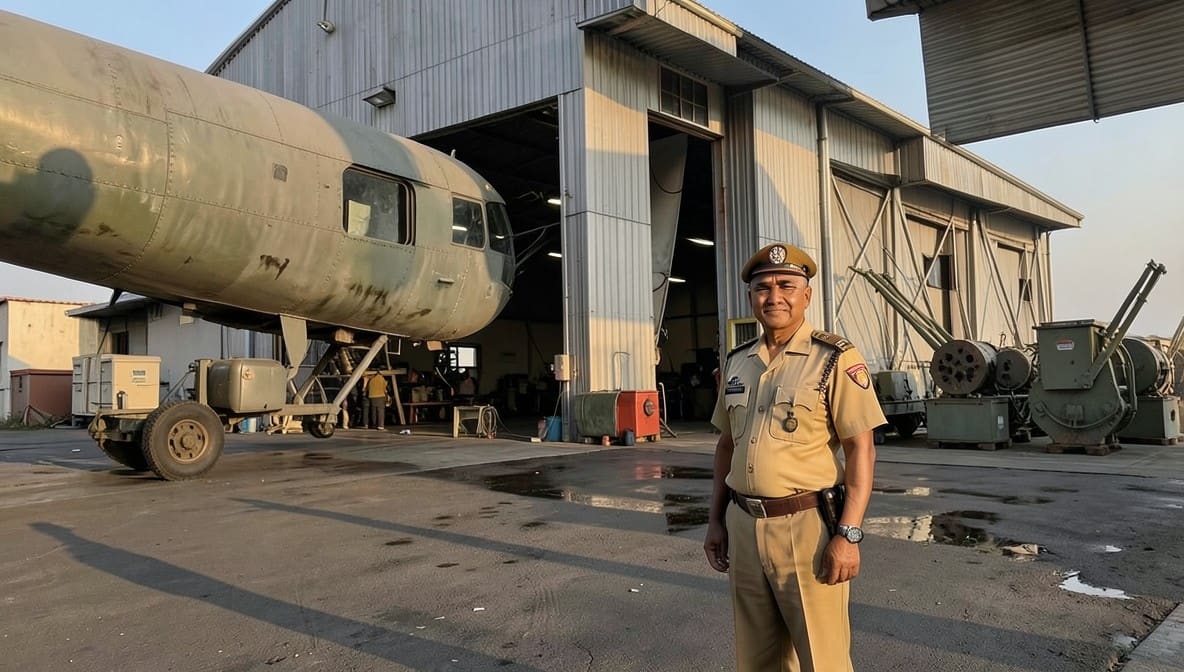
The Delhi High Court has clarified that ex-servicemen re-employed in combatised posts within the Air Wing of the Border Security Force (AW-BSF) after presidential sanction in 1989 are bound by the 57-year superannuation age, rejecting claims to civilian retirement benefits despite prior military service. This judgment reinforces the principle that service status cannot be selectively invoked for advantage.
Background & Facts
The Dispute
The dispute concerns whether respondents, former members of the Indian Air Force discharged in 1990, who were subsequently re-employed as Junior Aircraft Mechanics (JAM) in the AW-BSF in 1991, are entitled to retire at the civilian age of 60 years or the combatised age of 57 years. The respondents were appointed as Sub-Inspector (Junior Aircraft Mechanic) against a pay scale of Rs. 1400 - 2300, which corresponded to the combatised cadre, and received allowances such as ration money, uniform, and washing allowances.
Key Facts
- The respondents were discharged from the Indian Air Force on 31.08.1990.
- On 21.10.1991, they received appointment letters for the post of Junior Aircraft Mechanic in AW-BSF, with a pay scale of Rs. 1400 - 2300.
- They joined service on 13.12.1991.
- The civilian JAM post carried a lower pay scale of Rs. 1320 - 2040, later revised to Rs. 4000 - 6000.
- The combatised SI-JAM post carried a higher pay scale of Rs. 1400 - 2300, later revised to Rs. 5500 - 9000.
- The respondents received all benefits of a combatised post, including promotional avenues and allowances.
- The President of India, by letter dated 19.09.1989, sanctioned the combatisation of ministerial and civilian posts in the BSF Air Wing, including Aircraft Mechanic roles, assigning them equivalent combatised ranks (e.g., Senior Aircraft Mechanic → Sub-Inspector (Mech)).
- The 1991 circular creating 200 posts in AW-BSF did not explicitly label them as civilian, consistent with administrative practice that new posts within a combatised cadre inherit its status without fresh sanction.
- The respondents were never employed on the civilian pay scale or under the non-combatised recruitment framework.
Procedural History
- 13.12.1991: Respondent joined AW-BSF as SI-JAM.
- 12.05.2004: Central Administrative Tribunal (CAT) passed the Impugned Order allowing the OA, directing continuation until age 60.
- 23.03.2026: Delhi High Court delivered judgment on W.P.(C) 980/2004, W.P.(C) 981 - 982/2004, and W.P.(C) 17658 - 17660/2004.
The Parties' Positions
For the Petitioner (Union of India):
- The 1989 Presidential Sanction transformed all AW-BSF maintenance posts into combatised cadre.
- The 1991 appointments were made within this combatised structure.
- The respondents availed higher pay, allowances, and promotional benefits of the combatised stream.
- Rule 12 of BSF (Seniority, Promotion and Superannuation of Officers) Rules, 1978 mandates retirement at 57 for officers below Commandant rank.
- Circular dated 22.01.1999 confirms retirement age of 57 for Defence personnel re-employed in BSF up to the rank of Commandant.
- The principle of approbate and reprobate bars the respondents from claiming benefits of combatised service while denying its burdens.
For the Respondents:
- The post of JAM was classified as non-combatised under the Rules of 1996.
- The Rules of 1996 and 1997 permit re-employed Armed Forces personnel to continue until age 60 with reference to civil posts.
- The 1991 appointment did not carry explicit combatisation, so it should be treated as civilian.
- The Tribunal’s earlier decisions in AV Balachandran v. UOI and BN Chaubey v. UOI supported their claim.
Relief Sought
The Union sought quashing of the Tribunal’s order dated 12.05.2004, and a declaration that the respondents were liable to retire at age 57 under Rule 12 of the BSF Rules, 1978.
The Legal Issue
The central question was whether a former Armed Forces personnel, re-employed in the AW-BSF after the 1989 Presidential Sanction for combatisation, holding a post with a combatised pay scale and rank, is entitled to retire at 60 years under civilian service rules, or must retire at 57 years as a combatised officer.
Arguments Presented
For the Petitioner
The Union relied on the Presidential Sanction of 19.09.1989, which explicitly combatised the AW-BSF Air Wing posts, including Aircraft Mechanic roles, and assigned them equivalent combatised ranks. It argued that the 1991 appointments were made within this already-combatised cadre, and thus inherited its status without requiring fresh sanction. The higher pay scale (Rs. 1400 - 2300), allowances, and rank equivalence confirmed the combatised nature of the service. The Union cited M.S. Malik v. DG, BSF to assert that one cannot selectively enjoy benefits of a service stream while rejecting its obligations. Rule 12 of the BSF Rules, 1978, and the MHA Circular of 22.01.1999 were invoked to establish the 57-year retirement norm for non-commandant ranks.
For the Respondent
The respondents contended that the Rules of 1996, which classified JAM as a non-combatised Group C post, governed their service conditions. They argued that since their appointment preceded the Rules of 1997, the later combatised classification could not be applied retrospectively. They relied on Clause 12 of the Rules of 1996 and 1997, which permitted re-employment until the age of superannuation with reference to civil posts. They also cited prior Tribunal decisions (AV Balachandran, BN Chaubey) to argue that similar factual matrices had been decided in their favor.
The Court's Analysis
The Court began by emphasizing that the BSF is not a civil department but an armed force of the Union governed by the BSF Act, 1968, and its statutory rules. The Presidential Sanction of 19.09.1989 was pivotal: it did not merely recommend but legally transformed the nature of AW-BSF posts, assigning them combatised ranks and integrating them into the BSF’s hierarchical structure. The Court rejected the Tribunal’s reasoning that the absence of an explicit 1991 sanction meant the posts remained civilian. Once a cadre is combatised, subsequent posts within it inherit that status by operation of law.
"The combatised character inheres in the cadre itself. The Sanction of 1989 having already accomplished the transformation of the Air Wing posts, the additional posts sanctioned in 1991 must necessarily partake of the same combatised character."
The Court found that the respondents were never employed on the civilian pay scale (Rs. 1320 - 2040) nor under the non-combatised recruitment framework. Their appointment letter, pay scale, rank (Sub-Inspector), and allowances were exclusively those of a combatised officer. The Rules of 1996 applied only to civilian posts and were designed for serving personnel nearing retirement, not for ex-servicemen like the respondents who had already been discharged.
"The Respondent does not fall within the class of personnel contemplated under the Rules of 1996... he entered service directly against the post carrying the higher pay scale of Rs. 1400 - 2300, corresponding to the combatised rank of Sub-Inspector (Mech)."
The Court further held that the Rules of 1997, though using the phrase "General Central Service," were framed for combatised posts and did not override the statutory retirement age under Rule 12 of the 1978 Rules. The Tribunal’s reliance on its prior decisions was misplaced, as those cases involved different factual matrices where the posts were genuinely non-combatised. The principle of approbate and reprobate was firmly applied: one cannot accept the enhanced benefits of a combatised post and later claim the more favorable retirement age of a civilian.
The Court concluded that the Tribunal’s order was legally unsustainable, as it ignored the structural reality of the BSF and the transformative effect of the 1989 Sanction.
The Verdict
The petitions were allowed. The Impugned Order dated 12.05.2004 of the Central Administrative Tribunal was set aside. The respondents are directed to retire at the age of 57 years as per Rule 12 of the BSF (Seniority, Promotion and Superannuation of Officers) Rules, 1978. No monetary relief or compensation was awarded, as the matter pertained solely to the determination of retirement age.
What This Means For Similar Cases
Combatised Status Is Determined by Cadre, Not Nomenclature
- Practitioners must examine the underlying cadre structure and Presidential Sanctions, not merely job titles or recruitment rule classifications.
- A post’s legal character is fixed by the cadre to which it belongs, not by the date of appointment if the cadre was previously combatised.
Service Benefits and Burdens Are Inseparable
- Employees who receive higher pay, allowances, and rank equivalence under a combatised cadre cannot later claim civilian retirement benefits.
- The doctrine of approbate and reprobate is strictly enforced in service jurisprudence.
Rules of 1996 and 1997 Are Not Universal Safeguards
- The re-employment clause in Rules of 1996/1997 applies only to serving personnel nearing discharge, not to ex-servicemen.
- These rules do not override the statutory retirement age under the BSF Rules, 1978, for combatised posts.
Precedents Must Be Fact-Specific
- Tribunal decisions in cases involving genuinely non-combatised posts cannot be mechanically applied to combatised ones.
- Courts will distinguish precedents based on the existence of Presidential Sanction and actual service conditions.
Administrative Logic Trumps Literal Interpretation
- When a cadre is combatised, new posts within it are presumed combatised unless explicitly stated otherwise.
- Administrative practice and institutional structure must inform statutory interpretation in armed force contexts.