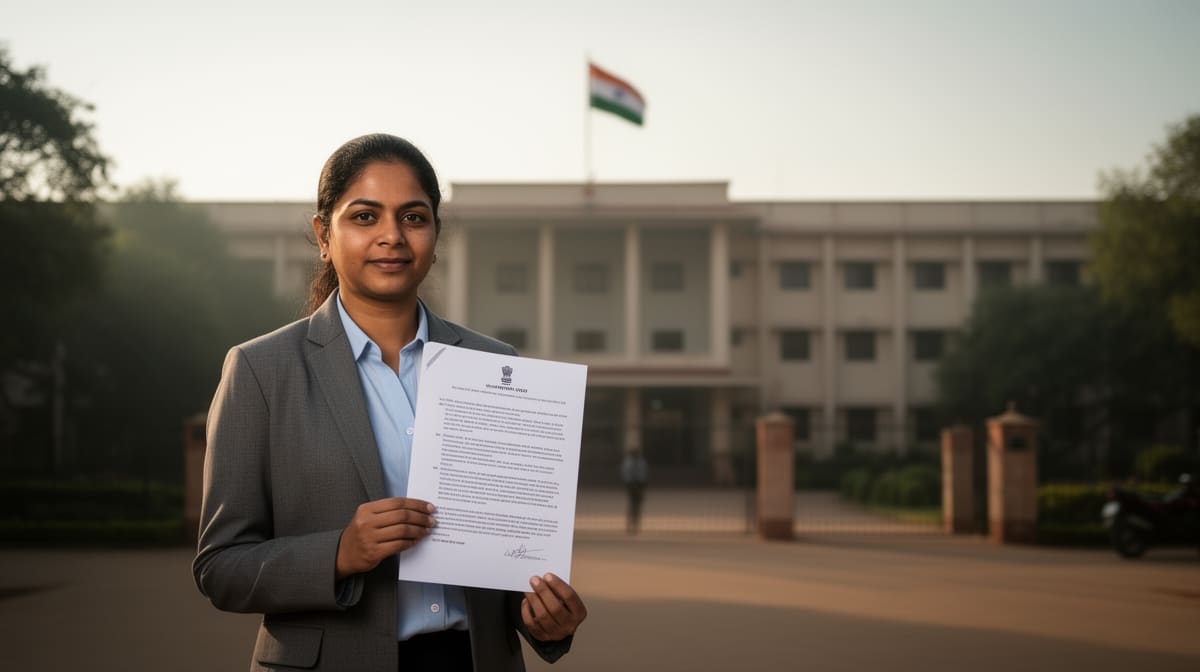
The Madhya Pradesh High Court has clarified that the pendency of an inheritance dispute between family members cannot be invoked to delay or deny the issuance of a caste certificate. This ruling reinforces the principle that caste certification is a distinct administrative process, governed by documentary evidence of community affiliation, and must not be entangled in unrelated civil litigation over property rights.
Background & Facts
The Dispute
The petitioners, Maya Panchal and others, applied for the issuance of a Caste Certificate to establish their eligibility for benefits under the Scheduled Caste category. Their application was rejected by the Sub Divisional Officer (SDO), Badnagar, District Ujjain, on 12.01.2026 (Annexure P/1). The SDO cited the existence of a pending inheritance dispute between the petitioners and certain family members as the reason for withholding decision, stating that the caste certificate application would be decided only after the final determination of the inheritance litigation.
Key Facts
- The petitioners had previously applied for a Caste Certificate, which was initially rejected by the SDO
- That initial rejection was set aside on appeal, and the matter was remanded to the SDO for fresh consideration
- Upon remand, the SDO again rejected the application, this time on the ground of a pending inheritance dispute
- The inheritance dispute involves claims over ancestral property and is pending before a civil or revenue forum
- The petitioners have not been parties to any final adjudication on the nature or validity of their caste affiliation
- No evidence was produced by the SDO to dispute the petitioners’ community identity or their documentary proof of caste
Procedural History
- Date of initial application: Not specified in judgment, but prior rejection occurred before remand
- Date of first rejection: Not specified, but overturned on appeal
- Date of remand order: Not specified, but occurred prior to 12.01.2026
- 12.01.2026: Impugned order passed by Sub Divisional Officer, Badnagar, rejecting caste certificate application on grounds of pending inheritance dispute
- 2026 (exact date not specified): Writ Petition No. 6611 of 2026 filed before the High Court of Madhya Pradesh at Indore
- 16.04.2026: Final hearing conducted with consent of parties
- 16.04.2026: Judgment delivered by Justice Pranay Verma
The Parties' Positions
For the Petitioners
The petitioners contended that the SDO’s refusal to decide their caste certificate application on merits was arbitrary and violative of their fundamental right to equality and non-discrimination under Article 14 of the Constitution. They argued that inheritance disputes pertain to property rights and have no legal bearing on caste identity, which must be determined by birth, lineage, and community recognition.
For the Respondent/State
The State, through the Government Advocate, did not contest the legal principle but defended the SDO’s action as a precautionary measure to avoid potential future litigation. No statutory provision or precedent was cited to justify linking caste certification to inheritance disputes.
Relief Sought
The petitioners sought quashing of the impugned order dated 12.01.2026 and a direction to the SDO to decide their caste certificate application on its merits, without reference to the pending inheritance dispute.
The Legal Issue
Can the pendency of an inheritance dispute between family members be grounds for refusing to decide an application for a Caste Certificate on its merits?
Arguments Presented
For the Petitioner
The petitioners relied on the settled principle that caste certification is an administrative function based on documentary evidence of community affiliation, such as birth records, ancestral village records, or community affidavits. They cited State of Madhya Pradesh v. Ram Singh and Suresh Kumar v. State of U.P. to argue that the validity of caste claims must be assessed independently of civil disputes over property. The SDO’s reliance on an unrelated litigation was arbitrary and violated the doctrine of audi alteram partem.
For the Respondent/State
The State did not advance any substantive legal argument to justify the SDO’s reasoning. The Government Advocate conceded that no statutory provision permits linking caste certification to inheritance litigation, but argued that the delay was intended to avoid administrative conflict. No precedent was cited to support this position.
The Court's Analysis
The Court observed that the issuance of a Caste Certificate is a distinct administrative process governed by rules framed under the Constitution and relevant state notifications. The purpose is to identify individuals belonging to Scheduled Castes for the purpose of affirmative action, and not to adjudicate property rights.
"If any dispute in respect of inheritance is pending between the petitioners and any of his family members then the same cannot be said to be an impediment for decision of their application for issuance of Caste Certificate. That would be an entirely different dispute in which the question for determination would be whether the petitioners are entitled to the property to which they are claiming. Regardless of the decision of the said dispute the issue as to whether the petitioners are entitled for issuance of Caste Certificate in their favour can certainly be decided in which the considerations would be entirely different."
The Court emphasized that even if the petitioners were to lose the inheritance suit, it would not negate their caste identity. Conversely, even if they succeeded in the inheritance dispute, it would not automatically confer Scheduled Caste status. The two issues are legally and factually distinct.
The SDO’s failure to decide the application on the basis of available evidence - such as birth certificates, village records, or community affidavits - amounted to an abdication of statutory duty. The Court held that administrative authorities cannot use the pendency of civil litigation as a shield to avoid making decisions on matters within their jurisdiction.
The Verdict
The petition succeeded. The Court quashed the impugned order dated 12.01.2026 passed by the Sub Divisional Officer, Badnagar. The matter was remanded to the same officer to decide the petitioners’ application for a Caste Certificate on its merits, without being influenced by the pendency of any inheritance dispute. The SDO was directed to complete the decision within six weeks from the date of receipt of the certified copy of this order.
What This Means For Similar Cases
Caste Certification Is Independent of Property Disputes
- Practitioners must challenge any rejection of caste certificates based on pending civil or revenue litigation over property
- Administrative authorities cannot use procedural delays in unrelated matters to avoid deciding caste applications
- Documentary proof of caste - not litigation outcomes - is the sole basis for certification
Administrative Authorities Must Act on Merits
- SDOs and other certifying officers are under a statutory duty to decide caste applications within a reasonable time
- Failure to do so on grounds unrelated to caste identity constitutes arbitrariness under Article 14
- Petitioners may seek writ relief under Article 226 if certification is unreasonably delayed or denied on extraneous grounds
No Burden on Applicant to Resolve Third-Party Litigation
- Applicants are not required to produce court orders resolving inheritance disputes to obtain caste certificates
- The onus remains on the certifying authority to verify caste claims through official records, not by waiting for outcomes of private litigation
- Any condition imposed beyond statutory requirements is ultra vires and void