The Madhya Pradesh High Court has granted bail to a 20-year-old accused in a POCSO case after finding that DNA evidence conclusively excludes him as the source of biological material found on the victim, and that the trial is likely to be protracted. The judgment underscores the importance of scientific evidence in bail decisions under the new Bharatiya Nagarik Suraksha Sanhita and reaffirms that prolonged pre-trial detention cannot be justified without concrete linkage to the offence.
Background & Facts
The Dispute
The applicant, Priyanshu Saket, was arrested on 04.02.2026 in connection with FIR No. 108/2026 registered at Police Station Waidhan, District Singrauli, Madhya Pradesh. The case involves allegations of sexual assault against a minor girl aged 15 years, 7 months, and 21 days, under Sections 65(1), 64(1), 332(B), and 351(3) of the Bharatiya Nagarik Suraksha Sanhita (BNSS), 2023, and Sections 3 and 4(2) of the Protection of Children from Sexual Offences (POCSO) Act, 2012. The applicant claims the complaint is false, arising from a longstanding land dispute with the victim’s family, who are neighbours.
Key Facts
- The victim and her two younger sisters, all above 12 years of age, were present at home during the alleged incident.
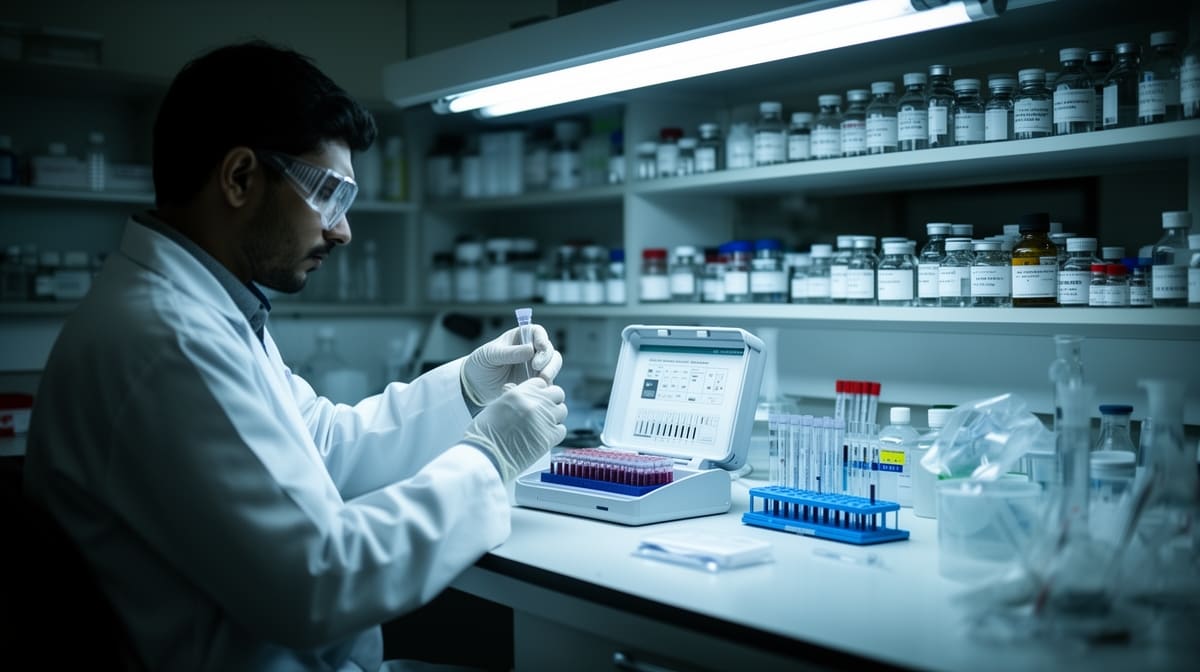
- A DNA analysis was conducted on vaginal swabs and the victim’s undergarments and pubic hair.
- The DNA report revealed no male hormone in the vaginal slide.
- Male DNA recovered from the victim’s undergarments and pubic hair did not match the applicant’s DNA profile.
- The applicant is 20 years old and has been in custody since 04.02.2026.
- The charge sheet has been filed, but no trial date has been fixed.
- The victim’s statement was recorded under Section 183 of BNSS; her sister was also examined as a witness.
Procedural History
- 04.02.2026: Applicant arrested and taken into custody.
- Before 05.05.2026: Charge sheet submitted by the prosecution.
- 05.05.2026: First bail application filed under Section 483 of BNSS (equivalent to Section 439 CrPC) before the High Court at Jabalpur.
Relief Sought
The applicant sought regular bail on grounds of: (i) absence of biological linkage to the offence as per DNA report; (ii) prolonged pre-trial detention; (iii) false implication due to a property dispute; and (iv) his youth and lack of prior criminal record.
The Legal Issue
The central question was whether the absence of DNA match between the accused and biological evidence found on the victim, combined with the likelihood of a prolonged trial, constitutes sufficient grounds for granting regular bail under Section 483 of the Bharatiya Nagarik Suraksha Sanhita, even in a case involving serious allegations under the POCSO Act.
Arguments Presented
For the Appellant/Petitioner
Learned counsel for the applicant argued that the DNA report conclusively negates the prosecution’s claim of sexual contact. The absence of the applicant’s DNA on critical forensic samples undermines the core allegation. Counsel relied on State of Madhya Pradesh v. Rameshwar and Kalyan Chandra Sarkar v. Rajesh Ranjan to assert that bail should not be denied solely on the gravity of the offence when scientific evidence exonerates the accused. The applicant’s youth and the fact that the charge sheet has been filed without any incriminating material linking him to the crime were emphasized. Counsel also highlighted that the dispute originated from a civil land conflict, suggesting mala fide intent behind the complaint.
For the Respondent/State
The State opposed bail, contending that the victim’s statement under Section 183 of BNSS and the testimony of her sister corroborated the prosecution’s version. Counsel argued that POCSO cases demand strict scrutiny and that bail should not be granted merely on the basis of a negative DNA report, especially where the victim’s testimony remains unchallenged. The State maintained that the seriousness of the offence - sexual assault on a minor - outweighs any procedural or forensic anomaly.
The Court's Analysis
The Court examined the DNA report with particular attention to its scientific reliability and its direct relevance to the allegations. The report showed no male hormone in the vaginal swab and, critically, the male DNA found on the victim’s undergarments and pubic hair did not match the applicant’s profile. The Court noted that while the victim’s statement and her sister’s testimony were recorded, they were not corroborated by any physical or forensic evidence linking the applicant to the crime.
"The DNA report obtained from the vaginal slide, no male hormone was found. Furthermore, the male DNA found on the victim's undergarments and pubic hair did not match with the present applicant..."
The Court held that in cases involving serious allegations, bail cannot be granted lightly, but neither can it be denied mechanically when exculpatory scientific evidence is present. The Court distinguished this case from those where DNA evidence is inconclusive or absent, emphasizing that the absence of a match is not a mere technicality but a substantive denial of the prosecution’s theory. The Court further observed that the trial is likely to be protracted, and continued detention without a prima facie case supported by forensic evidence violates the principle of presumption of innocence under Article 21 of the Constitution. The Court declined to comment on the merits of the case, stating that its role was limited to assessing the appropriateness of bail at this stage.
The Verdict
The applicant succeeded. The High Court granted regular bail on the condition that the applicant furnish a personal bond of Rs. 50,000 with one surety of the same amount, to be approved by the trial court. The applicant is directed to comply with Section 480(3) of the Bharatiya Nagarik Suraksha Sanhita. The Court explicitly stated that this order is without prejudice to the trial’s outcome and does not reflect any view on the merits of the case.
What This Means For Similar Cases
DNA Exclusion Can Override Testimonial Evidence in Bail Decisions
- Practitioners may now argue that a conclusive DNA exclusion, even in POCSO cases, constitutes a compelling ground for bail under Section 483 BNSS.
- The burden shifts to the prosecution to explain why testimony should prevail over scientific evidence when the two are in direct conflict.
- Courts must now treat DNA reports not as supplementary but as potentially dispositive in bail applications involving biological evidence.
Trial Delay Alone Can Justify Bail in Serious Offences
- Prolonged pre-trial detention, even in heinous cases, cannot be justified if the prosecution’s case lacks forensic corroboration.
- The Court’s refusal to delay bail pending trial underscores that the right to liberty under Article 21 is not suspended merely because the charge sheet has been filed.
- This sets a precedent for bail applications in other serious cases where forensic evidence is absent or exculpatory.
Procedural Compliance Under BNSS Must Be Strictly Adhered To
- The Court’s direction to comply with Section 480(3) BNSS reinforces that bail conditions under the new Code are not discretionary but mandatory.
- Practitioners must ensure clients are fully briefed on conditions such as reporting to police, surrendering passports, and refraining from contacting witnesses.
- Failure to comply may result in immediate cancellation of bail, regardless of the merits of the underlying case.