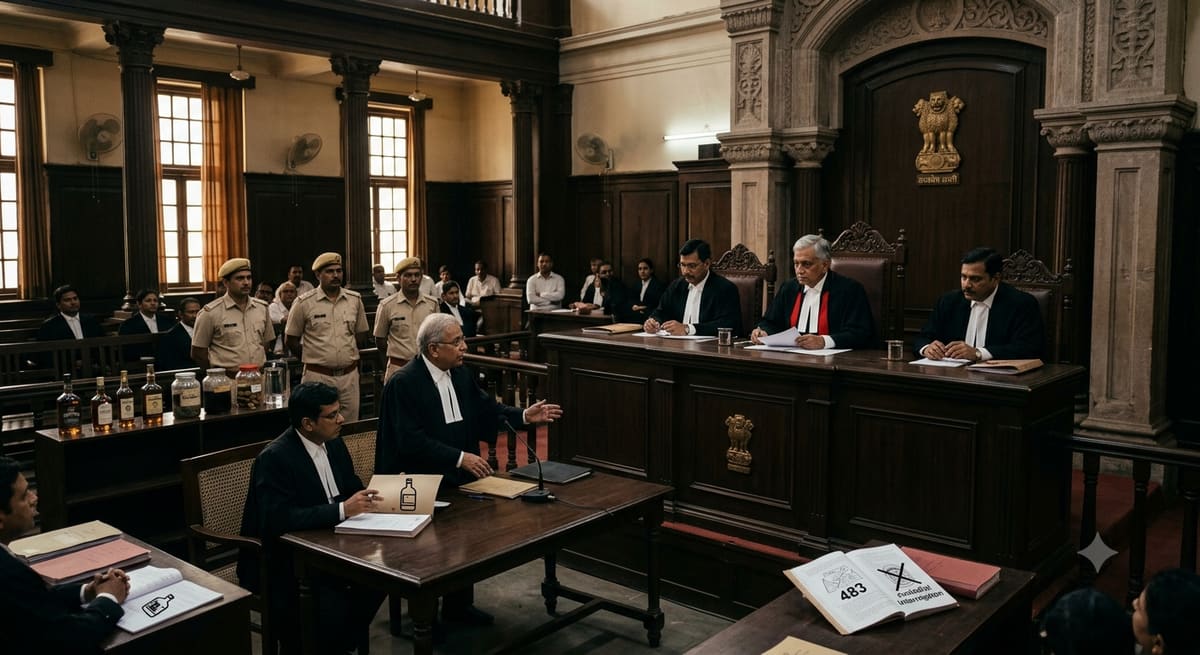
The Madhya Pradesh High Court has clarified that once a charge sheet is filed in a non-bailable offence under the Madhya Pradesh Excise Act, the necessity for continued custody ceases, entitling the accused to regular bail unless exceptional circumstances exist. This ruling reinforces the principle that post-charge sheet detention requires justification beyond mere accusation.
Background & Facts
The Dispute
The applicant, Rahul Parihar, was arrested on 17.05.2026 in connection with Crime No. 176 of 2026 registered at Police Station Barotha, District Dewas, Madhya Pradesh. The case pertains to the seizure of 135 bulk litres of liquor from an abandoned vehicle on 02.05.2026. The applicant was named as the owner of the vehicle and subsequently made an accused in the case.
Key Facts
- Liquor seized: 135 bulk litres on 02.05.2026
- Arrest date: 17.05.2026
- Charge sheet filed: Prior to the bail application
- Offence charged: Section 34(2) of the Madhya Pradesh Excise Act, 1915
- Applicant’s claim: Falsely implicated; no involvement in possession or transportation of liquor
- Prosecution’s claim: Ownership of vehicle links applicant to offence
- Prior criminal history: Four previous cases, including one similar excise offence resulting in a fine
Procedural History
- 02.05.2026: Seizure of 135 bulk litres of liquor from abandoned vehicle
- 17.05.2026: Applicant arrested and taken into custody
- Between 17.05.2026 and 22.06.2026: Investigation completed and charge sheet filed
- 22.06.2026: Bail application filed under Section 483 of the Bhartiya Nagarik Suraksha Sanhita, 2023 (equivalent to Section 439 CrPC)
The Parties' Positions
For the Applicant
The applicant’s counsel, Shri Surendra Tuteja, submitted that:
- The investigation is complete and the charge sheet has been filed
- No further custodial interrogation is required
- The applicant has been in custody since 17.05.2026, over a month
- There is no allegation of flight risk or tampering with evidence
- The applicant is entitled to bail as a matter of right under the principle that custody after charge sheet filing requires exceptional justification
For the Respondent
The State, represented by Shri Tarun Pagare, opposed bail on the grounds that:
- The applicant has a criminal history of four prior cases
- One of those cases involved a similar excise offence, resulting in a fine
- The nature of the offence involves contraband and public order concerns
- Granting bail may encourage repeat offences
Relief Sought
The applicant sought regular bail under Section 483 of the Bhartiya Nagarik Suraksha Sanhita, 2023, with conditions to ensure appearance before the trial court.
The Legal Issue
The central question was whether an accused, who has been in custody since arrest and against whom a charge sheet has been filed in a non-bailable offence under the Madhya Pradesh Excise Act, is entitled to regular bail in the absence of any ongoing need for custodial interrogation.
Arguments Presented
For the Applicant
The applicant’s counsel relied on the settled principle that once the investigation concludes and the charge sheet is filed, the necessity for custody diminishes. He cited Arnesh Kumar v. State of Bihar to emphasize that arrest is not automatic and custody must be justified beyond the filing of the charge sheet. He argued that the applicant’s detention had exceeded a reasonable period without any new evidence or interrogation needs, and that bail should be granted as a matter of routine unless strong countervailing factors exist.
For the Respondent
The State contended that the applicant’s prior criminal record, particularly a previous conviction under the same statute, demonstrates a propensity for repeat offences. It argued that the nature of the offence - possession of large quantities of illicit liquor - poses a risk to public order and that granting bail without stringent conditions could undermine deterrence. The State did not dispute the completion of investigation but insisted that antecedents override the presumption of entitlement to bail.
The Court's Analysis
The Court examined the procedural posture of the case and noted that the charge sheet had been filed, indicating the conclusion of the investigative phase. The Court observed that the Bhartiya Nagarik Suraksha Sanhita, 2023, retains the spirit of Section 439 CrPC, which permits bail after charge sheet filing if custody is no longer necessary for investigation.
"The completion of the investigation entails that no further custodial interrogation is required in the matter."
The Court acknowledged the applicant’s prior criminal history but held that such antecedents, while relevant, do not automatically disqualify an accused from bail. The Court emphasized that bail is the rule and jail is the exception, particularly when the investigation is closed and the accused is not alleged to be a flight risk or a threat to witnesses.
The Court further noted that the applicant had not been charged with violence, conspiracy, or destruction of evidence. The Court concluded that the balance of convenience and the right to liberty under Article 21 of the Constitution weighed in favor of granting bail, subject to appropriate conditions.
The Verdict
The applicant succeeded. The Court granted regular bail on the following terms:
- Personal bond of Rs. 1,00,000 with one solvent surety of like amount
- Regular appearance before the trial court on all dates
- Compliance with all conditions under Section 480(3) of the Bhartiya Nagarik Suraksha Sanhita, 2023
- Mandatory monthly reporting at the concerned police station on the last Sunday of each month between 10:00 AM and 12:00 Noon until trial concludes
- This order remains effective till the end of trial, subject to revocation for breach of conditions or bail jump
What This Means For Similar Cases
Custodial Interrogation Ends With Charge Sheet
- Practitioners must argue that once the charge sheet is filed, continued custody requires specific, documented justification beyond the nature of the offence
- The burden shifts to the prosecution to demonstrate why custody remains necessary post-investigation
- Routine opposition to bail on grounds of offence severity alone is legally insufficient
Prior Antecedents Require Tailored Conditions, Not Automatic Denial
- A history of similar offences does not automatically disqualify bail
- Courts may impose reporting conditions, travel restrictions, or surety requirements instead of outright denial
- The condition of monthly police reporting in this case sets a precedent for managing risk without incarceration
Procedural Compliance Is Non-Negotiable
- Courts will scrutinize whether the investigation is truly complete before granting bail
- Applications filed before charge sheet filing may be premature; timing matters
- Counsel must confirm the filing status of the charge sheet before moving for bail under Section 483 BNSS