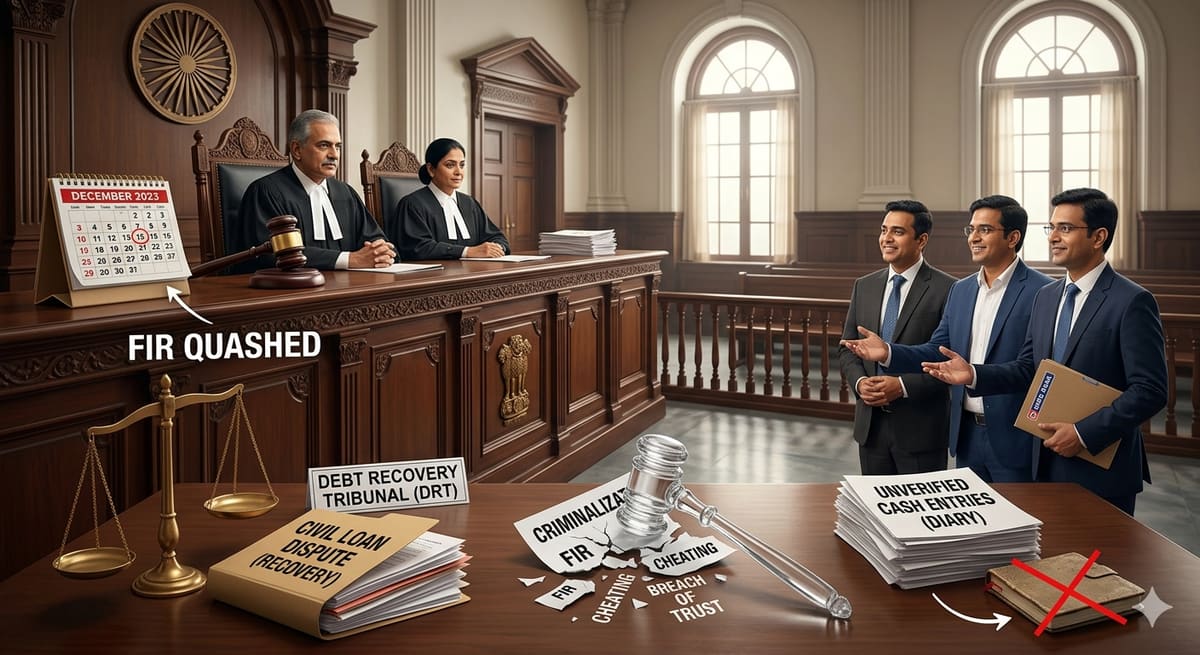
The Bombay High Court has decisively held that civil loan recovery disputes, even when accompanied by suspicious financial entries, cannot be converted into criminal proceedings under Sections 406, 409, and 420 of the IPC merely on the basis of unverified photocopies of cash registers. The judgment underscores the limits of judicial intervention to prevent abuse of criminal process in cases where the underlying dispute is purely financial and has already been adjudicated by civil forums.
Background & Facts
The Dispute
The dispute originates from long-standing loan recovery proceedings initiated by HDFC Bank against Splendour Gems Limited (formerly Beautiful Diamond Limited), a company owned and managed by the Mehta family. The late Mr. Kishore Mehta, along with his sons Mr. Rajesh Mehta and Mr. Rajiv Mehta, executed personal guarantees for loans extended by a consortium of banks, including HDFC Bank, in 1995. Persistent default led to legal action by HDFC Bank before the Debts Recovery Tribunal (DRT), Mumbai.
Key Facts
The DRT, Mumbai, passed an order on 26.10.2004 directing the borrower and guarantors to repay Rs. 14,74,51,929.35 with 16% interest.
A Recovery Certificate was issued in favor of HDFC Bank on 30.11.2004.
Despite the order, the Mehta family filed multiple applications between 2004 and 2020 to obstruct recovery, including challenges to asset attachments and valuations.
On 05.02.2020, the DRT issued arrest warrants against the guarantors, observing "Enough is Enough."
The DRT reaffirmed its coercive orders on 25.10.2023.
Writ Petition (L) No. 2604 of 2024, filed by the Mehta family to challenge the 2004 DRT order, was dismissed by the Bombay High Court on 03.05.2024 for gross delay and lack of merit.
Late Mr. Kishore Mehta died on 20.05.2024.
On 01.03.2024, the Lilavati Kirtilal Mehta Medical Trust (the Trust) authorized respondent No. 3, Mr. Prashant Mehta, to institute legal proceedings on its behalf.
On 17.04.2025, the Trust filed Application No. CC 63/SW/2025 under Section 175(3) of the Bharatiya Nagarik Suraksha Sanhita (BNSS), seeking registration of an FIR based on a photocopy of a cash register allegedly showing cash payments of Rs. 2.05 crores from the erstwhile trustees to Sashidhar Jagdishan, CEO of HDFC Bank, between 16.03.2022 and 21.06.2023.
The Trust claimed these payments were made to harass Mr. Kishore Mehta, leading to his death.
The Bandra Police, in its report dated 27.05.2025, stated that three prior FIRs (Nos. 972/2024, 1916/2024, and 375/2025) on identical allegations were already pending.
The Judicial Magistrate First Class, Bandra, passed an order on 29.05.2025 directing registration of FIR No. 0818/2025 under Sections 406, 409, and 420 read with Section 34 IPC against the petitioner and former trustees.
FIR No. 0818/2025 and FIR No. 0819/2025 were registered on 31.05.2025.
As of 31.05.2025, outstanding dues owed by the Mehta family to HDFC Bank exceeded Rs. 65 crores.
Procedural History
1995: Loan facilities extended to Splendour Gems Limited by HDFC Bank and consortium.
26.10.2004: DRT orders repayment of Rs. 14.74 crores with 16% interest.
30.11.2004: Recovery Certificate issued to HDFC Bank.
05.02.2020: DRT issues arrest warrants against guarantors.
25.10.2023: DRT reconfirms coercive orders.
03.05.2024: Bombay High Court dismisses Writ Petition (L) No. 2604 of 2024.
01.03.2024: Trust authorizes Mr. Prashant Mehta to institute proceedings.
25.04.2024 & 26.08.2024: Complaints filed with RBI and Ministry of Finance; both rejected as meritless.
22.07.2024: Complaint filed with Maharashtra State Minorities Commission.
18.09.2024: Bombay High Court quashes Minorities Commission proceedings as frivolous.
03.08.2024: JMFC dismisses C.C. No. 105/SW/2024 (alleging culpable homicide) against HDFC Bank.
12.09.2024: Police complaint filed under Section 154(1) BNSS; police found no cognizable offence.
17.04.2025: Application under Section 175(3) BNSS filed before JMFC, Bandra.
27.05.2025: Bandra Police report states three prior FIRs on same allegations.
29.05.2025: JMFC orders registration of FIR.
31.05.2025: FIR No. 0818/2025 and FIR No. 0819/2025 registered.
05.05.2026: Bombay High Court pronounces judgment quashing FIRs.
The Parties' Positions
Petitioners (HDFC Bank officials and Phoenix ARC directors): Argued that the FIRs are a retaliatory measure to obstruct lawful recovery proceedings. They contended that the photocopy of the cash register is unreliable, lacks corroboration, and does not establish criminal intent or entrustment under Sections 406, 409, or 420 IPC. They relied on State of Haryana v. Bhajan Lal to assert that the proceedings are a clear abuse of process.
Respondents (Trust and complainant): Maintained that the cash diary entries prima facie disclose criminal breach of trust and cheating. They argued that the Magistrate acted within jurisdiction under Section 175(3) BNSS and that allegations must be tested through investigation, not pre-emptive quashing. They relied on CBI v. Ravi Shankar Srivastava and State of Orissa v. Saroj Kumar Sahoo.
Relief Sought
The petitioners sought quashing of FIR Nos. 0818/2025 and 0819/2025, and the order dated 29.05.2025 directing their registration. They also sought dismissal of pending applications for transfer of investigation to CBI, arguing that no grounds existed for such transfer at the nascent stage.
The Legal Issue
Can a criminal FIR under Sections 406, 409, and 420 IPC be registered based solely on unverified photocopies of cash entries, when the underlying dispute is a long-pending civil loan recovery matter already adjudicated by the DRT and High Court, and where the complainant’s motive appears to be retaliation?
Arguments Presented
For the Appellant/Petitioner
The petitioners argued that the allegations do not satisfy the essential ingredients of Sections 406, 409, or 420 IPC. There is no evidence of entrustment of property by the Trust to the bank officials, nor any dishonest inducement or fraudulent intent at the time of transaction. The cash diary is a photocopy of unknown provenance, unauthenticated, and lacks any supporting documentation. The entire complaint is a retaliatory tactic to derail lawful recovery proceedings that have been repeatedly upheld by judicial forums. The petitioners relied on State of Haryana v. Bhajan Lal and Zandu Pharmaceutical Works Ltd. v. Mohd. Sharaful Haq to assert that courts must intervene to prevent abuse of process where civil disputes are weaponized into criminal proceedings. They further contended that Section 175(3) BNSS does not confer a mechanical right to register an FIR where prior judicial orders have already rejected identical allegations.
For the Respondent/State
The State and complainant argued that the Magistrate acted within his statutory powers under Section 175(3) BNSS, which permits him to order an FIR where prima facie cognizable offences are disclosed. They contended that the cash diary entries, however circumstantial, raise a reasonable suspicion of criminal conduct warranting investigation. They emphasized that the veracity of allegations must be tested during investigation, not at the threshold. Reliance was placed on CBI v. Ravi Shankar Srivastava and State of Orissa v. Saroj Kumar Sahoo to argue that mala fides of the complainant cannot be grounds for quashing at the initial stage. They also argued that procedural irregularities in filing the application (e.g., lack of affidavit) are curable under Section 511 BNSS and do not vitiate the Magistrate’s order.
The Court's Analysis
The Court undertook a meticulous review of the factual matrix and legal principles governing the quashing of FIRs under Section 482 CrPC (now Section 528 BNSS) and Article 226 of the Constitution. It emphasized that while the High Court must exercise its inherent powers sparingly, it is not barred from intervention merely because the investigation is at a nascent stage, as clarified in Imran Pratapgarhi v. State of Gujarat.
The Court observed that the entire dispute stems from a civil debt recovery process that has been litigated for over two decades, culminating in multiple judicial orders affirming the legitimacy of HDFC Bank’s actions. The DRT’s orders, upheld by this Court, are final and binding. The complainant’s attempt to recast the consequences of a civil default as criminal conspiracy is, in the Court’s view, an abuse of process.
"The complaint is nothing but a counterblast to the recovery proceedings initiated and the materials on record do not at all justify an investigation into the claim made by the complainant."
The Court rejected the reliance on the photocopy of the cash register as insufficient to establish criminal intent. It noted that the entries, even if accepted as true, do not demonstrate that the bank officials were entrusted with Trust funds, nor that they dishonestly misappropriated them. The payments, if made, were allegedly from the erstwhile trustees to the bank officials - a transaction that, without proof of criminal collusion or breach of fiduciary duty, cannot sustain charges under Sections 406 or 409 IPC.
The Court further held that the complainant’s assertion that the death of Mr. Kishore Mehta was caused by harassment from the bank is a personal belief, not a legal ground for criminal prosecution. The Court stated:
"The demise of the complainant's father undoubtedly is unfortunate. But the petitioners cannot be blamed for this. This impression of the complainant is personal to him but cannot be a justifiable reason to trigger a criminal prosecution on the specious plea that a photocopy of a diary is found..."
The Court also dismissed the procedural arguments raised by the petitioners, noting that even if there were irregularities in the filing of the application under Section 175(3) BNSS, they were not fatal. However, the substantive flaw - the absence of any criminal disclosure - rendered the FIR unsustainable.
The Court distinguished this case from those where investigation is warranted, emphasizing that the complaint lacked bonafides and was clearly motivated by a desire to retaliate against lawful recovery efforts. It held that allowing such proceedings to continue would deter financial institutions from pursuing legitimate recovery actions, thereby undermining the financial ecosystem.
The Verdict
The petitioners succeeded. The Bombay High Court quashed FIR Nos. 0818/2025 and 0819/2025 registered at Bandra Police Station under Sections 406, 409, and 420 read with Section 34 IPC against the petitioners. The order dated 29.05.2025 of the Judicial Magistrate First Class, Bandra, directing registration of the FIRs, was set aside. The Court also dismissed Criminal Writ Petitions Nos. 3227/2025 and 3313/2025 seeking transfer of investigation to CBI, holding that no grounds existed for such transfer at the nascent stage. The Court clarified that the quashing applies only to the petitioners (HDFC Bank officials and Phoenix ARC directors) and not to the erstwhile trustees of the Trust, against whom the allegations remain open for investigation.
What This Means For Similar Cases
Civil Recovery Cannot Be Criminalized Through Suspicious Documentation
Practitioners must challenge FIRs based on unverified documents (e.g., photocopies, handwritten diaries) where the underlying dispute is civil and has been adjudicated.
Courts will not permit criminal proceedings to be initiated merely because a complainant finds a document suggesting financial irregularity - the document must establish a prima facie criminal act.
The burden is on the complainant to show entrustment and dishonest intent under Sections 406 and 409 IPC; mere suspicion or circumstantial inference is insufficient.
Judicial Finality in Civil Matters Bars Repetitive Criminal Action
Where civil courts or tribunals have conclusively upheld the legality of recovery actions, subsequent criminal complaints based on the same facts are prima facie abusive.
Repeated complaints to police, regulatory bodies, and magistrates on identical allegations after judicial rejection constitute a clear case of multiplicity and abuse of process.
Courts must examine the motive behind the complaint - retaliation against lawful debt recovery is not a valid basis for criminal prosecution.
Procedural Irregularities Are Curable, But Substantive Deficiencies Are Not
While technical lapses in filing applications under Section 175(3) BNSS (e.g., lack of affidavit) may be cured under Section 511 BNSS, they cannot compensate for the absence of a cognizable offence.
Magistrates must apply their minds to whether the allegations, even if true, constitute a criminal offence - not merely whether they are serious or shocking.
The High Court retains the power to intervene at the earliest stage if the complaint is manifestly mala fide or lacks the essential ingredients of the alleged offence.