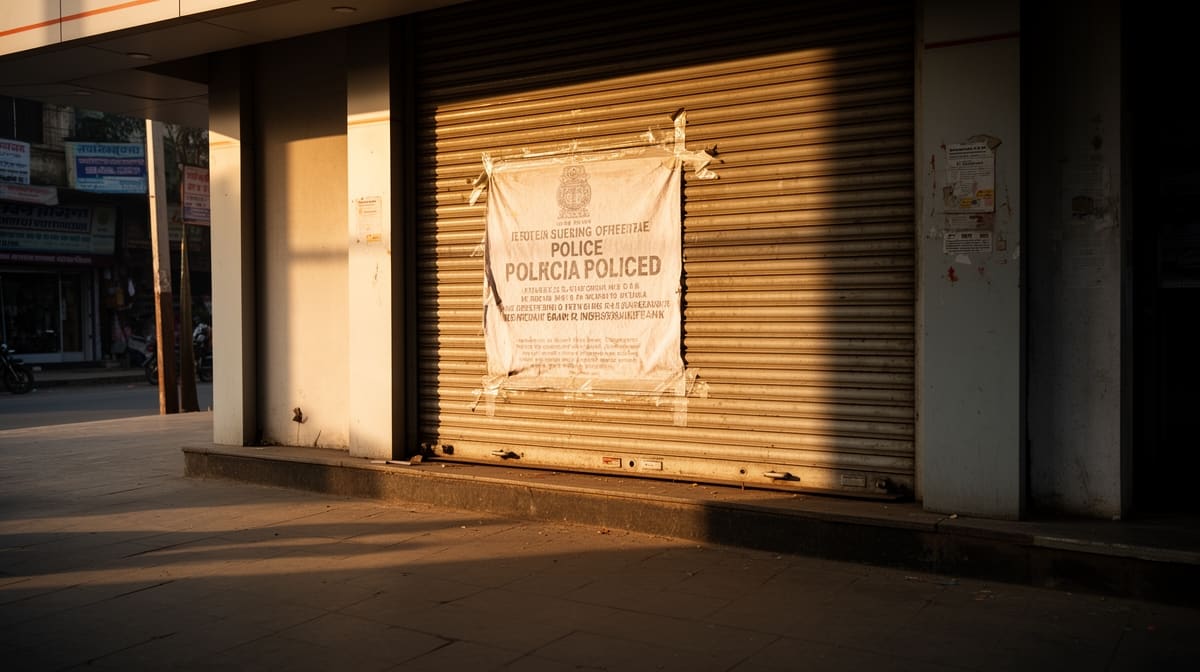
The Kerala High Court has clarified that banks cannot impose complete freezes on bank accounts solely based on police requisitions, especially when the account holder is not an accused. The judgment reinforces constitutional protections under Article 300A and mandates adherence to standardized procedures for handling funds linked to cyber-enabled financial crimes.
Background & Facts
The Dispute
The Petitioner, Mohammed Afsal N.A., is a private individual whose bank account with Federal Bank, Pathadippakam Branch, was frozen on the requisition of the Cyber Crime Police Station, Gandhinagar, Gujarat. The requisition sought to freeze Rs. 4,89,409/-, allegedly linked to a cybercrime investigation involving other persons. The Petitioner is not named as an accused in any FIR or charge sheet related to the matter. He contends that the freezing of his entire account violates his right to property under Article 300A of the Constitution of India and exceeds the scope of powers under Sections 106 and 107 of the Bharatiya Nagarik Suraksha Sanhita, 2023 (BNSS).
Key Facts
- The Petitioner’s account was frozen on the basis of a requisition dated 10.01.2026 from Respondent No. 2 (Cyber Crime Police Station, Gandhinagar)
- The amount sought to be frozen: Rs. 4,89,409/-
- The Petitioner is not named as an accused, suspect, or witness in the underlying cybercrime case
- The Bank, in addition to acting on police requisition, independently suspended all operations of the account citing "suspicion" regarding transaction patterns
- The Petitioner had no prior notice or opportunity to explain the transactions before the freeze
- The account was opened and operated lawfully since 2018 with no prior complaints or regulatory action
- The Petitioner submitted Exhibit P1: a cheque leaf showing account details; Exhibit P2: a prior judgment dated 10.07.2024 from the same Court
Procedural History
- 10.01.2026: Cyber Crime Police Station, Gandhinagar, issued requisition to Federal Bank to freeze Rs. 4,89,409/- in Petitioner’s account
- 15.01.2026: Bank implemented full freeze on account without notice to Petitioner
- 22.01.2026: Petitioner filed representation with Bank seeking clarification and unfreezing; no response received
- 05.02.2026: Petitioner filed Writ Petition (WP(C) No. 41196 of 2025) before the Kerala High Court
- 16.01.2026: Additional Respondent 2 (Cyber Crime Police Station, Gandhinagar) impleaded by Court order
- 10.02.2026: Additional Respondent 3 (Kalamassery Police Station) impleaded
- 09.03.2026: Additional Respondent 4 (Cyber Crime Police Station, Sector 27, Gandhinagar) impleaded
- 15.06.2026: Writ Petition heard and disposed of by the Court
Relief Sought
The Petitioner sought:
- Immediate lifting of the freeze on his bank account
- Declaration that the freeze violated Article 300A and Sections 106 and 107 of BNSS
- Direction to the Bank to provide details of suspicious transactions
- Direction to the Police to cease using his account as a conduit for unrelated investigations
- Costs of litigation
The Legal Issue
The central question was whether a bank can completely freeze a customer’s account based solely on a police requisition, when the account holder is not an accused, and whether such action complies with Article 300A and the newly formulated SOP for NCRP-CFCFRMS, 2026.
Arguments Presented
For the Petitioner
The Petitioner’s counsel argued that:
- Article 300A protects the right to property and prohibits arbitrary deprivation
- Sections 106 and 107 of BNSS permit only provisional attachment or lien on specific amounts, not complete account freeze
- The Bank’s independent suspension of account operations without any judicial or statutory basis is ultra vires
- The Police requisition lacks specificity: no FIR number, no accused name, no nexus established between the Petitioner and the alleged offence
- The Indian Cyber Crime Co-ordination Centre’s SOP, 2026, mandates transparency, time-bound grievance redressal, and interim custody of funds - not blanket freezes
- Precedents in Dr. Sajeer v. RBI and Abhiraj Rajan v. State of Kerala support limited lien, not total freeze
For the Respondent/Bank
The Bank’s counsel conceded that:
- The freeze was implemented upon receipt of the requisition from Respondent No. 2
- The Bank did not independently investigate the transactions before freezing
- The Bank had no authority to question the police requisition
- However, the Bank also suspended operations due to internal suspicion of possible money mule activity, which it claimed justified the freeze
The Court's Analysis
The Court examined the evolving legal framework governing bank account freezes in cybercrime investigations. It noted that while police authorities may requisition freezing of funds under Section 106 of BNSS, such requisition does not empower banks to impose total account suspension. The Court emphasized that Article 300A imposes a constitutional obligation on the State and its instrumentalities - including banks - to act fairly and proportionately.
"The Bank cannot act as an extension of the police without independent scrutiny. A requisition is not a warrant; it is a request that must be evaluated in light of constitutional rights and procedural safeguards."
The Court relied on its own precedents in Dr. Sajeer v. RBI, Nazeer K.T. v. Federal Bank, and Abhiraj Rajan v. State of Kerala, which consistently held that banks must permit account operation subject to a lien on the exact amount specified in the requisition, unless the bank itself has independent, documented suspicion of cybercrime involvement.
The Court further noted the issuance of the SOP for NCRP-CFCFRMS, 2026 by the Indian Cyber Crime Co-ordination Centre, which establishes a uniform, transparent mechanism for handling frozen funds. Clause 10 of the SOP mandates a grievance redressal mechanism for affected account holders, including timelines for response and review.
The Court held that the Bank’s independent suspension of the account - without any requisition and based on vague "suspicion" - violates the guidelines laid down in Abdul Azeez v. Union of India, which require banks to provide account holders with details of suspicious transactions and an opportunity to explain before taking restrictive action.
The Verdict
The Petitioner succeeded. The Court directed:
- The Bank to provide full details of suspicious transactions to the Petitioner within one week of receipt of this judgment
- The Bank to permit the Petitioner to operate his account, subject to a lien only on Rs. 4,89,409/-, if the explanation submitted by the Petitioner is found satisfactory
- The frozen amount to be handled strictly in accordance with Clause 10 of the SOP for NCRP-CFCFRMS, 2026
- The Petitioner to avail the grievance redressal mechanism under Clause 10 of the SOP
- The Bank may impose future liens only upon receipt of valid, specific requisitions
- No costs awarded
What This Means For Similar Cases
Bank Freezes Must Be Proportionate and Transparent
- Banks cannot impose total account freezes based solely on police requisitions
- Only the exact amount specified in the requisition may be lien-marked, unless the bank independently establishes cybercrime involvement
- Account holders must be given notice and opportunity to explain suspicious transactions before any restriction
SOP 2026 Is Binding on All Financial Institutions
- The NCRP-CFCFRMS SOP, 2026, is not advisory - it is a mandatory framework for handling cybercrime-related fund freezes
- Banks must integrate Clause 10’s grievance mechanism into their internal protocols
- Failure to comply may expose banks to writ jurisdiction and liability for violation of Article 300A
Police Requisitions Are Not Automatic Orders
-
Requisitions must specify: FIR number, accused names, nexus to the account, and legal provision invoked
-
Blanket requisitions without particulars are legally invalid
-
Banks must verify requisitions against BNSS provisions before acting
-
Practitioners must now demand SOP compliance in all account freeze cases
-
Clients should be advised to immediately file grievances under Clause 10 if frozen
-
Banks must maintain audit trails of all suspicious transaction reviews