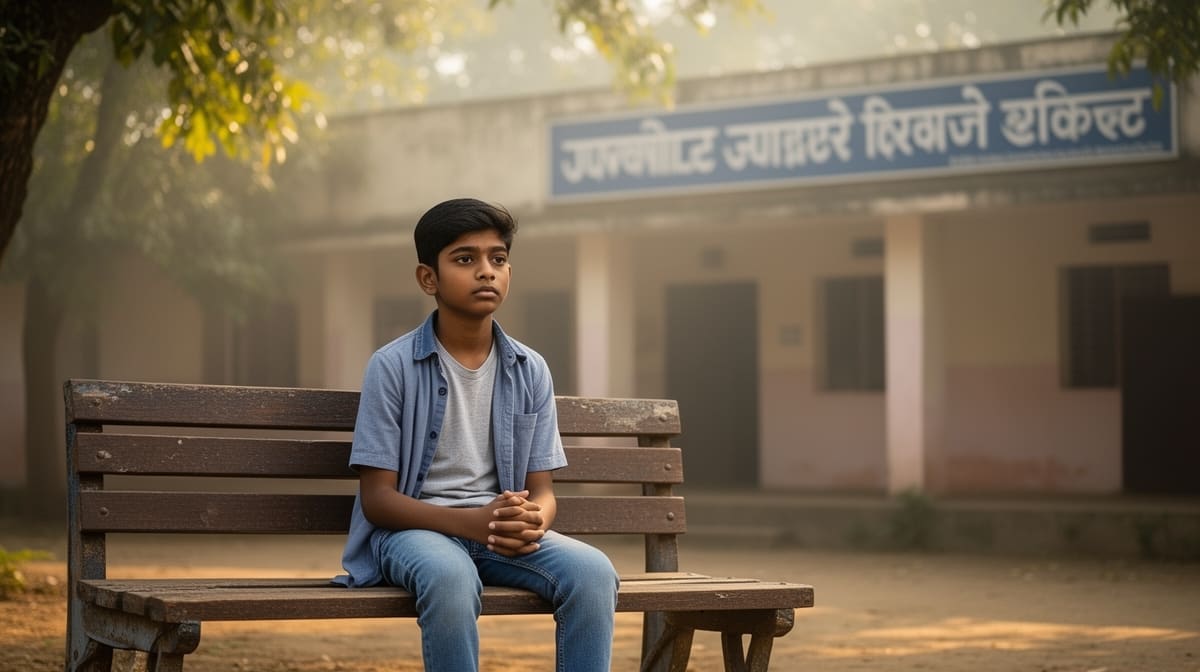
The Madhya Pradesh High Court has reaffirmed the foundational principle that bail is the rule, not the exception, for children in conflict with law. In a significant ruling under the Juvenile Justice (Care and Protection of Children) Act, 2015, the Court emphasized that procedural safeguards for juveniles must prevail over presumptions of guilt, even in serious cases. This judgment reinforces the statutory mandate of child welfare over punitive approaches.
Background & Facts
The Dispute
The case arose from a violent incident on 11 September 2025 in Village Khimla, District Neemuch, where a bus collision with a motorcycle resulted in the death of the rider and injuries to others. A mob gathered at the scene, leading to destruction of company property and an assault on Head Constable Janis Tawar, who was attempting to record the events. The police registered Crime No. 191/2025 under multiple sections of the Bharatiya Nyaya Sanhita, 2023, against 20 unknown persons. The present petitioner, a juvenile, was subsequently named as an accused despite no direct evidence linking him to the violence.
Procedural History
The case progressed through the following stages:
- 22 December 2025: The Principal Magistrate, Juvenile Justice Board, Neemuch, rejected the juvenile’s bail application under Section 12 of the Juvenile Justice Act, 2015.
- 9 January 2026: The IInd Additional Special Judge, Neemuch, dismissed the appeal against the rejection of bail.
- 11 February 2026: The petitioner filed Criminal Revision No. 296 of 2026 before the Madhya Pradesh High Court, challenging the denial of bail.
Relief Sought
The petitioner sought release on bail, arguing that he had no prior criminal record, was falsely implicated, and was entitled to the protective presumption under Section 12 of the Act. He emphasized that his detention since 12 December 2025 violated the Act’s child-centric ethos.
The Legal Issue
The central question was whether Section 12 of the Juvenile Justice (Care and Protection of Children) Act, 2015 permits denial of bail to a child in conflict with law merely on the basis of prima facie involvement in a serious offence, or whether the statutory mandate to treat bail as the default requires a compelling justification for its denial.
Arguments Presented
For the Petitioner
The petitioner’s counsel relied on Jitendra Kumar v. State of Haryana and State of Rajasthan v. Rajendra, arguing that Section 12 mandates a presumption in favour of bail for juveniles. He submitted that the courts below failed to consider the social investigation report, which showed no prior criminality, and that the juvenile’s detention was prolonged without substantive evidence. He contended that the Act’s primary objective - rehabilitation and reintegration - requires that detention be the last resort.
For the Respondent
The State opposed the revision, asserting that the gravity of the offences under the Bharatiya Nyaya Sanhita, including assault on a public servant and destruction of property, warranted denial of bail. It argued that the juvenile’s presence in the crowd and association with the accused created a reasonable apprehension of tampering with evidence or influencing witnesses.
The Court's Analysis
The Court examined the structure and intent of Section 12 of the Juvenile Justice Act, 2015, which provides that a child in conflict with law shall be released on bail unless there is a reasonable ground to believe that the release would result in association with known criminals, risk to the child’s safety, or defeat of justice. The Court held that the burden lies on the State to demonstrate such grounds - not on the child to prove innocence.
"The Act is not a penal statute but a welfare legislation designed to protect the child from the harshness of the adult criminal justice system. A prima facie case, however serious, cannot override the statutory presumption in favour of bail."
The Court placed decisive weight on the Social Investigation Report prepared by the Child Welfare Police Officer, which confirmed the juvenile had no prior exposure to criminal activity. It noted that the lower courts had not engaged with this report at all, thereby violating the mandatory procedural requirement under Section 14 of the Act. The Court emphasized that the Act’s philosophy is rooted in the principle of best interest of the child, as recognized under Article 21 and the UN Convention on the Rights of the Child.
The Court further distinguished this case from adult bail jurisprudence, where gravity of offence may weigh heavily. For juveniles, the focus must be on social reintegration, not deterrence. The absence of any evidence directly implicating the juvenile in the violent acts, coupled with his clean background, rendered the denial of bail arbitrary and contrary to statutory intent.
The Verdict
The petitioner won. The Court held that bail must be granted to juveniles under Section 12 unless compelling, documented reasons exist to deny it, and that failure to consider the social investigation report constitutes a violation of statutory procedure. The impugned orders were set aside, and the juvenile was directed to be released on bail with specific conditions.
What This Means For Similar Cases
Bail Is the Presumption, Not the Exception
- Practitioners must now treat Section 12 as creating a rebuttable presumption in favour of bail for all juveniles, regardless of the nature of the alleged offence.
- Courts must record specific, evidence-based reasons for denying bail - vague references to "seriousness of offence" are insufficient.
- Social investigation reports are not optional; they are mandatory under Section 14 and must be considered before any bail decision.
Documentation Trumps Assumption
- The absence of prior criminal history, verified through official reports, is a decisive factor in favour of bail.
- Merely being present at the scene of a crime or being named in an FIR does not justify detention.
- Advocates must proactively seek and submit social investigation reports at the earliest stage of proceedings.
Judicial Duty to Apply Child-Centric Standards
- Judges must consciously apply the best interest of the child standard, even in cases involving public order or violence.
- The Court’s directive for probationary oversight reinforces that release is not an end but a step toward rehabilitation.
- Any breach of bail conditions must trigger a fresh hearing before the Juvenile Justice Board - not automatic remand.